The Ask At The End: Writing A Call To Action Viewers Can Answer In Two Seconds
Watch enough videos in any niche and you will notice the same closing line, delivered with the same slightly tired energy: like the video, share it with a friend, drop a comment, and don’t forget to subscribe. Four requests, stacked into one breath, at the exact moment the viewer’s thumb is already moving towards the next thing.
I have been publishing on YouTube since 2017, mostly faceless channels aimed at English-speaking audiences, and I have written that outro more times than I would like to admit. It almost never does anything. Not because asking is wrong, but because asking for four things at once is the same as asking for nothing.
What follows is how I think about the ask now: how big it should be, where it goes, and – the part almost nobody does – how to tell whether the one you wrote is doing any work at all.
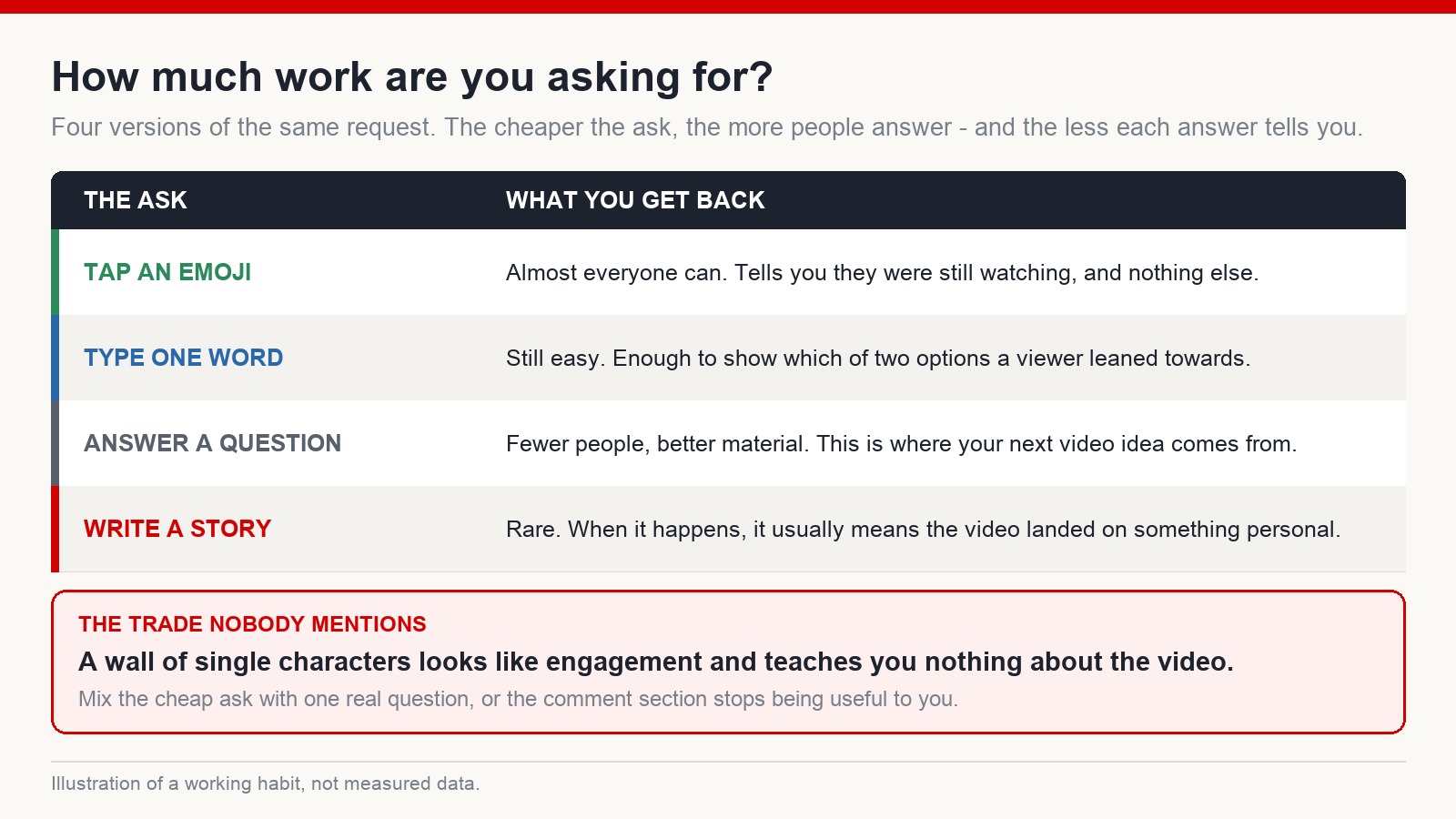
The ask is a price, and most people set it too high
Every request you make of a viewer has a price attached, paid in effort. Tapping an emoji costs almost nothing. Typing a single word costs a little more. Writing a sentence that expresses an opinion costs quite a lot – the viewer has to decide what they think, then decide whether they want strangers reading it.
Most creators price their ask like a paragraph and then wonder why the comment section is empty. The fix is not to beg harder. It is to lower the price.
Instead of “let me know what you think in the comments”, which requires the viewer to compose something from nothing, give them a fork in the road:
- “If you’d have taken the first option, type 1. If you’d have taken the second, type 2.”
- “If you spotted the mistake before I said it, put a T.”
- “If that ending surprised you, drop an emoji – anything – so I know.”
- “Guess the number before the next section. Anything you like.”
Each of those is answerable in about two seconds, without thinking hard, without composing a sentence, without feeling exposed. That is the whole mechanism. There is nothing clever in it.
The trade you are making
Here is the part the tactic threads leave out. The cheaper the ask, the less each answer is worth to you.
A comment section full of the digit 1 is not a conversation. You cannot mine it for the next video. You cannot tell whether people liked the video or just liked being told what to type. If every video you publish ends with the same one-character request, you end up with a comment count that looks healthy and a comment section that tells you nothing about your own audience.
So I use both, in the same video. One cheap ask, placed where the emotion is, for the people who will never write a sentence. And one real question – open, specific, worth answering – for the handful of people who will. The second group is small and it is where every good video idea I have had in the last three years came from.
Where the ask goes
Placement changes the response rate more than wording does.
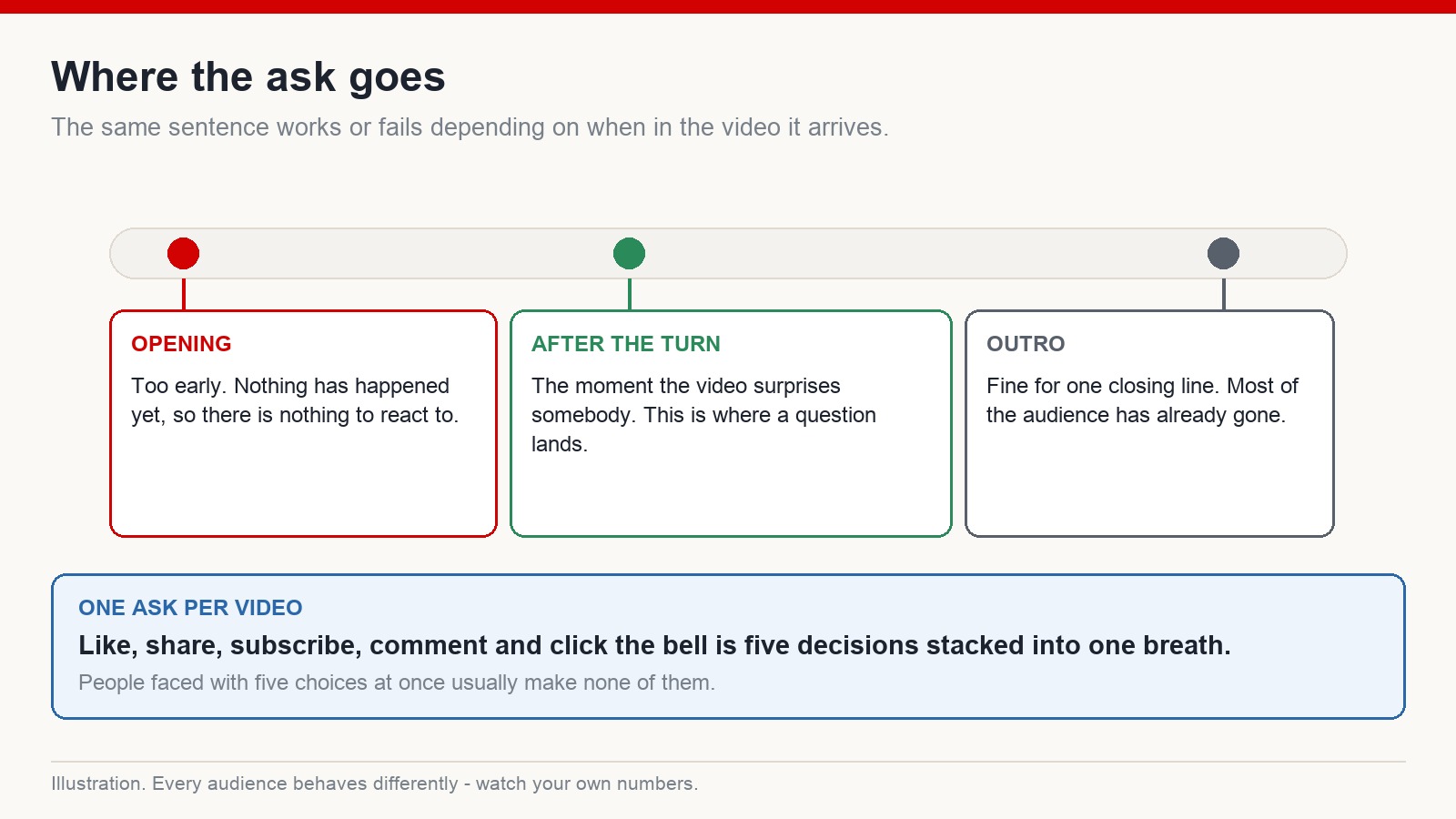
An ask in the first thirty seconds arrives before anything has happened. There is no opinion to express yet, because the viewer has not seen anything to have an opinion about. Worse, it reads as a demand from someone who has not yet given them a reason to care.
An ask in the outro reaches the smallest audience you will have all video. Most people have gone. The ones still there are the ones most likely to respond, which is why the outro is not useless – but it should carry your one closing line, not your main request.
The position that works is right after the turn: the moment the video reveals something, contradicts an expectation, or lands the point it has been building towards. The viewer is already reacting internally. All you are doing is giving that reaction somewhere to go.
In practice this means the ask lives in the script, not in a template you paste at the end of every edit. If you cannot say where the turn is in your own video, that is worth knowing for its own sake.
Make it a question you actually want answered
There is a difference between “comment 1 if you agree” and “I’ve been arguing about this with someone all week – would you have done it the other way?” Both are cheap to answer. Only one of them sounds like a person.
The framing that works for me is curiosity rather than instruction. Not “leave a comment below” but “I genuinely don’t know how this reads to someone who wasn’t there – tell me.” The viewer is being invited into something rather than assigned a task, and the difference shows up in what they write back.
Two things reliably kill this. The first is asking for a comment about a topic the video never raised, which reads as transparently manufactured. The second is asking in the same words every single video, which trains regular viewers to tune the line out entirely.
How to tell whether any of it worked
This is where most advice stops, and where the useful part starts.
Do not judge a call to action by the raw number of comments, because that number tracks the size of the audience more than the quality of the ask. A video with three times the views will have more comments regardless of what you said.
What I do instead: take the median of my last ten uploads on that channel – comments per thousand views is fine, or replies per video if your view counts are stable – and compare the new video against that. Your own history is the only benchmark that accounts for your topic, your video length and your audience. A figure from someone’s blog post accounts for none of them.
Then change one thing at a time. Different placement, same wording. Or different wording, same placement. Change both and you have learned nothing about either. And give it several videos, because a single upload swings for reasons that have nothing to do with the sentence you added.
One warning that belongs in every article on this subject. The moment you find yourself tempted to post the first few replies from accounts you control, to make the section look busy enough that real people will join in, stop. That is fake engagement under YouTube’s spam and deceptive practices policy – the metrics can be stripped out, the video can be removed, and repeated cases can end a channel. It also quietly ruins the only measurement you have, because from then on you are comparing your videos against a baseline you invented.
The ask cannot rescue the video
Worth saying plainly: none of this makes a weak video perform. People comment because something in the video moved them – it was funny, or it was wrong, or it named something they had felt and never articulated. The call to action does not create that feeling. It removes the friction between the feeling and the keyboard.
If a video is getting clicks and losing people in the first minute, the ask is not your problem. If people are staying to the end and saying nothing, then yes, look at what you asked for and where you asked for it.
Does asking for a single character actually work?
It reliably increases the number of responses, because the effort required is close to zero. It just as reliably lowers the value of each one. Use it alongside a real question rather than instead of one.
Should every video end with a request?
No. On a video where the ending carries emotional weight, an outro request can flatten it. Silence is a legitimate choice, and the ask can live in the middle of the video instead.
Is asking people to comment a specific word against the rules?
Asking your audience to participate is normal. What crosses the line is manufacturing the engagement yourself – accounts you own, traded interactions, purchased comments – or building an exchange where people comment on each other’s videos purely to be commented on in return.
Where should the ask sit in a short video?
Same principle, compressed. Immediately after the reveal, not before it, and only one ask – a short video does not have room for two.
How long before I know whether a new ask is working?
Several uploads at minimum, compared against your own recent median. One video is noise dressed up as a result.
The short version
Ask for one thing. Ask for it at the moment the viewer already has a reaction. Make the cheap version cheap enough that anyone can answer it, keep one real question for the people who want to say more, and measure the change against your own last ten videos rather than a number you read somewhere.
If you want the rest of the process for building a faceless channel aimed at an English-speaking audience, that is what we work through at mmoyoutube.com.