Why a One-Person YouTube Channel Stops Growing
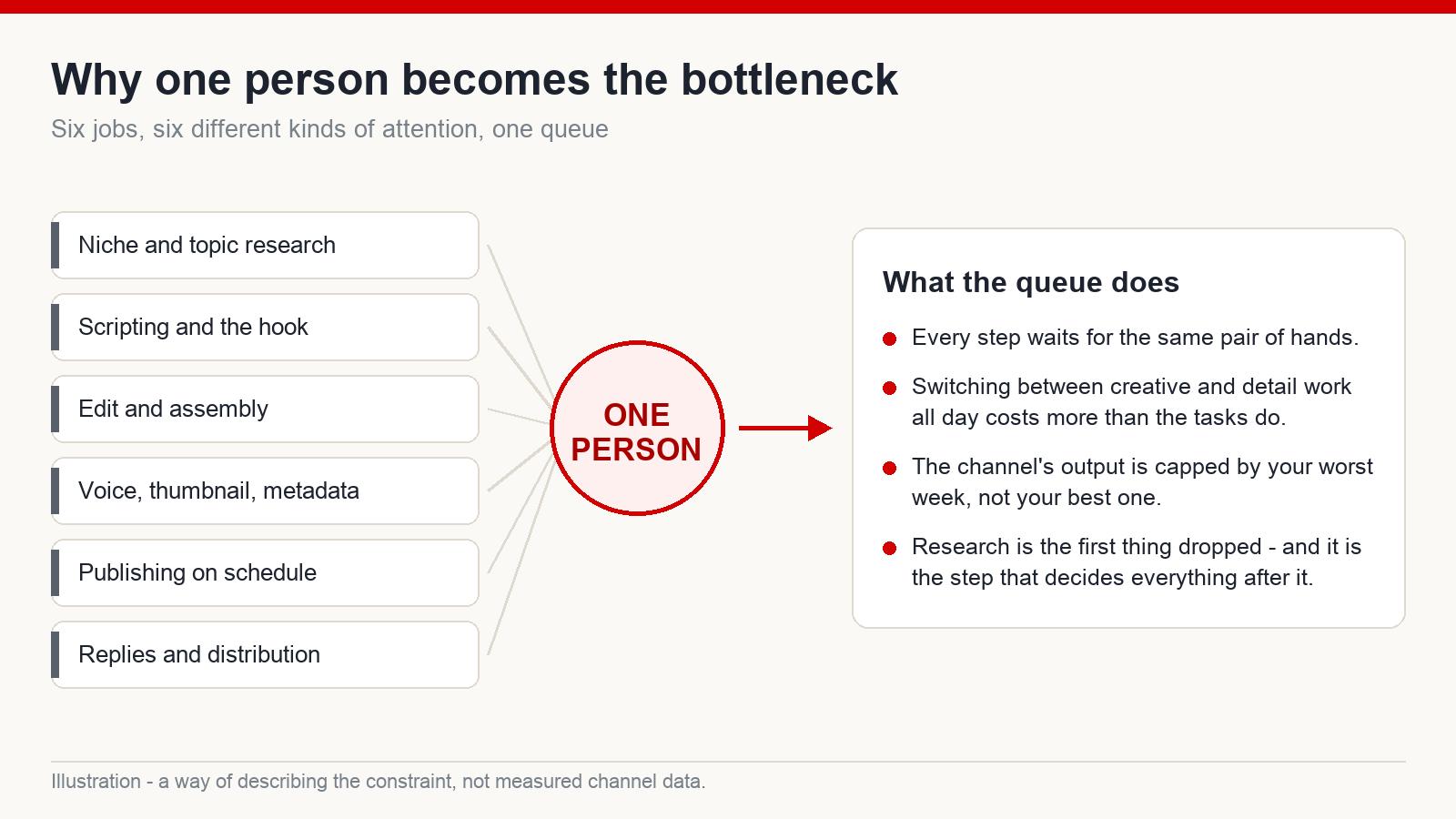
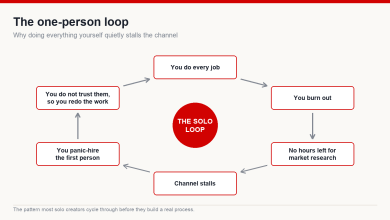
You do the research. You write the script. You cut the video, record or generate the voice, build the thumbnail, write the metadata, upload it, then go back and answer the comments. You are consistent. You have been consistent for months. And the channel has barely moved.
Before you decide you are lazy or untalented, consider a duller explanation: you may have hit the ceiling of the one-person model. That ceiling is real, it is structural, and no amount of additional effort raises it – because effort is the thing that is already maxed out.
The ceiling of working alone
Running a channel properly is not one job. It is six or seven, and they want different kinds of attention from you.
Research is open, associative, comfortable with being wrong for an hour. Scripting is structured and argumentative. Editing is detail work that punishes drifting. Packaging – thumbnail, title, metadata – is a marketing job. Publishing on schedule is pure discipline. Replying to an audience is patience and social energy at the end of a day when you have none left.
Very few people are naturally good at all of those, and nobody is good at all of them on the same day. Worse, moving between them costs you real time. Every switch from creative mode to detail mode carries a tax you never see itemised, and over a week it adds up to more hours than any single task on the list.
So everything queues behind you. The channel’s output is not set by your best week; it is set by your worst one, because the worst week is the one where nothing gets made at all. The bigger you try to grow, the tighter that constraint pulls.
You are probably not the problem – but check anyway
Most people read a plateau as a verdict on their ability, push harder, and burn out faster. Usually the constraint sits in the model rather than the person. The same creator, dropped into a working process or a team that divides the labour sensibly, produces noticeably better work almost immediately.
That said, do not reach for the flattering diagnosis without testing it. There are two different problems here and they need opposite responses.
If your videos land reasonably when you manage to publish them – people click, people stay – and the actual failure is that you can only publish sporadically, that is a capacity problem. More structure or more hands will help.
If the videos underperform consistently no matter how much time you spend on each one, that is a craft or a positioning problem, and adding capacity just produces more of the same result faster. Fix the videos first. Hiring somebody to help you make work that is not landing is an expensive way to keep being wrong.
The honest test is comparing a video against the recent median of your own channel rather than against numbers you read somewhere. Your own back catalogue is the only benchmark that means anything.
First move: write the process down
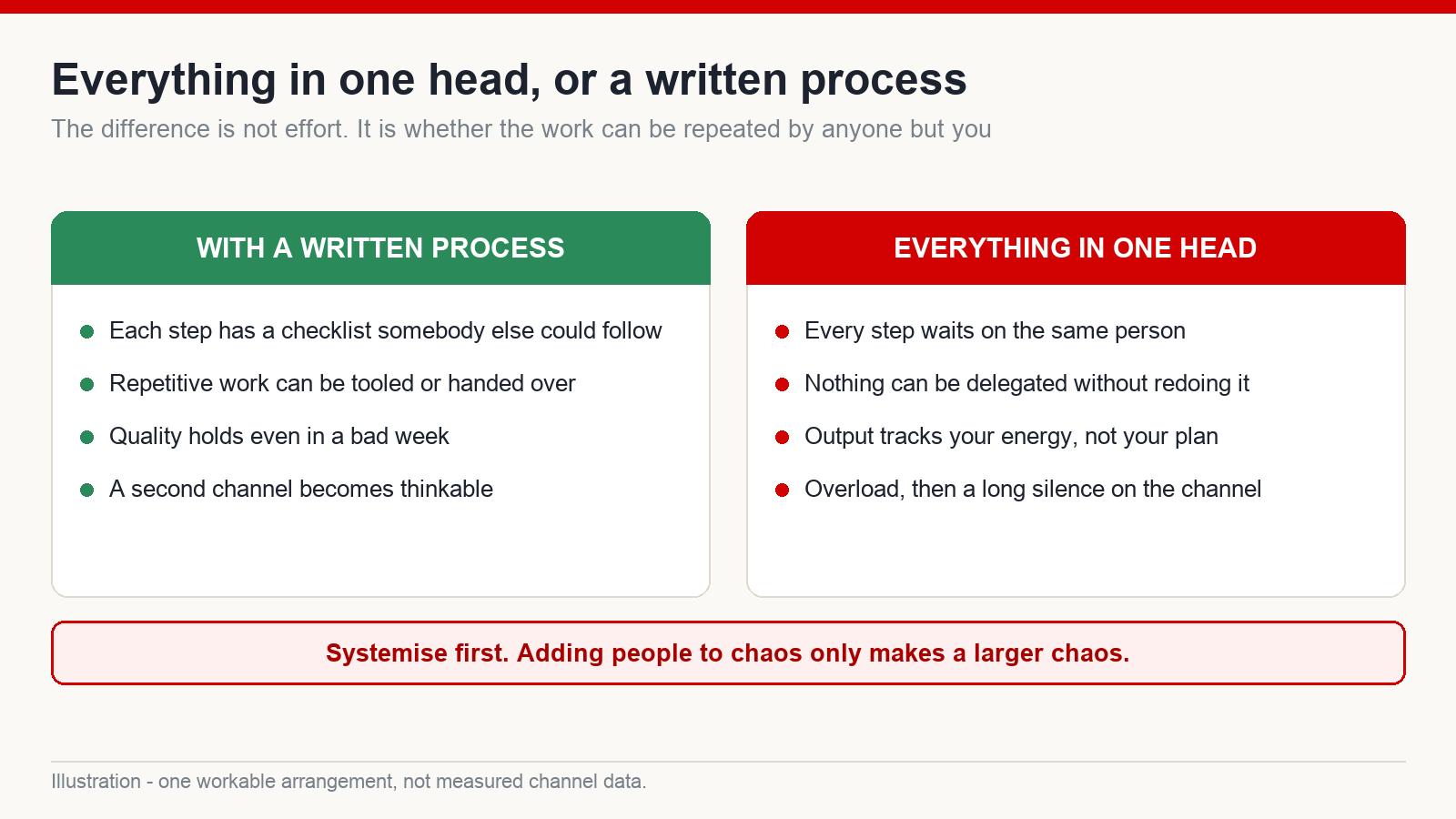
Not everyone can hire, and you do not need to yet. The first move is to turn what currently lives in your head into something repeatable.
Concretely, that means a small set of written artefacts, none of which need to be elaborate:
- A topic brief template: who the video is for, what promise the title makes, why anyone would finish it.
- A script skeleton for your format – where the hook sits, where the first turn lands, how sections are signposted.
- An edit checklist covering the things you always forget at eleven at night.
- A packaging checklist for thumbnail, title and description.
- A publish checklist, including whatever you do in the first hours after upload.
- One place where scripts, footage and project files live, named the same way every time.
Then change how you schedule the work. Batch by mode rather than by video: research several topics in one sitting, script two or three in another, edit in a block. You stop paying the switching tax a dozen times a day.
Tools and generation software belong in the grunt-work layer – rough assembly, transcripts, captions, first-pass narration – with a human quality pass on everything before it goes out. That combination is what lets a busy person keep publishing. What it does not do is replace judgement about what to make and why, which is the part that actually decides how the channel performs.
Written process has a second benefit that is easy to miss. It is the only thing that makes delegation possible later. You cannot hand over a job that exists only as instinct – you will simply redo everything the other person touches, which is how most first hires fail.
Second move: divide the work by strength
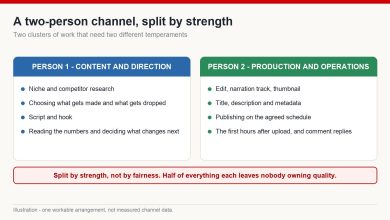
Once the process runs, adding a person is the natural next step. The principle that matters is dividing work by strength rather than by fairness. The creative, restless one takes research and scripting. The precise one takes the edit. The dependable one takes publishing, packaging and audience replies.
Two people, each spending most of their time on work they are actually suited to, move faster and last longer than one person doing all of it badly in rotation. And the sequencing is not optional: process first, people second. A team without a written process is not a team, it is two people improvising in parallel.
When to expand, and what to hand over first
Do not expand while everything is still chaotic. Adding a person to a mess produces a larger mess, plus a salary.
The signals that you are ready are unglamorous. You have a written process and you actually follow it. You understand every step well enough to review someone else’s work on it. And when you look honestly at what is holding the channel back, the answer is no longer skill or clarity – it is the number of hours you personally have.
When that is true, hand over the most repetitive, most specifiable, lowest-judgement step first. For most channels that is the edit or the packaging, not the research. Give it away with the checklist attached, review the first few outputs closely, then stop reviewing every one. Keep the step that decides what gets made – that one is the channel’s identity, and it should be the last thing you let go of, if ever.
Expect the first handover to be slower than doing it yourself. It usually takes several rounds before it is faster. That is not a sign it is failing; it is what learning looks like from the outside. Results vary, and some people find they prefer working alone at a smaller scale – which is a legitimate choice, as long as it is a choice rather than a plateau you are calling a preference.
Break the ceiling with the model, not with effort
Working alone stops scaling not because you are not trying, but because one person has a fixed number of hours and a finite tolerance for switching between six different jobs. The way out is to change the model: write the process down first, then bring in help.
If time is your scarcest resource right now, start with the process. It is free, it takes an afternoon, and it is the prerequisite for everything after it. A structured route through that work is what we run at mmoyoutube.com – practice with guidance, not a promise of results.