Your Channel Is Not Being Suppressed: Where Videos Are Actually Lost
Three sentences turn up constantly in messages from people whose channels are not moving. I publish consistently and nobody watches. I put in enormous hours and nothing changes. Is the platform suppressing me?
The answer is almost always no, and not because platforms are benevolent. A recommendation system has no incentive to hold back a small channel. It has one job: work out which videos keep people watching, and show more of those. If a video is not being pushed further, the usual reading is that it did not give the system a reason to.
That is a blunter answer than “you were suppressed”, and considerably more useful, because it points at something you control.
Three places a video is usually lost
Before diagnosing anything else, work out which of three stages actually broke. They look identical from the outside – a flat view count – and they have almost nothing in common as problems.
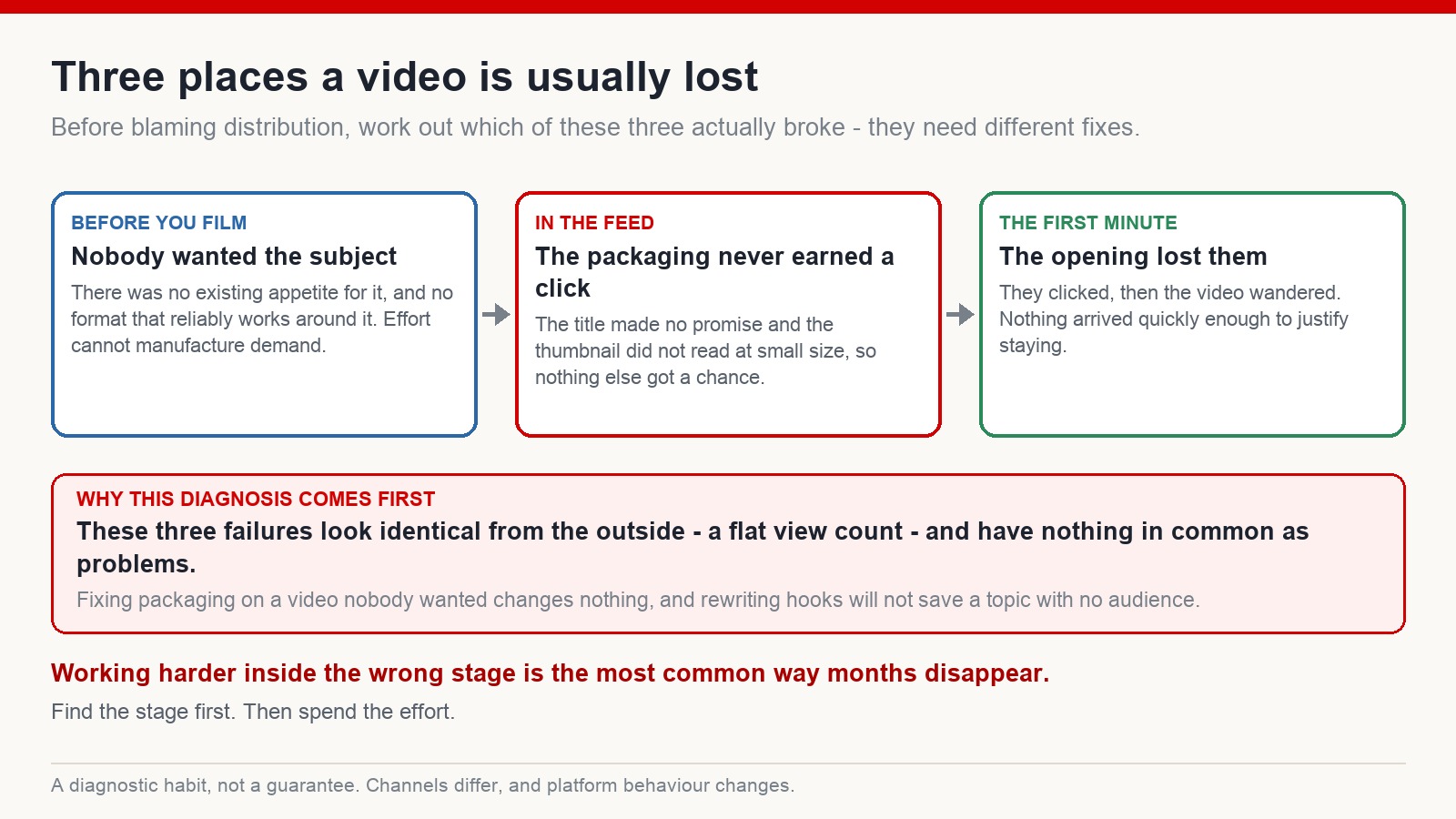
Nobody wanted the subject
You can spend days on a video about something almost nobody is looking for, in a format that does not work for that material. No distribution system creates appetite that does not exist. This is the most demoralising failure because the work was real and it never had a route to an audience.
The packaging never earned a click
A viewer decides in about a second. If the title makes no promise and the thumbnail does not read at the size it is actually displayed, nothing else in the video gets a chance. Content quality is irrelevant at this stage – it has not been sampled yet.
The opening lost them
They clicked, and then the video wandered. A long preamble, a slow arrival at the point, no reason established for staying. Retention collapses in the first stretch, the system reads that as a video people do not want, and distribution stops there.
Fixing packaging on a video nobody wanted changes nothing. Rewriting openings will not save a topic with no audience. Working harder inside the wrong stage is the most common way months disappear.
The gap is not effort
Most people who feel stuck are working ten to twenty hours a week on their channel. They are not short of effort. What they are short of is sequence.
The pattern in a stalled channel is nearly always the same: the work starts when the editing software opens. Whatever occurred to them that week becomes the video. The pattern in channels that grow is that production is one of the last steps. What comes first is research – what the audience is currently looking for, which subjects have demand, which formats are working in that niche, what has already been proven to hold attention.
The difference is not hours worked. It is the order the hours are spent in.
Work to the standard you are aiming at
A habit worth adopting early: before publishing, ask what a channel you admire in your niche would have done with this exact video. Not their budget or their audience – their standard.
They would have started from a subject with demonstrated interest. They would have written a title that gives someone a reason to click rather than one that describes the file. They would have got to the value quickly. They would have kept the video moving so there was never a stretch with nothing happening.
None of that requires an audience you do not have yet. It is a decision about the standard you hold your own work to while nobody is watching, which is exactly when it is hardest and matters most.
The review pass that turns publishing into a system
Publishing without reviewing is repetition, not practice. The review is what converts each video into information about the next one.
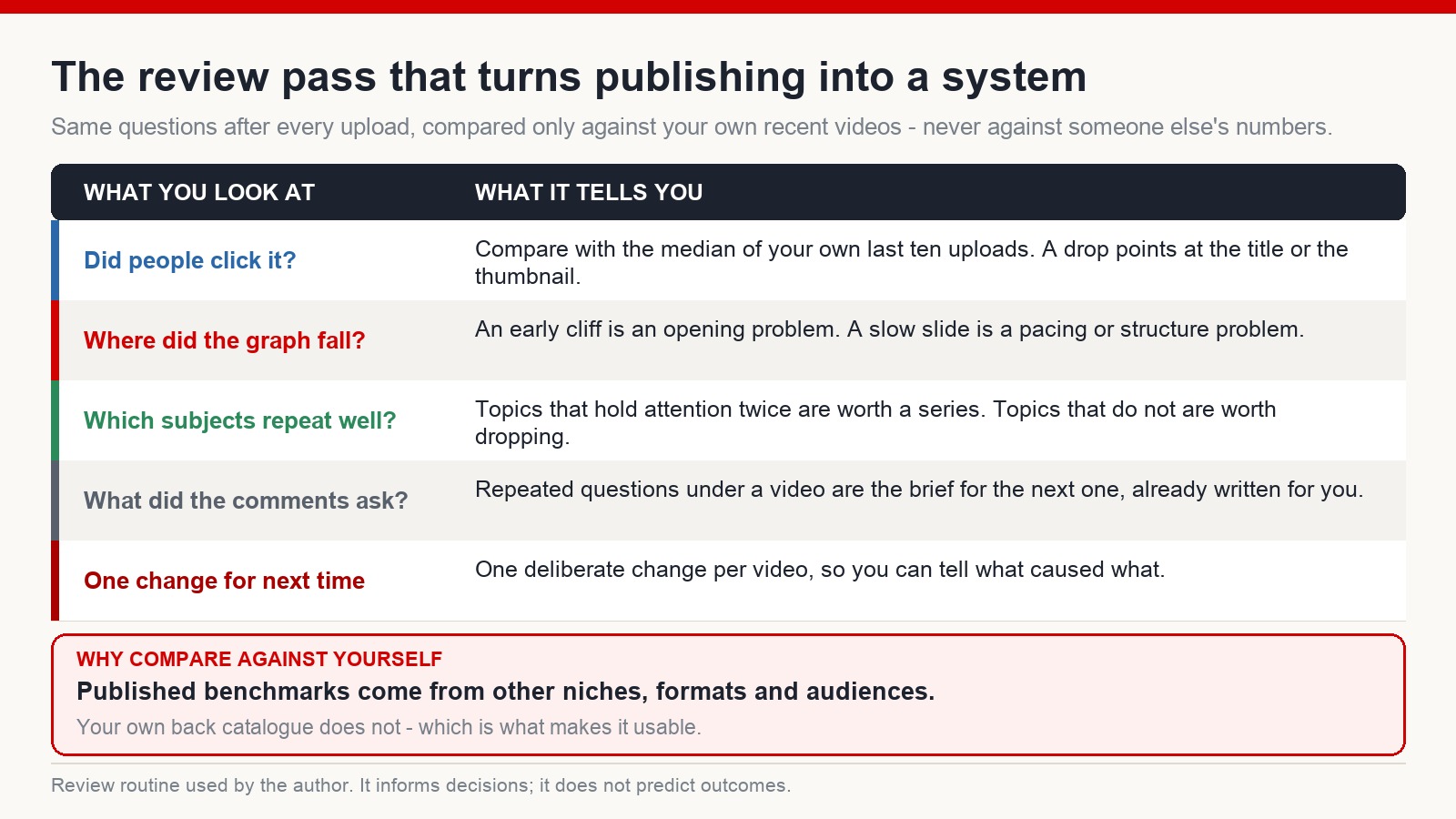
The important constraint is what you compare against. Published benchmarks come from other niches, other formats and other audiences, and they will mislead you in both directions. Your own last ten videos will not. Did this one get clicked more or less than your recent median? Did the retention graph fall off a cliff early – an opening problem – or slide gradually, which is usually structure or pacing?
Then change one thing on the next video, deliberately, so that you can attribute the result. Changing five things at once produces a result you cannot learn anything from.
When distribution problems are real
To be fair to the suspicion: there are genuine cases. Videos can be age-restricted, limited for advertising, or affected by a policy action, and all of those have visible effects on reach. The distinction is that these are visible – they appear against the video or the channel in the creator dashboard, with a stated reason and usually an appeal route.
If nothing is flagged, there is no hidden penalty to find. There is a video that did not get clicked, or did not get watched, and the data will say which.
It was never a motivation problem
People who stall usually describe it as lost motivation. Watching enough of them, that is rarely what happened. What is missing is a system clear enough to answer four questions: what to work on today, what to look at after publishing, which videos to make more of, and what to change next time.
With that, every video moves you forward whether it performs or not. Without it, you repeat the same attempt and hope the outcome differs. Change the process and the results follow – not on a schedule, and not with any guarantee, but reliably enough to be worth doing. If you want that process laid out for English-language faceless channels, that is what I work on at mmoyoutube.com.
Frequently asked questions
Is the platform suppressing my small channel?
Very unlikely. Genuine restrictions – age limits, advertising limits, policy actions – appear in the creator dashboard with a reason. If nothing is flagged, the cause is usually demand, packaging or the opening.
Why do click rate and retention matter so much?
Together they answer the only two questions a recommendation system has: did people choose this video, and did they stay with it. Everything else is downstream of those two.
What should a beginner fix first?
Subject selection, then the title and thumbnail, then the first minute. In that order, because each one is pointless without the one before it.
How many videos before I judge whether something is working?
Enough that you are reading a pattern rather than a single result. One video tells you almost nothing; a run of them on the same subject and format tells you a great deal.
Should I delete videos that performed badly?
Generally not. They cost nothing to leave up and they are part of your comparison set. Removing them mostly removes your own evidence.