Surface Topic, Real Audience: How to Read Who a Competitor Is Actually Serving
Here is something that used to confuse me. Two channels in the same niche, using footage that looks almost interchangeable, publishing at a similar rate. One of them climbs. The other barely moves.
For a long time I assumed the difference had to be craft – better editing, a sharper thumbnail, stronger retention. Sometimes it is. But often, when I sat down and compared them properly, the biggest difference was not the videos at all. It was who each channel was talking to.
Same subject on the surface. Completely different audience underneath. And once you can see that layer on someone else’s channel, you can stop guessing about your own.
The surface topic is not the audience
Every video has two descriptions. The first is what is in the frame: animals, rain, a workshop, a piece of history. The second is what the viewer came for: a state they want to be in, a question they want answered, a feeling they want more of.
Beginners tend to plan with the first description and wonder why the second never shows up. A channel full of nature clips can be serving people who like wildlife, or people who want something quiet on in the background while they work, or people who want to fall asleep to something that will not startle them. Those are three different audiences with three different sets of expectations, and they respond to three different sets of words.
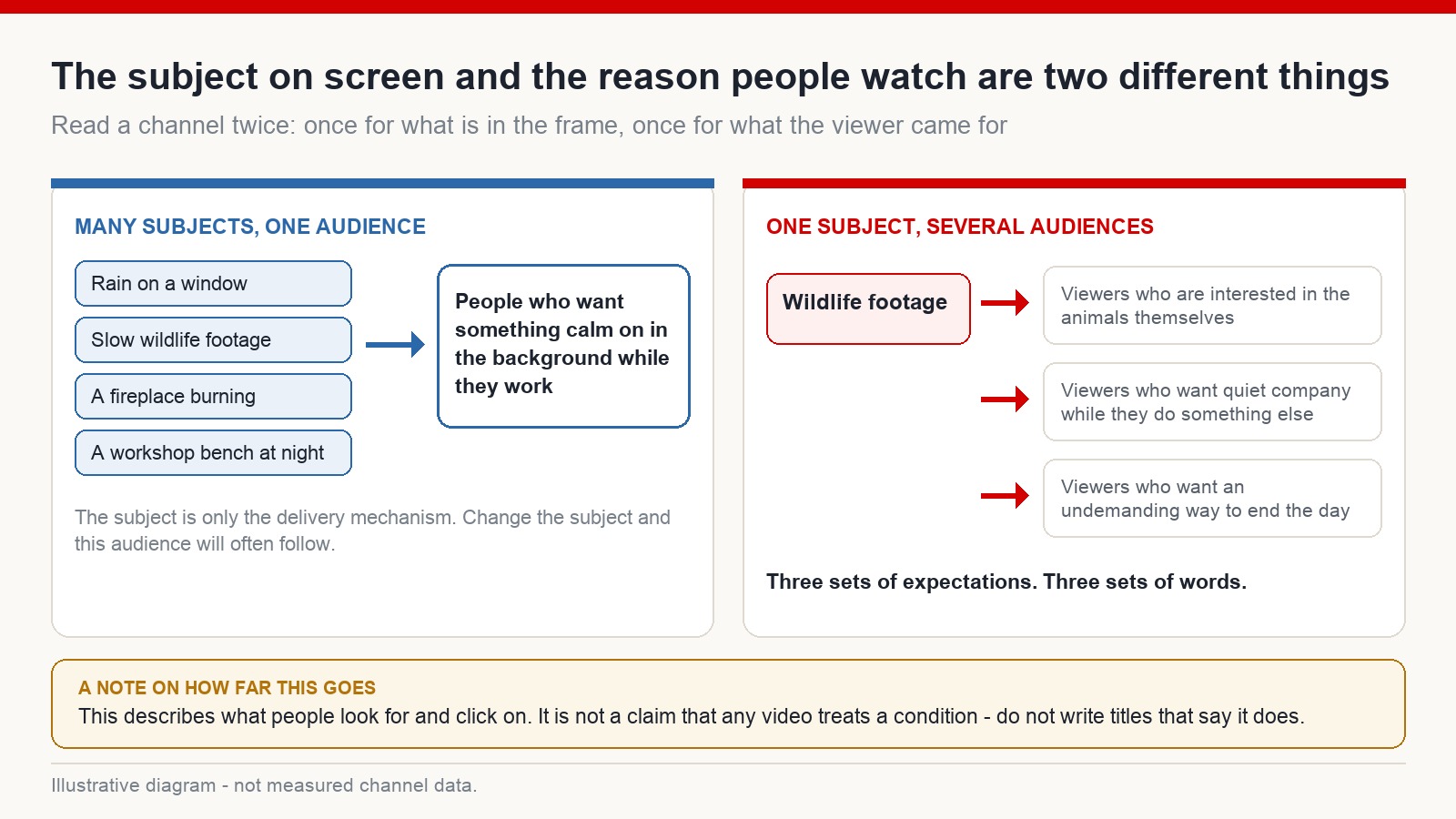
One caution before the signals, because this is territory where it is easy to overclaim. Reading which audience a channel serves is a description of what people search for and click on. It is not a claim that your video treats anything. Calm background content is not a medical product, and saying otherwise in a title is both untrue and a fast way to attract the wrong kind of attention.
Signal one: the title language does not match the footage
This is the strongest tell, and the easiest to check.
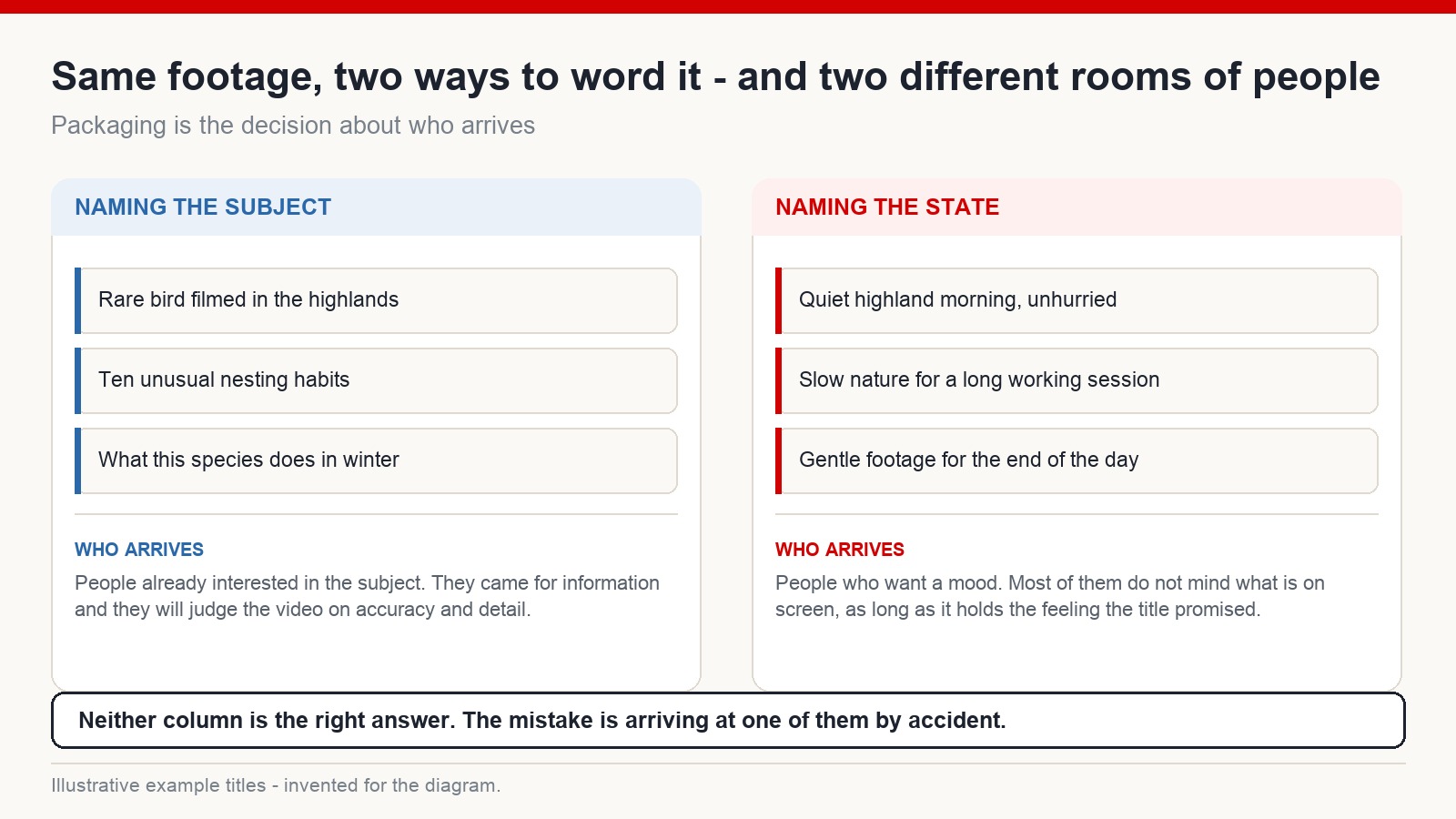
Look at a channel where the visuals are clearly about one subject, and the titles are consistently about something else – a mood, a state, a time of day. Not the animal, but how the footage is meant to feel. When the words and the pictures point in different directions like that, the words are the ones aimed at the audience.
Compare two title sets over identical footage and it becomes obvious. One set names the subject and attracts people interested in the subject. The other names the state and attracts people who want the state, most of whom do not care what is on screen at all.
Signal two: one phrase turns up across unrelated subjects
Take a phrase from a competitor’s title and search it on YouTube on its own. Then look at what comes back.
If the results all sit inside one subject area, you are looking at a niche phrase – it belongs to the topic. If the results span several unrelated subjects, you have found something more useful: an audience phrase, a set of words that a particular group of people uses regardless of what the video is actually about.
Audience phrases are valuable because they let you leave a saturated subject without leaving your audience. The people are the asset. The subject is just the current delivery mechanism.
Run this test with three or four phrases from the same channel and you will usually be able to name the group they are serving in a sentence.
Signal three: the same emotional words keep coming back
Scan the twelve most-watched titles on a channel and mark every word that describes a feeling rather than a fact. If the same handful of words keeps appearing – and it usually does on channels that grow – that is the core of their positioning, stated in public.
Words like these behave differently from search terms. They are curiosity keywords: almost nobody types them into a search box, so research tools tend to make them look worthless, but they are what stops a scroll in a recommendation feed. Demand keywords are the opposite – they show up in search data because people go looking for them.
Neither one is better. Most healthy channels run both: demand keywords to be findable, curiosity keywords to be clickable. What you are diagnosing here is the ratio, because it tells you where a competitor’s traffic is really coming from.
Signal four: very large numbers used as proof
You will also notice titles built around enormous round figures – millions of people, huge counts, sweeping claims of scale. It is worth understanding what is happening there, and worth being careful about it.
What works about the technique is not the number itself. It is specificity and stakes: a figure makes an abstract claim feel checkable, and it implies that a lot of other people already cared. What breaks it is that most of those numbers are invented. A figure you cannot source is a promise you cannot keep, and metadata that misrepresents a video is exactly the kind of thing platforms act on.
So take the mechanism and leave the habit. If you have a real number, use it and be able to say where it came from. If you do not, use a concrete detail instead – a specific place, a specific object, a specific consequence. Concreteness is what was doing the work in the first place.
How to run the check on any channel
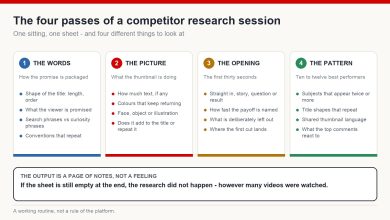
Four steps, twenty minutes.
Read twelve titles, not one. A single title tells you nothing about intent. Twelve tells you which words the channel has settled on and which it has abandoned.
Read the thumbnails as a set. The palette usually gives the audience away before the words do. Dark, low-contrast frames tend to belong to late-night and background viewing. Loud, high-contrast frames belong to feed browsing. Soft, muted frames belong to people looking for something undemanding. You are not judging the design – you are asking what state it is dressed for.
Reverse-search their phrases. As above: does the phrase belong to the topic, or to a group of people?
Read the top comments. This is where the audience describes itself in its own words. People say when they watch, why they came back, and what they were doing while it played. That is positioning research you did not have to pay for.
Why the audience layer decides more than the topic does
Everything downstream is shaped by who shows up. Click-through depends on whether the packaging speaks the language of the people it reaches. Retention depends on whether the video delivers the state it advertised. Whether anyone comes back depends on whether the channel keeps its promise a second time. And advertisers value different audiences differently, which is why two channels with similar view counts can be in quite different commercial positions.
None of that is under your control at the point of upload. It is decided earlier, when you choose who the video is for.
Three mistakes to avoid while doing this
Reading the subject instead of the need. “This is a cat video” is a description of the frame, not of the viewer. Ask what the viewer wanted at the moment they clicked.
Copying wording rather than understanding it. Lifting a competitor’s phrases without knowing which audience they were built for produces titles that sound right and attract the wrong people, which is worse than a plain title.
Assuming people search for videos. Often they are searching for a solution, a distraction or a mood, and the video is whatever satisfies it first. Positioning is the act of being that thing.
What it comes down to
A lot of creators think they are competing on content. Most of the time they are competing on understanding – on whether they can name, precisely, the person on the other side of the screen and what that person came for.
The good news is that this understanding is visible. It is written in your competitors’ titles, printed on their thumbnails and typed out underneath their videos by the audience itself. It only takes an afternoon to read it.
Frequently asked questions
What is an audience layer?
It is the group a video is really made for, defined by what they want out of watching rather than by the subject on screen. Several unrelated topics can serve the same audience layer, and one topic can be sliced into several.
Why do two channels with the same footage get such different results?
Usually because their titles and thumbnails are addressed to different people. Packaging decides who arrives, and who arrives decides how the video performs from that point on.
How do I tell which audience a competitor is targeting?
Read their twelve most-watched titles as a set, look at the thumbnails as a palette, search their key phrases on their own to see whether those phrases cross subjects, and read the top comments to hear the audience describe itself.
Are emotional words better than search terms in a title?
They do different jobs. Search terms make a video findable; emotional words make it clickable in a feed. Channels that only use one tend to be limited by whichever source of traffic they ignored.
Should I use big numbers in titles because competitors do?
Only ones you can source. An unverifiable figure is a claim you cannot support, and misleading metadata is a risk to the channel. A specific, true detail usually outperforms an invented statistic anyway.
If you want the full workflow that this positioning check belongs to, that is what I teach at mmoyoutube.com. Results vary from channel to channel, and platform rules change – treat everything here as a way of reading a market, not a formula.