The Video You Want to Make and the Video People Want to Watch
There is a particular kind of disappointment that most creators only need to feel once. You spend a week on something – the script is good, the edit is tight, the thumbnail took three attempts – and it lands with almost nobody watching.
The instinct afterwards is to blame the execution, or the algorithm. Usually it was neither. The video was made in the wrong order: it started with what you wanted to say instead of with something an audience had already shown it wanted.
That order is the whole subject of this piece. Not “make what is popular” – that advice produces bad, forgettable channels. Something narrower: find the want first, then decide what you are going to build on top of it.
Your enthusiasm is an input, not evidence
Being interested in a subject is genuinely useful. It is what keeps you researching at eleven at night and what makes the twentieth video on a topic better than the first. It is not, however, information about anybody else.
An idea can be thoughtful, original and completely uninteresting to the group of people you were hoping to reach. That is not a judgement on you or on them. It just means the idea was never tested against anything outside your own head before a week of work went into it.
What people say and what people watch are different data
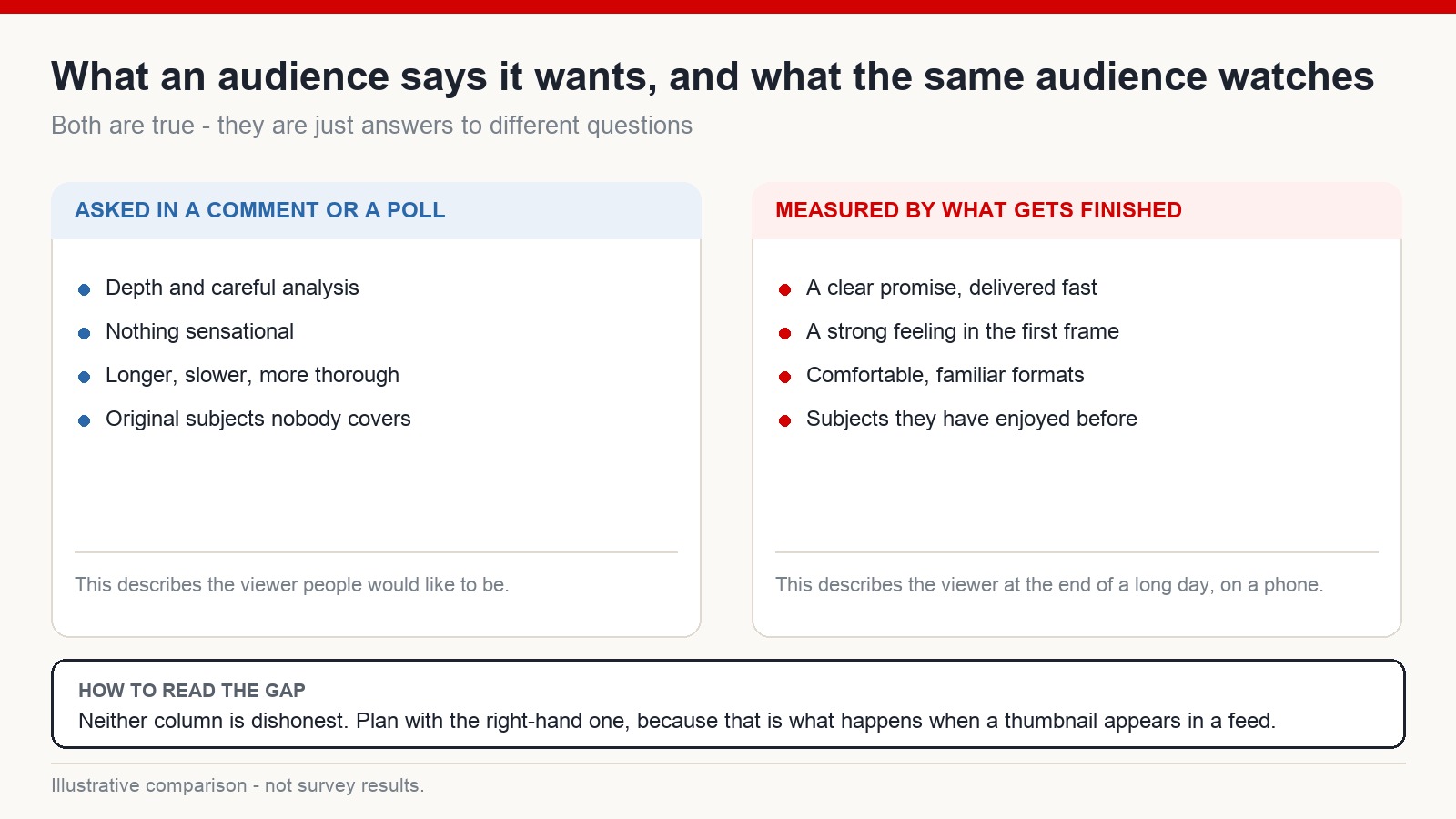
Ask an audience what they want and you will hear the flattering version: depth, substance, careful analysis, nothing sensational. Look at what the same audience actually finishes and you will often find something faster, simpler and more emotionally direct.
Both things are true at once. People describe the viewer they would like to be, and then behave like the viewer they are, at the end of a long day, on a phone, half-distracted.
This is why watching behaviour is the more reliable signal. Not because stated preferences are lies, but because behaviour is what actually happens when a thumbnail appears in a feed and someone has three seconds to decide.
Do not argue with the view count – decode it
It is tempting to look at something enormous and simple and conclude that the audience has bad taste. It is also useless, because the video is still there and it still worked.
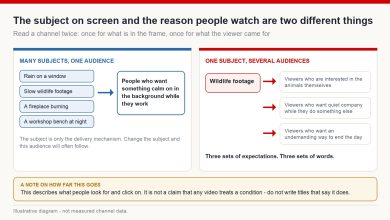
The productive question is: what job did it do? Something that a lot of people watch is doing something for them – answering a question quickly, holding a mood, resolving a tension, providing company. Simplicity is often not laziness but friction removal: nothing to decode, no work required to enjoy it.
Once you can name the job, you can do that job better, or do it for a group nobody is currently serving well. Sneering at the format tells you nothing you can use.
The order that works: demand first, then supply
Most people run the sequence backwards – idea, production, publish, hope. Reversing it costs an hour and changes the odds noticeably.
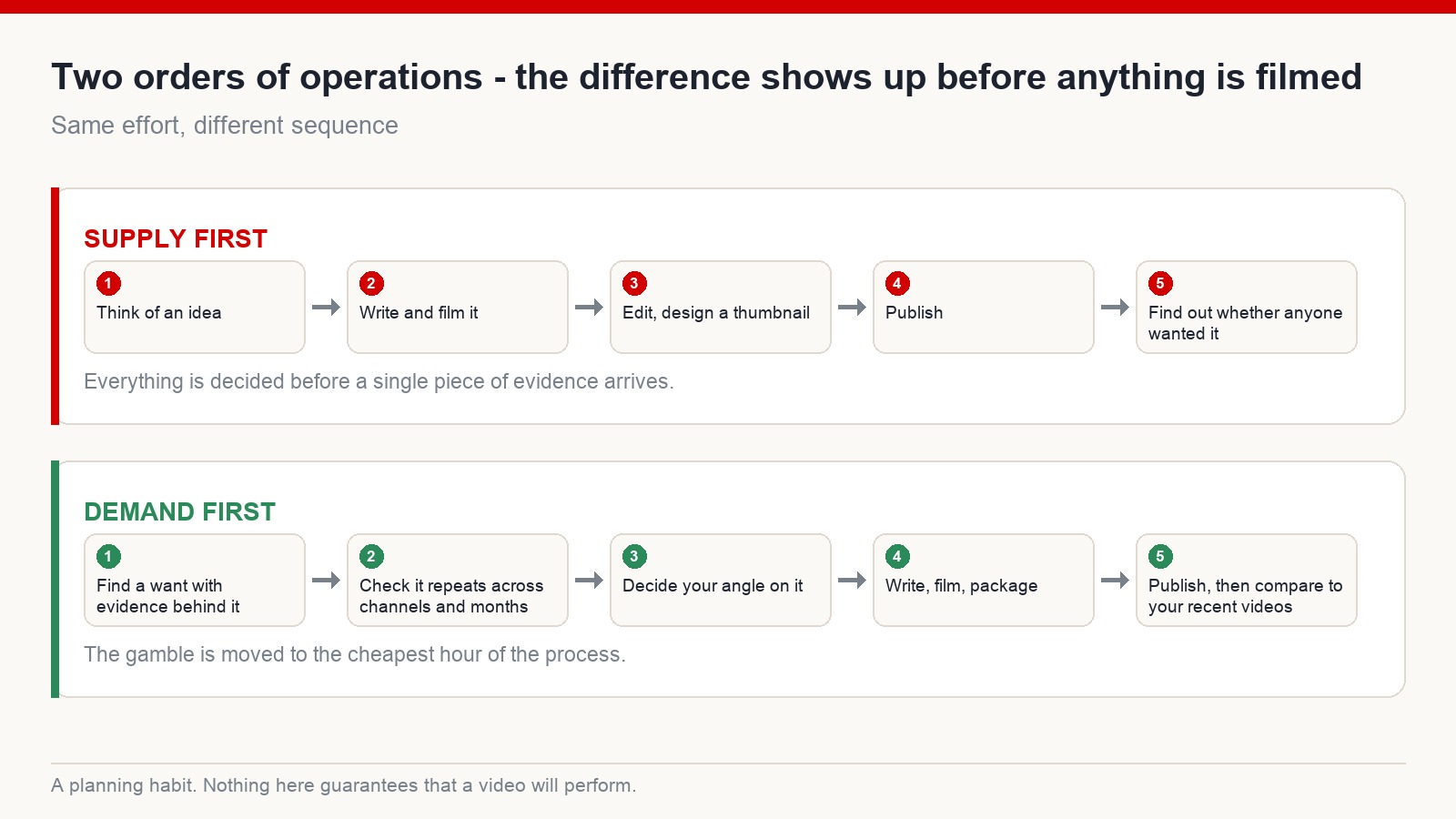
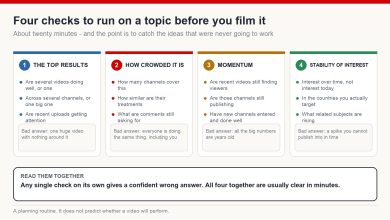
Demand first means you look for evidence that a want exists before anything gets made: several channels serving it, several videos on the same theme doing well rather than one, and a group of people who keep asking for the same thing in comments. Supply second means your idea, your angle and your voice get applied to a want that is already there.
That is not the death of originality. Originality lives in the execution – the framing, the detail, the point of view, the craft. It just stops being the thing you gamble the whole video on.
Repetition is the signal, not the outlier
One enormous video proves very little. It could be a moment, a lucky recommendation, a subject that will never come round again. What tells you something is repetition: the same theme performing several times, across several channels, over several months.
When you see a subject show up repeatedly among a channel’s strongest videos, and then again on a second and third channel, you are looking at a standing want rather than an event. Standing wants are what you can build a library on.
Depth beats breadth, and it is not close
A common failure pattern: one week a mystery video, then a motivational one, then something about technology, then a news reaction. Every video is fine on its own. The channel goes nowhere.
Two things break. The audience never learns what to expect, so nobody has a reason to return or to subscribe. And you never learn anything either, because no two videos are comparable – every result is a one-off.
Creators who move quickly tend to do the opposite: pick a narrow want and go far into it, until they know that audience better than anyone casually passing through. Depth is also what makes a small channel competitive against a large generalist one, because the large channel cannot afford to be that specific.
Using AI without letting it invent things
AI is good at one part of this and bad at another, and the difference matters.
It is genuinely useful for splitting a broad subject into narrower ones, listing angles you had not considered, and rephrasing a subject as the question a viewer would actually ask. Give it a subject and ask for sub-topics that a faceless channel could cover, or the ten questions a newcomer to this subject has – the output is a decent starting list.
What it cannot do is tell you whether anybody wants those things. It has no view counts, it does not know what is happening this month, and when it does not know something it will produce a confident, plausible sentence anyway. So treat every AI suggestion as a hypothesis to check against real videos and real search behaviour, never as a finding.
Emotion is a real category, and it comes with a rule
People do not click because a video is informative. They click because something in the packaging created a small pull – curiosity, tension, warmth, recognition, mild dread. That is not a flaw in the audience; it is how attention works everywhere, including in the books and films we take seriously.
The rule that goes with it: the video has to pay off what the packaging promised. A title that manufactures a feeling the content never delivers gets the click and loses everything after it – the watch time, the returning viewer, and the trust that makes the next video easier. Curiosity is a legitimate tool right up until it becomes a lie.
The limit of “make what they want”
There is a version of this advice that produces miserable creators. If you chase every want regardless of whether you can stand the subject, you will publish for a few months and then stop, because nothing about it is sustainable.
So the target is an overlap, not a surrender. Somewhere between what an audience has already voted for and what you can keep making for two years without resenting it, there is a narrower space than either one alone. That space is the channel worth building – and results vary enormously even inside it, so treat this as a way of improving your odds rather than a guarantee of anything.
What it comes down to
When a channel is not growing, the first question is usually the wrong one. “Why does the algorithm not like my videos?” has no useful answer.
“What have these viewers already shown me they want, and am I making it?” does. It is a less flattering question, and it is the one that changes what you publish next week.
Frequently asked questions
How do I tell what an audience actually wants?
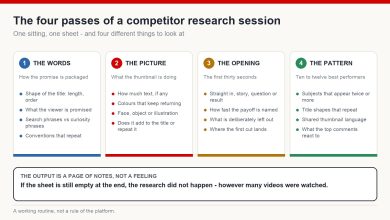
Look at behaviour rather than statements: which themes appear repeatedly among the best-performing videos in your space, what the top comments keep asking for, and which subjects several different channels have converged on.
Does this mean I should never make what I like?
No. It means your interest is the starting point rather than the proof. Look for the place where something you can sustain overlaps with something an audience has already asked for.
Why do simple videos often outperform careful ones?
Usually because they do a clear job with no friction – a question answered fast, a mood held, a tension resolved. Working out what job a popular video is doing is more useful than deciding it does not deserve its views.
Can AI tell me which topics will work?
It can suggest sub-topics and angles, which is genuinely helpful. It cannot verify demand, and it will produce confident answers about popularity that are simply invented. Check everything it suggests against real videos.
Is it bad to use curiosity in a title?
Not at all – it is most of what makes a title work. It only becomes a problem when the video does not deliver what the title implied, which costs you watch time and the viewer’s trust at the same time.
If you want the whole workflow around this – research, packaging and production for an English-speaking audience – that is what I teach at mmoyoutube.com.