Can You Actually Make It? Niche Selection for a One-Person Faceless Channel
There was a month where I did everything right and got nothing back. I learned prompting. I learned the editing software. I learned the basics of search. The channel stayed exactly where it was.
What I eventually understood is that I had been optimising a variable that was not the problem. Very few channels fail because the videos are badly made. A great many fail because the topic was never going to work for a single person with a normal amount of time.
For a one-person faceless channel, topic choice is not the first decision. It is the decision that determines whether the rest of your decisions matter.
What you like versus what the market needs
Beginners tend to open with “what am I interested in?” People who have done this a few times open with “what is being watched, and is there space for me in it?”
That is not cynicism about passion. Interest still matters, because you have to survive a long stretch of producing before anything compounds. But interest is a filter applied second, to a shortlist the market has already approved. Applied first, it produces channels about topics nobody was looking for.
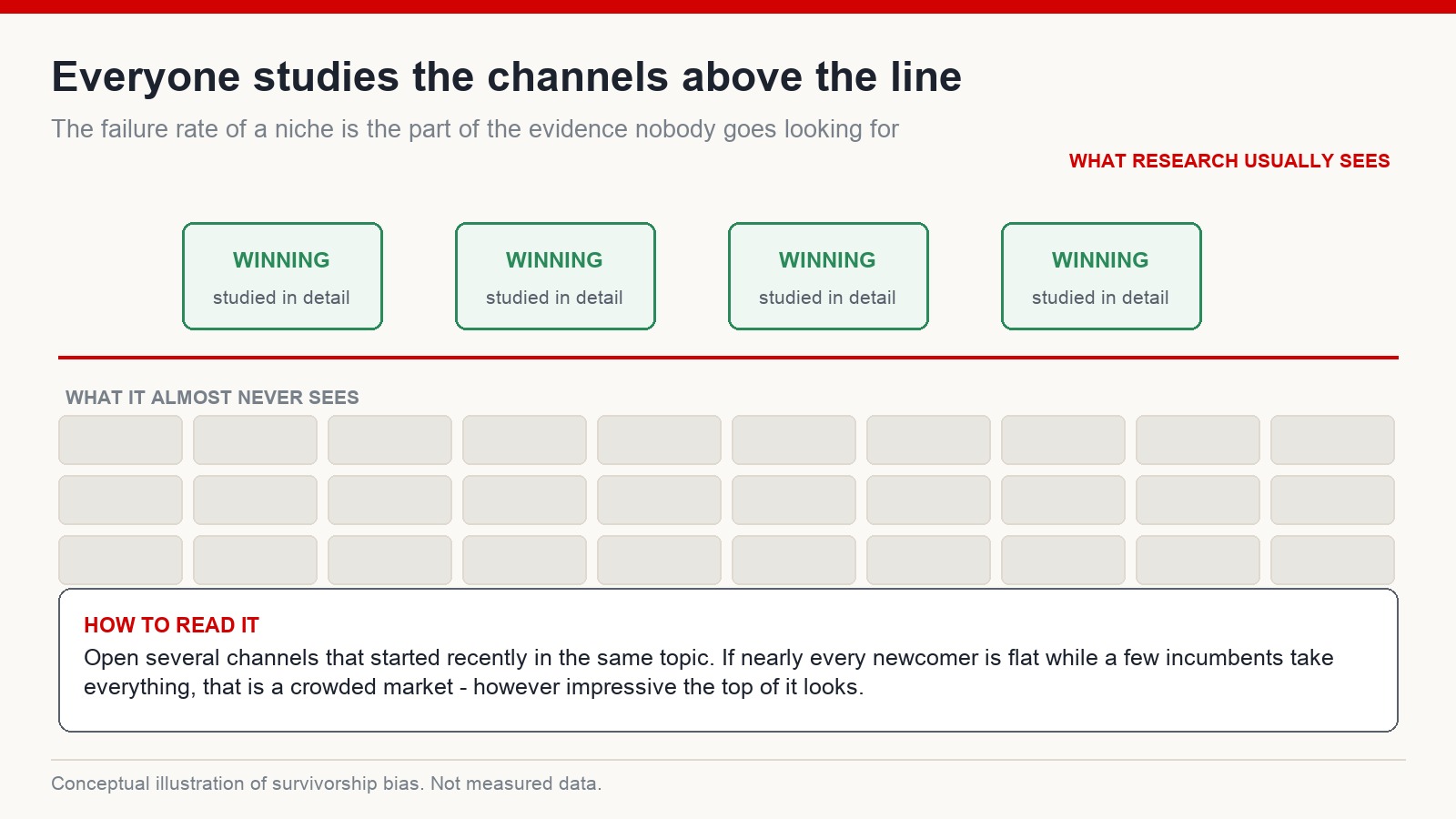
Everyone studies the winners. Study the losers.
Here is the habit that separates careful research from wishful research.
When people examine a niche, they look at the channels doing well and count that as evidence. It is evidence – of a very specific kind. It tells you what winning looks like. It tells you nothing at all about how many people tried and did not.
So do the opposite search as well. Look for recently started channels in the same topic that are getting almost no attention. Open several. If nearly every newcomer is flat while a handful of incumbents take everything, you are looking at a crowded market with a high failure rate, no matter how impressive the top of it looks.
If instead you find a mix – some new channels struggling, several clearly breaking through – the topic is behaving like a market with room in it.
Four mistakes that come from only reading the top
Working from published niche lists. By the time a topic appears on a widely shared list of promising niches, a large number of people are acting on the same information. The list is not wrong; it is just no longer private.
Choosing on personal taste alone. Your enthusiasm does not create demand. The platform serves what viewers want, and the data will tell you what that is if you let it lead.
Ignoring the failure rate. Covered above, and it is the most common blind spot in this entire process.
Ignoring whether you can actually make it. This one deserves its own section, because it quietly kills more channels than any of the others.
The feasibility audit
Some of the most impressive videos in any niche are made by teams. Photoreal three-dimensional sequences, custom animation, licensed archive material, extended location work. You can admire the result and still recognise that reproducing it alone, every week, indefinitely, is not a plan.
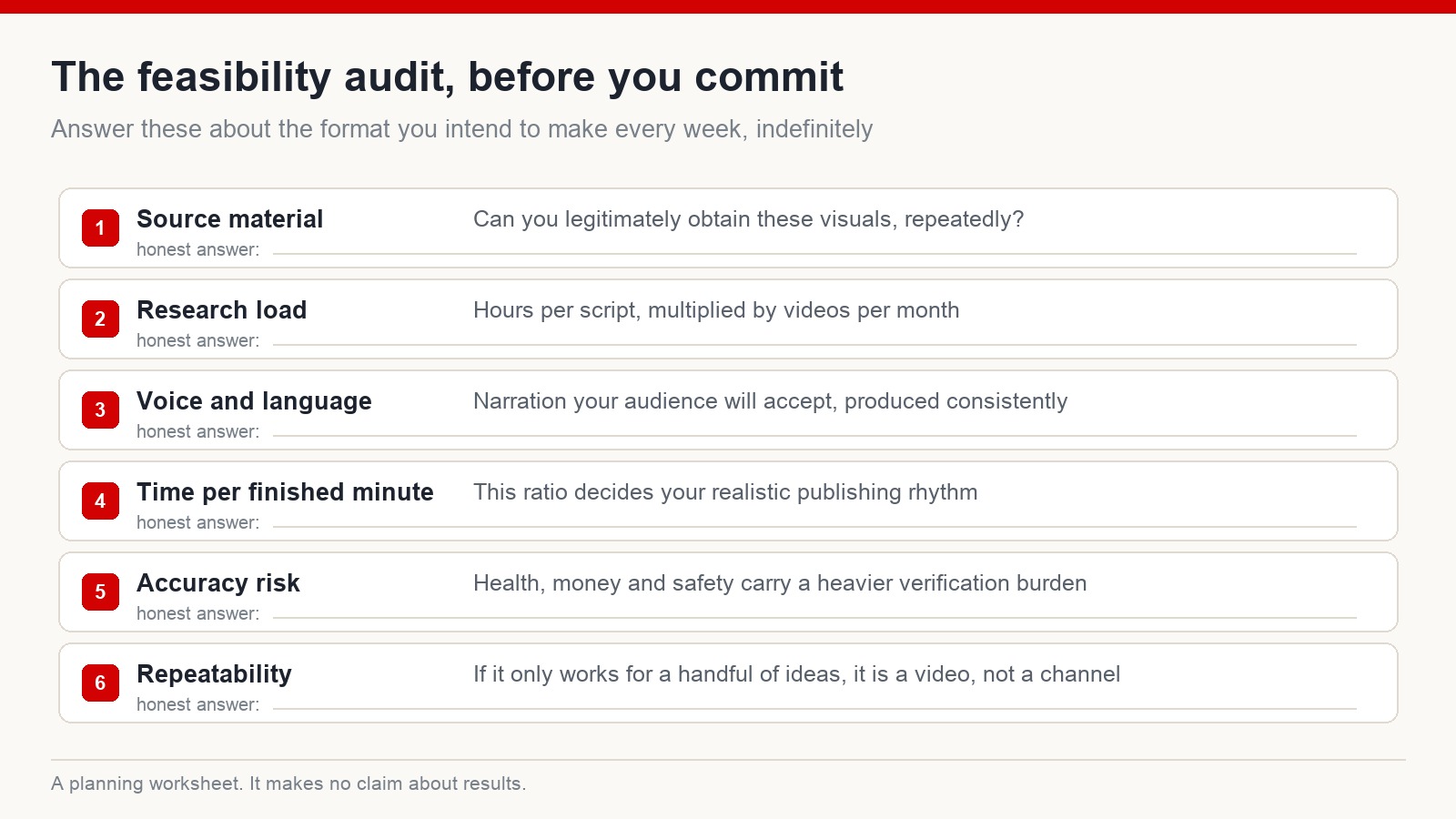
Before committing, work through the honest version of these questions:
- Source material. Can you legitimately obtain the visuals this format needs, repeatedly, without relying on other people’s footage?
- Research load. How many hours does one script take before you can write it? Multiply by the number of videos per month and see whether the number is survivable.
- Voice and language. Does the format need narration your audience will accept, and can you produce that consistently?
- Time per finished minute. Some formats take three times as long per minute of output as others. That ratio decides your realistic publishing rhythm.
- Accuracy risk. Topics touching health, money or safety carry a duty of care and a heavier verification burden. That is a real production cost, not a footnote.
- Repeatability. Could you make a hundred of these? If the format only works for a handful of ideas, it is a video, not a channel.
Four niche families, sorted by what they cost you
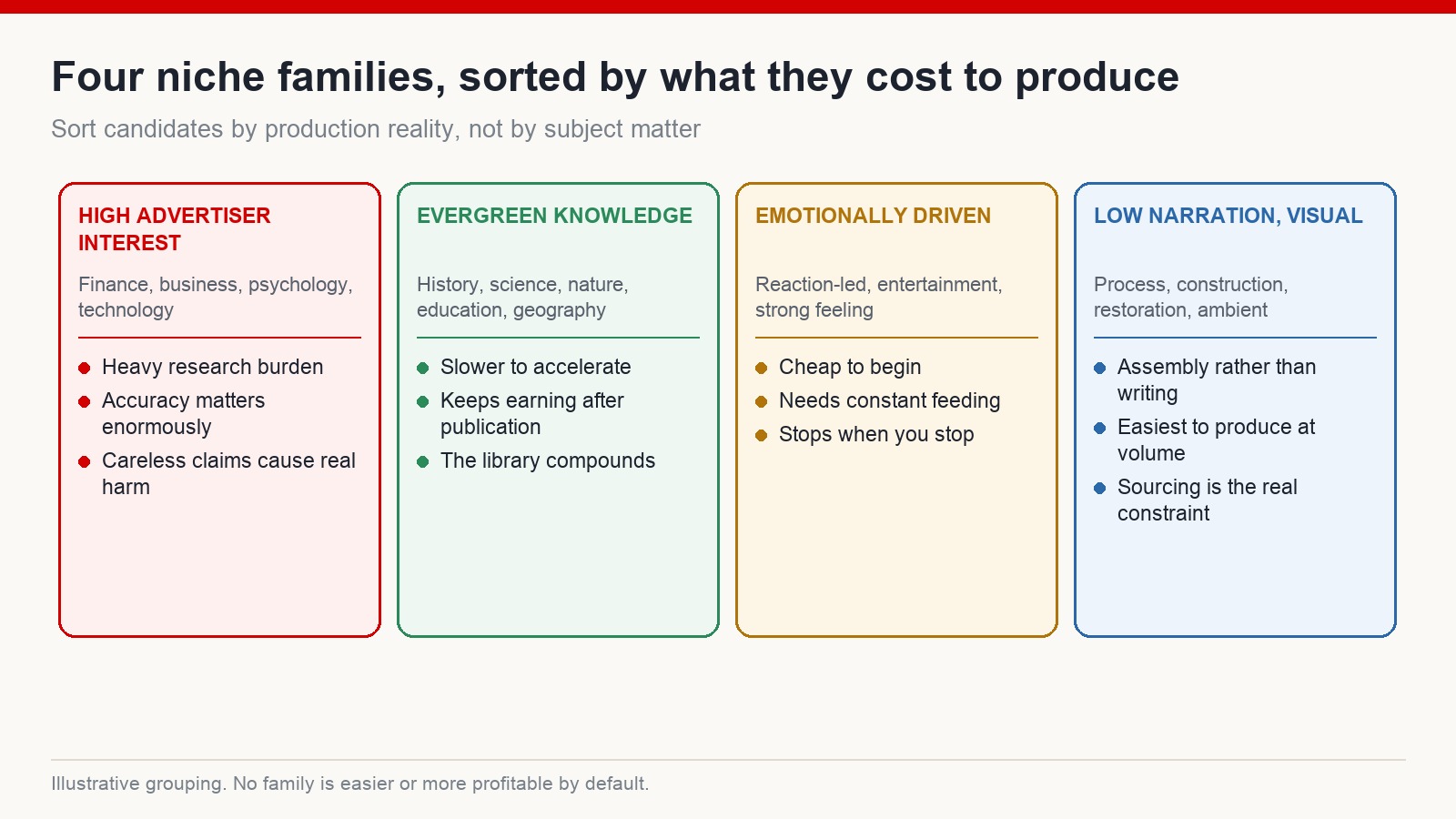
Not everyone suits the same kind of content, and the useful way to sort candidate topics is by production reality rather than by subject.
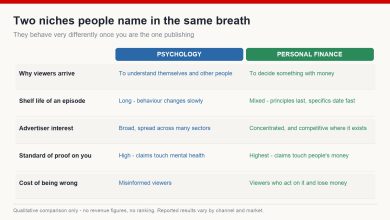
High advertiser interest. Finance, business, psychology, technology. Advertisers compete for these audiences, so the ceiling is higher – but the research burden is heavy, accuracy matters enormously, and much of it sits in territory where careless claims cause real harm. Sustainable if you genuinely know the subject.
Evergreen knowledge. History, science, nature, education, geography. Slower to accelerate, but a well-made video can keep earning views long after publication. The library compounds, which is exactly what a solo operator needs.
Emotionally driven. Highly entertaining, strong reactions, capable of large spikes. Cheap to begin. The catch is that it needs constant feeding: performance is tied to what is happening right now, so the moment you stop, the channel stops.
Low-narration and visual. Process footage, construction, restoration, nature, ambient and sound-led content. The most straightforward to produce at volume, because the pipeline is mostly assembly rather than writing. The constraint moves to sourcing: you need a legitimate, renewable supply of visuals, and that is a harder problem than it first appears.
The two conditions worth waiting for
Whichever family you land in, one pattern is worth holding out for.
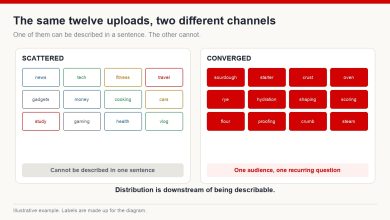
The first condition is that established channels in the topic are clearly performing now. That proves the market is real. The second is that at least one small, young channel is also performing on the same theme. That is the entry-door test, and it proves the market is still reachable by someone without an audience.
Either signal on its own is weak. Both together is the most encouraging thing you will find in niche research, and it is worth waiting a couple of weeks to find rather than starting on a topic where only incumbents win.
A word about doing this responsibly
Producing at volume with assistive tools makes it easy to publish quickly and easy to publish carelessly. Two things are worth holding to regardless of niche: only use material you have the right to use, and make sure each video contains something a viewer could not get from the fifty near-identical uploads around it.
Platform rules also change, sometimes with little warning, and a format that is accepted today may be treated differently next year. Building on genuine value rather than on a loophole is the only version of this that survives that.
Where this leaves you
Choosing a niche is not the first step. It is the most important one, and it is the one people spend the least time on.
A topic worth committing to has real demand, visible room for a newcomer, and a production shape that one person can hold for a year. Research the losers as carefully as the winners, be honest about what you can actually make each week, and you will avoid the failure that ends most faceless channels – not bad videos, but a topic that was never workable in the first place.
Frequently asked questions
How do I know a niche is too crowded?
Look at recently launched channels rather than established ones. If almost none of them are getting traction while a small number of incumbents take nearly all the attention, that is a crowded market regardless of how large the totals look.
Should I pick the family with the strongest advertiser interest?
Only if you can carry its research and accuracy burden. Those topics reward depth and punish sloppiness, and a poorly researched video in a money or health subject does real damage to viewers and to your channel.
Is low-narration content the easiest place to start?
It is the easiest to assemble and the hardest to supply. Before choosing it, work out where every second of usable footage is going to come from, legitimately, for the next hundred videos.
How many videos before I judge the topic?
Enough that you are judging the topic rather than your early learning curve. The first several uploads mostly measure how new you are at the format, not whether anyone wants it.
If you want the full research and production process for building toward an English-speaking audience, it is laid out at mmoyoutube.com.