How to Build a Small YouTube Team: Three Seats, DISC and the SOP That Lets You Delegate
Two in the morning, and you are still at the desk finishing an edit somebody else could have done. I am not going to describe that feeling to you. You already know it.
What I want to show you instead is the loop I was stuck inside for my first few years in this business, because it has a shape, and shapes can be broken.
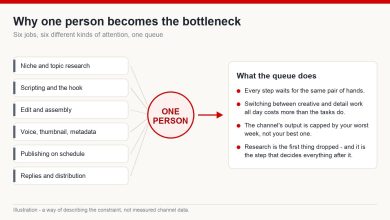
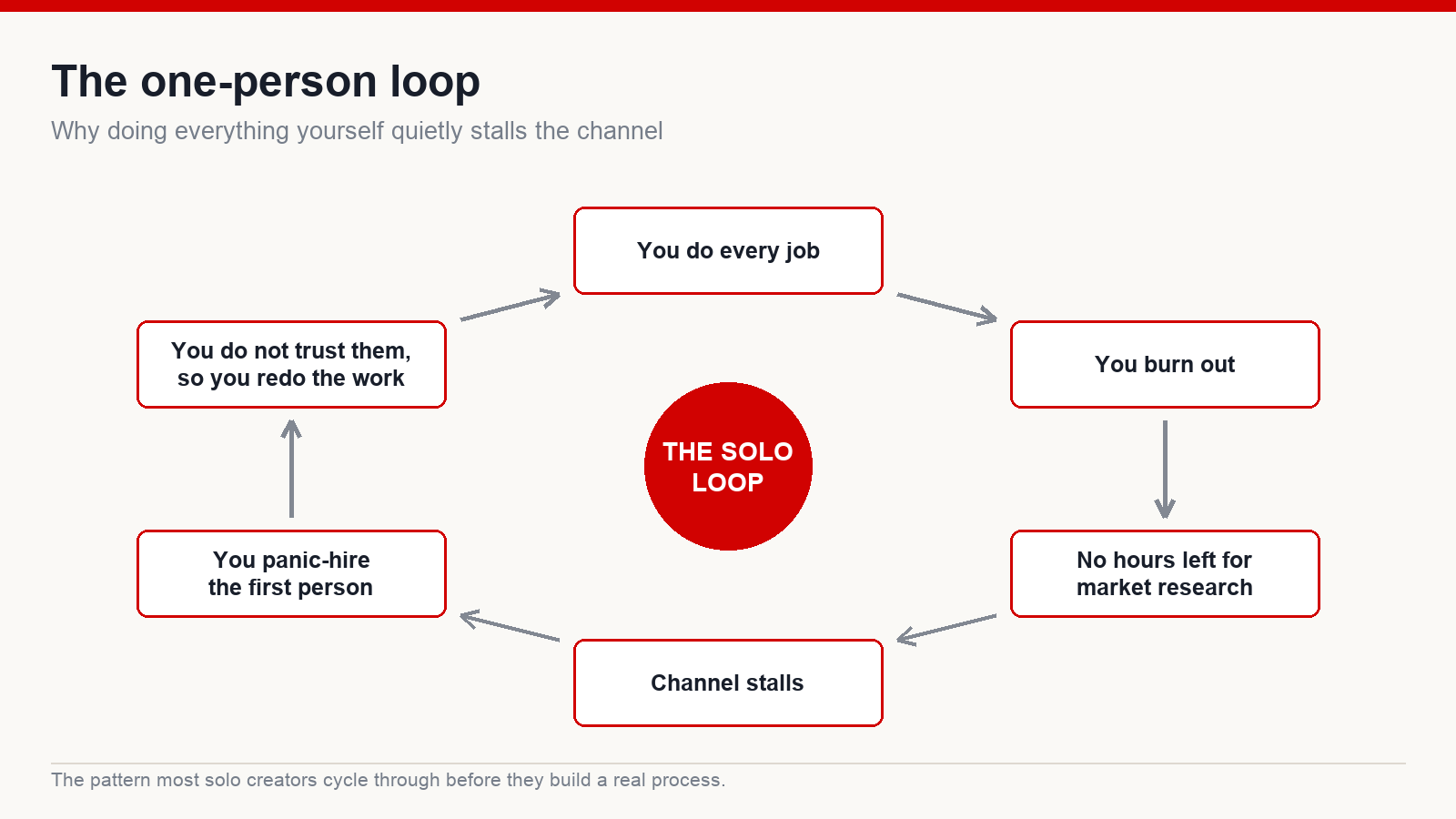
You do everything. Scripts, edits, thumbnails, uploads, comment replies. Alone. Then you burn out. Burnt out, you have no hours left for market research – and in this line of work, content always has to run ahead of editing, while the market shifts week to week. You stop watching it, and the channel stalls. The channel stalls, you panic, and you hire the first person who says yes. But you do not trust them, so you redo everything they touch. They sit idle, feel redundant, get bored, and leave. You end up alone again. Same starting point, more tired.
I went round that loop several times. Each time a team fell apart I told myself the same thing: I just have not found the right person yet. Wrong. It was never the person.
Here is the thing I wish somebody had told me earlier: the problem is not that you are bad at this, and it is not that they are incompetent. It is two specific gaps, and both are fixable.
One, you delegate on the wrong frequency – you hand people work that runs against how they are wired, then judge them for struggling with it. Two, neither of you has any process discipline: everything runs on mood, and there is no framework for the next person to hold on to.
This article opens up both. But before you read on, do one thing tonight: write down ONE task you are currently holding that somebody else could do. Just one. That is the first brick in learning to let go.
What a small YouTube team actually looks like: two or three real seats
Before we talk about who is good at what, I want you to see the destination. Most solo creators are not hoarding work out of ego. They are hoarding it because they have never had a clear mental picture of what a functioning small team looks like. It is not a company. It is not ten people. It is two or three seats.
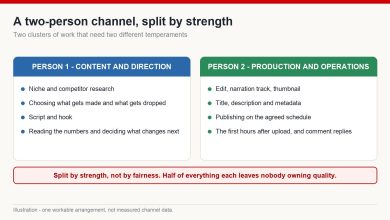
Two people is the leanest workable version. One person researches and writes – call them P1. One person edits, and only edits – P2. That is it. P2 does not brainstorm topics, does not dig through the market, does not chase trends. P2 takes a finished script, assembles the edit, drops in the narration track, and delivers a video. One person owns what gets said. The other owns how it gets built. Clean line between them.
At three people the split gets cleaner still. The Manager seat: market research, community interaction, publishing, and outreach to build early traction. The Content seat: research and writing. The Edit seat: studying how the format should be cut, and knowing which piece is time-sensitive enough to build first. Three seats, three jobs, no overlap.
There is one rule underneath all of it, and I would put it on the wall: content always runs ahead of editing. The writer stays a beat in front. The editor never sits waiting for work, and never starts cutting before a script is finished. Reverse that order and the whole line jams.
The team runs on two simple things: one shared task board and one shared drive. Who is doing what, how far along it is, where the files live – all visible without anybody having to message anybody. That is the structure I actually use, pulled from a written standard operating procedure and refined in live coaching sessions, not a diagram invented to look tidy.
So here is your small task: sketch how many seats your channel currently has and who is sitting in each one. Even if the honest answer is “all three seats are me” – that is exactly where we start.
DISC in plain English: four frequencies, including your own
You have the seat map. Now the people, because seats stay still and people do not. And you have already met all four of these types. You just have not had names for them.
Some people walk into a meeting and open with: how many views will this get, and when is it done? Say one sentence too many and they get restless. That is D – Dominance: results-driven, fast, direct, allergic to preamble.
Some people are the opposite – warm, optimistic, genuinely enjoyable to talk to, happy to spend an afternoon turning a title over, and unusually good at sensing what an audience wants. That is I – Influence: people-oriented and creative.
The third type is steady, patient, does consistent work day after day – but throw a sudden schedule change at them and they wobble. That is S – Steadiness: built for rhythm and endurance.
The last type is meticulous, detail-obsessed, and asks whether something meets the standard and what the data says. That is C – Compliance: precision and process, evidence before action.
The four fall onto two axes: task-focused versus people-focused, and fast and assertive versus measured and cautious. Cross them and you get four corners: D, I, S, C. The framework traces back to the psychologist William Moulton Marston in the 1920s and 30s, and was later developed into behavioural assessments. Four letters is genuinely all you need to remember.
Now the caveat, because using this badly does real damage. Nobody is 100% one type. Everybody is a blend, usually with one or two dominant traits – D-C, I-C, C-S. DISC is a reference for behaviour. It does not measure ability, and it is not a psychological diagnosis. A “C” person can be more creative than an “I” person, so do not box anyone in. Behaviour also shifts with context: someone with breathing room behaves nothing like the same person against a deadline. Use it to understand each other and assign work sensibly. Do not staple a label to somebody’s forehead, and never use it as an excuse to trap a person in one job forever.
Small experiment tonight: guess your own dominant frequency, then guess it for whoever you work with. That is all. Seating comes next.
Matching people to the Manager, Content and Edit seats
So you have two or three people and a rough read on how each one is wired. The real question: who goes where?
Here is how I tend to seat people. To be clear up front: this is a suggestion, not a law. Real people are blends and nobody fits an ideal profile. Treat it as a map to navigate by, not a mould to force people into.
The Manager seat suits a dominant D with some C. The D makes calls: this video ships, that one gets cut, we chase this trend or we do not – decided quickly, without agonising. But pure D decides too fast. A streak of C makes them sit down with the numbers before committing.
The Content seat suits a dominant I with some C. The I brings creativity, and the most valuable thing of all: empathy for the audience, an instinct for what the person on the other side of the screen actually wants. The C keeps them tethered so they stick to the sequence – thumbnail concept, then title, then content – instead of drifting.
The Edit seat suits a dominant C with some S. Editing is repetitive work: every cut, every music bed, every subtitle line, and a small error shows. The C brings that precision. The S lets them sit with it for hours without going stale, which is what keeps a publishing rhythm alive.
Only two of you? P1 leans I or D – the person who thinks and decides. P2 leans C or S – the person who builds and holds the rhythm.
Now the painful part. Do not put a strong C on community outreach and live interaction – crowds drain them, and pushing harder makes them shut down. Do not put a strong I in an eight-hour-a-day editing chair – they will last a few weeks. This is the actual root of that miserable feeling of paying someone and getting nothing back. Often the person is fine. You just seated them wrong. Right person, wrong chair, and you are still asking a fish to climb a tree.
Tonight’s task: look at your team and ask who is sitting in the wrong seat.
Talking to each frequency: one sentence, four different meanings
Seated correctly, job done? Not yet. Because the same sentence out of your mouth arrives as four different messages in four different heads. This one took me years to work out.
Early on, when I briefed someone and the work came back wrong, I assumed they were slow or lazy. Eventually I understood: most of the time they were neither. I was broadcasting on the wrong frequency.
With a dominant D, keep it short. State the objective and the deadline. Skip the backstory. They need two things: what, and by when. The longer you talk, the more they fidget.
With a dominant I, open with recognition, then paint the picture. “That title you came up with yesterday was sharp – if this one lands, it changes the shape of the channel.” They run on inspiration and acknowledgement, not dry instructions.
With a dominant S, the thing they fear is a sudden change of rhythm. If the schedule or the method is changing, tell them in advance. Do not ask them on Monday morning to reverse everything they did on Friday. That is not resistance you are seeing, it is disorientation.
With a dominant C, drop the vague language. Give numbers, a checklist, a reason. “Use this structure, because the last three videos that followed it performed” – and they will run with it happily.
How you brief someone is also how you should measure them. A dominant D is privately asking what this video produced, so hold them to outcomes. A dominant C is asking whether the work met the standard, so hold them to a quality checklist. Measure someone against the wrong yardstick and you are being unfair to them. And here is the good part: mix those two frequencies inside one team and you get a machine that is both fast and reliable, because the D pushes pace while the C protects quality.
Something you can apply immediately: before your next handoff, pause a few seconds, guess the person’s dominant frequency, and adjust how you say it. Same task, different delivery, noticeably different result.
Teams fall apart when everyone tilts the same way
Right people, right wording – and teams still collapse. Why? Because this gap is not in any individual. It is in the combination.
This is the fear I hear most often: I hired, and the team still fell apart. In most cases it was not because you hired someone incapable. It was because the whole team leaned in one direction. A four-legged table with three legs crowded into one corner will tip eventually, however solid each leg is.
Look at yours honestly. A team of all I types is a delight – ideas everywhere, every meeting ends with enthusiasm. Then deadlines slip. The video promised this week moves to next week, and nobody wants to sit and check every subtitle line. That team has a C-shaped hole: no one holding the checklist, demanding evidence, insisting the standard is met.
Flip it. A team of C and S types is solid, consistent, low error rate. But slow to catch a shift. The market turned a month ago and they are still finishing the old thing, reluctant to try a new format, reluctant to change the thumbnail style. That team is missing D and I – nobody willing to bang the table and say drop this, move to that, today.
Want to find your hole? Pull out the questions any manager should be asking every week. What is rising in the market right now? Which niches and formats are heating up? Which channels are growing fastest, which videos are trending, how are their thumbnails composed? And the uncomfortable one: does my channel resemble the market at all, or am I out here on my own? If nobody on the team can even ask these, that is exactly where the hole is.
And please remember: DISC exists so you can understand each other and assign work well. It is not a stamp for somebody’s forehead. Nobody is one pure type, and behaviour shifts with context.
Tonight’s task: look at your team as it stands – even if it is just you and one other person – and name the missing frequency. Next hire, fill that gap. Do not hire another copy of yourself.
The process checklist: right person, still no team, without this
By now you have all four pieces: the seat map, how to read frequencies, how to seat people, how to brief each one. And now I have to tell you something unwelcome, right at the moment you feel like you have cracked it.
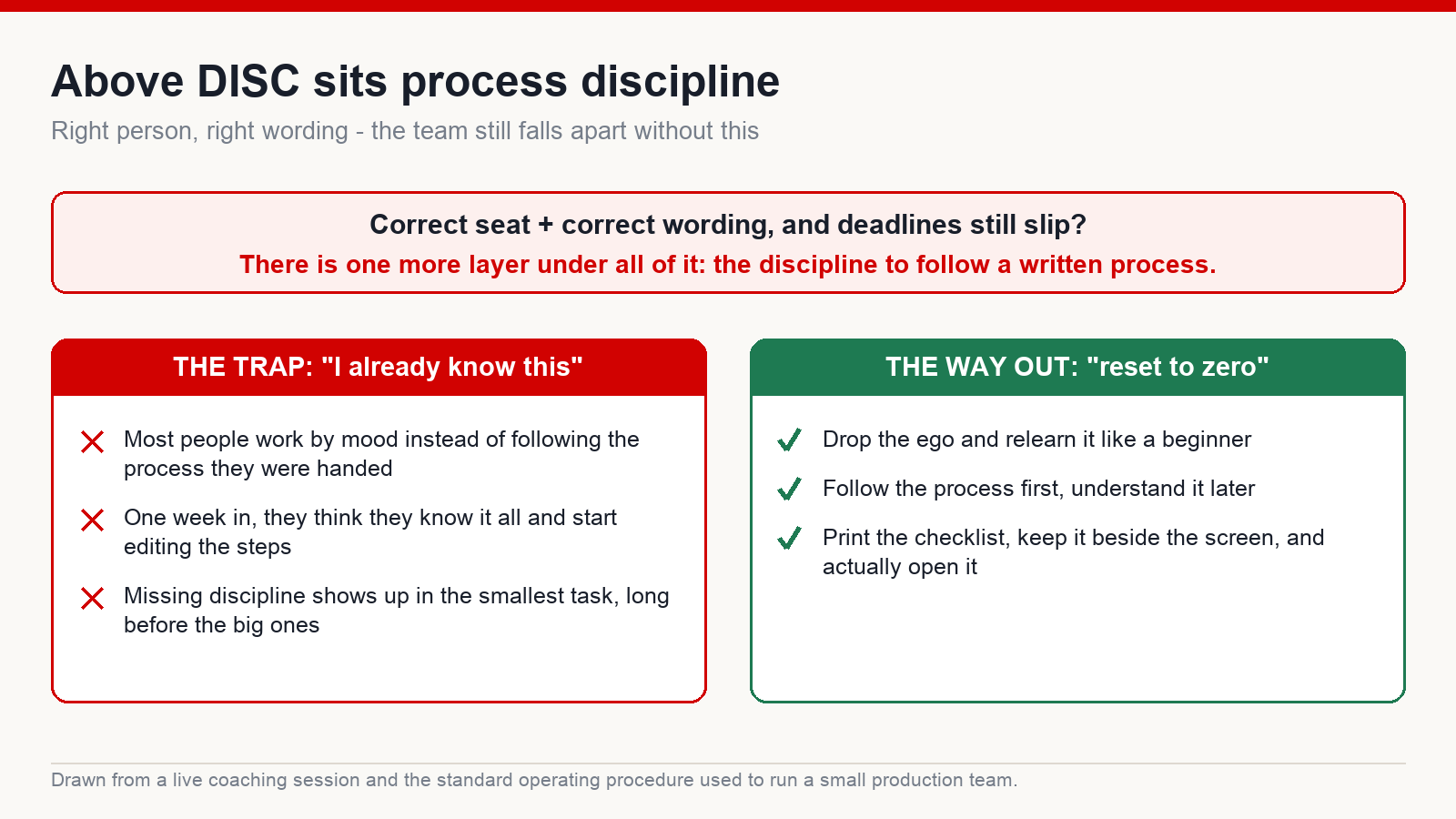
You put the right people in the right seats. You know the four frequencies cold and you speak to each person on the band they receive. And the team still falls apart. Deadlines still slip. Somebody still works a month and quietly resigns. Because underneath DISC there is one more layer, and without it the smartest delegation in the world drains straight into the ground: the discipline to follow a process.
The hardest lesson from my coaching work is this. The biggest barrier for the people I teach is not a lack of intelligence. It is unwillingness to follow the process they were handed, step by step. In my experience, the large majority work by preference instead of by procedure – and that, more than anything else, is why most of them never get traction.
The trap has a name: the illusion of competence. A week in, a month in, you feel like you know the whole thing, and you start editing the process before you have run it through once at full fidelity. The only way out is a reset to zero: put the ego down, learn it like a beginner, follow first and understand later.
Let me give you a small example from a coaching session that has stayed with me. Someone had the checklist in their hand and never opened it. Asked to lay out four pens in a specific colour order – red, then blue, then black, then green – they could not do it. Not because it was difficult. Because there was no habit of order, no discipline. Missing discipline shows up in the smallest task long before it shows up in the big one.
So here is what actually lets you let go. The team runs on one task board and one shared drive. The checklist is standardised: major sections labelled A, B, C; inside each section, steps numbered in the exact order they must happen; tick when done; export it or print it on a sheet of paper and tape it next to the monitor. However big the numbers get, that basic discipline does not become optional.
Why is the checklist, rather than the hiring, the thing that frees you? Because once the process lives on paper instead of in your head, somebody else can take your place – and the channel becomes something you can replicate. And honestly, this is also why AI is such a good process operator: it has no instinct to resist. It does not silently skip steps or change its mind because it is having an off day.
Let go in the right place, starting with the first pen
That two-in-the-morning night – I am not going to describe it again. You already know it.
What I want you to take away is not “work harder”. You do not need to be better than the person you are about to hire. You need to do two things properly.
One: brief people on their own frequency. D, keep it short and name the target. I, recognise them and paint the picture. S, warn them before you change the rhythm. C, give them the data and the checklist.
Two: keep the discipline of one simple process that lives on paper, not in your head. A process in your head dies with you. A process on paper can be carried by somebody else. That is how the channel becomes replicable, and how you get your hands free.
Keep this one: free hands are not the reward for carrying the most. They are the reward for letting go in the right place.
Tonight, nothing dramatic. Write the checklist for ONE video. Hand ONE task to ONE person. That is all. Get the four pens in order first, then we can talk about scale.
Frequently asked questions
What is the smallest workable faceless YouTube team?
Two people is enough: one who researches and writes (P1), and one who only edits (P2). When you want cleaner separation, move to three seats – Manager, Content and Edit. The rule that does not change in either model: content always runs ahead of editing, and the writer stays a beat in front.
Is DISC a test of someone’s ability?
No. DISC is a behavioural framework, not a measure of capability and not a psychological diagnosis. A “C” person can easily be more creative than an “I” person. Nobody is 100% one type, and behaviour shifts with context. Use it to understand each other and seat people sensibly, not to label someone and lock them into one role.
I seated everyone correctly and the team still fell apart. Why?
Usually a lack of process discipline. However cleverly you delegate, if both of you work on instinct with no written checklist, the person after you has nothing to hold on to. Standardise it: one task board, one shared drive, one checklist with lettered sections and numbered steps, ticked as you go. Once the process is on paper rather than in your head, somebody else can take your place.
Which seat should I hire for first?
Whichever one you are worst at holding while also doing everything else – which for most solo creators is editing, because it eats the most hours per video. But check the frequency gap in your team before you post the role. Do not hire another copy of yourself.
I have been building faceless channels for English-speaking audiences since 2017, and every piece of this came out of getting it wrong first. If you want to go deeper into building that kind of channel with a team behind it, that is what I write about at mmoyoutube.com. There is no get-rich shortcut there – just the craft, and it holds up when you do it honestly.