A Channel That Lost Distribution: The Live Stream Recovery Plan
The worst part of a channel losing distribution is not the falling numbers. It is the silence. You publish, and nothing happens. You publish again, and nothing happens again. There is no error message, no explanation, no obvious thing to fix – just the growing suspicion that you are talking into an empty room.
I have sat with a lot of people at exactly that point, and the approach I keep coming back to is live streaming. Not as a magic fix – I want to be careful with that word – but as a structured experiment that gives a stalled channel a chance to be seen again.
This is the whole plan, start to finish, including the part where you decide not to do it.
Step zero: work out what you are actually treating
Skip this and everything after it is wasted effort.
There are two very different situations that feel identical from the inside. The first is a distribution problem: your channel used to reach people, and at some point it stopped. The second is a demand problem: your channel never reached anyone, because the subject has no audience, or the content is not good enough yet, or you are making something that already exists in better form elsewhere.
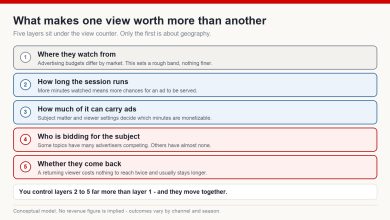
Live streaming is a plausible response to the first. It does nothing for the second. If you have never had a video reach an audience, the honest work is upstream – in the subject, the audience you chose, and the quality of the thing itself.
To tell them apart, look back over your own history. Was there a period where videos reliably found viewers? Did something change around the time it stopped – the subject, the format, the upload rhythm? You are not looking for certainty here, just for whether there was ever something to lose.
The core move, in one paragraph
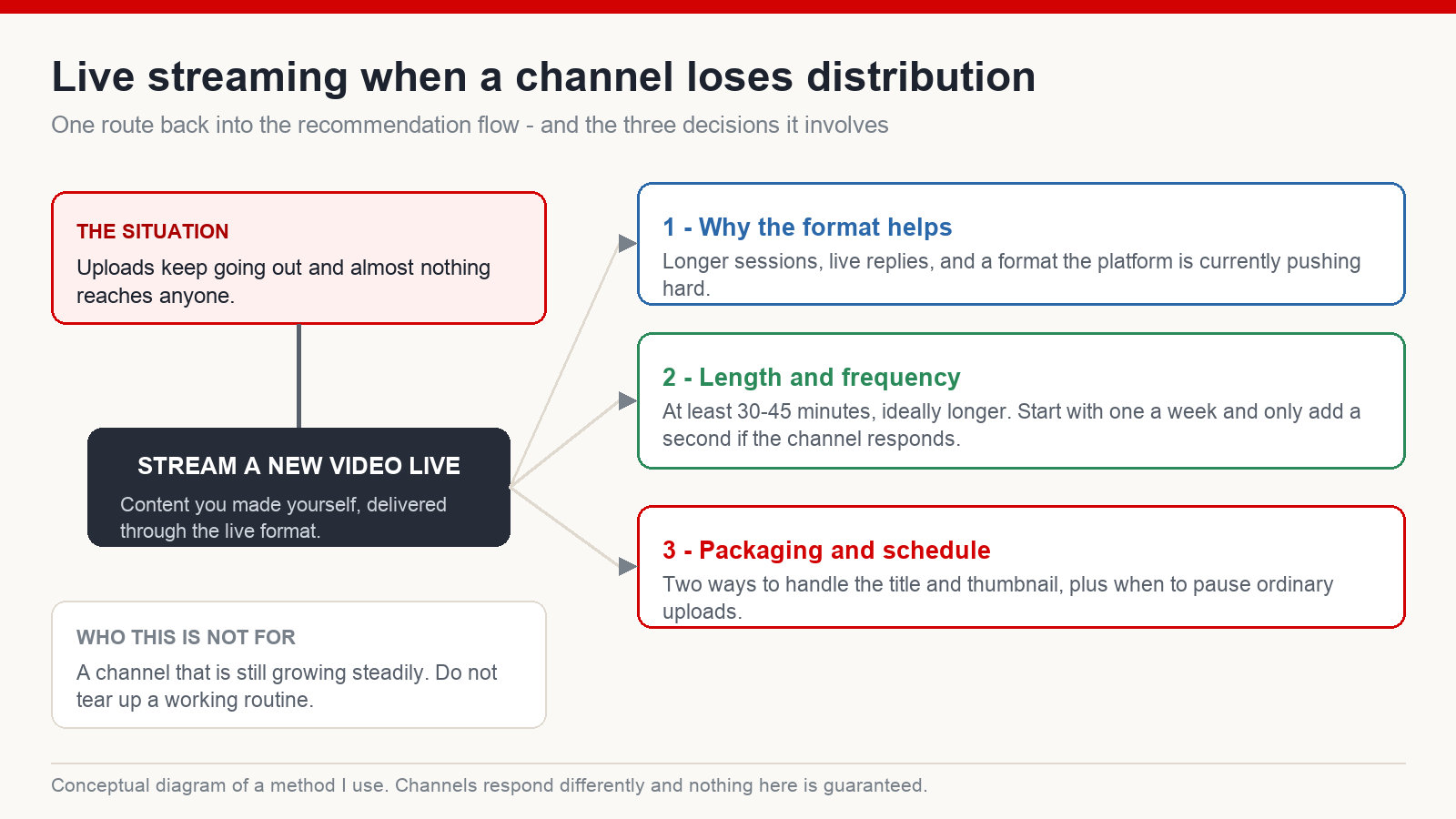
You produce a brand new video – your own content, edited properly – and you deliver it to the channel as a live broadcast rather than an ordinary upload, using an encoder such as OBS Studio or a legitimate streaming service.
The reason this is worth doing is that the live format currently receives distribution that ordinary uploads on a quiet channel do not. It produces sustained watch time, it produces live interaction, and it is a format the platform is actively promoting. That combination gives a recommendation system something fresh to react to.
It is worth saying plainly what this is not. It is not buying engagement, not inflating numbers, not re-uploading old material with a new label, and not evading moderation. It is choosing a format, and doing honest work inside it.
Step one: make one video actually worth streaming
The single most common way this fails is that people treat the stream as a distribution trick and skip the content.
Whatever you stream should be something you would have been happy to publish normally. If the format succeeds in getting you in front of people again and what they find is filler, you have spent your one reintroduction badly. A channel gets a limited number of second impressions.
Make one good thing. Not four rushed ones.
Step two: set the length before you start
My working rule, drawn from the channels I have run this on rather than from any published number: at least 30 to 45 minutes, and preferably over an hour. The quieter the channel, the longer I want the session to be. With one creator whose channel had gone almost entirely dark, I asked for roughly an hour and a half per session.
The logic is simply that watch time is the signal you are trying to generate, and a short session generates very little of it. But length is a means, not a target – a long stream nobody stays for is worse than a shorter one they do.
Step three: decide how you are packaging it
You have two options, and I use both depending on the channel.
You can design a new title and thumbnail from scratch, as you would for any upload you cared about. Or you can reuse the packaging from the strongest video already on your channel, on the reasoning that it has already been tested against real people and won.
The second option carries one hard condition: the stream has to genuinely deliver what that packaging promises. Borrowing a proven title for unrelated content is not a clever reuse, it is a misleading title, and platforms treat misleading titles and thumbnails as a policy issue rather than a tactic. If nothing in your library honestly fits what you are about to stream, build something new.
Step four: clear the schedule around it
The upload schedule during a recovery attempt is different from your normal one, and it depends on what your channel is currently doing.
If uploads are landing silently, pause them for a few days and put the week’s effort into the stream. This feels wrong – publishing feels like progress – but producing videos that reach nobody buys you no information at all. One clear signal is worth more than five ambiguous ones.
On any day you stream, publish nothing else. Let the stream be the only thing your channel is asking attention for.
And if your channel is still growing steadily, change nothing. This is a treatment for a channel that has lost distribution. A healthy channel does not need treating, and I have watched people dismantle a routine that was working because they read that streaming was effective.
Step five: run it weekly, and write down what you did
Start with one stream a week. One. The temptation to flood the channel immediately is strong and you should resist it, because if you change four things at once you will never learn which one mattered.
Before each session, note the date, the length, which packaging approach you used and what the video was about. It takes two minutes and it is the difference between running an experiment and simply hoping.
If the channel responds, then consider a second weekly session. Not before.
Step six: read the result honestly after several weeks
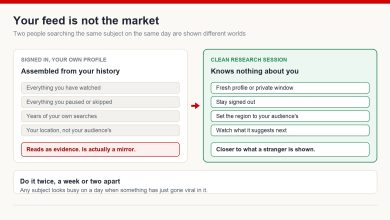
Compare each stream to your own channel’s recent history – not to anyone else’s screenshots, not to a figure quoted in a video. Your last ten pieces of content share your niche, your audience and your history, which makes them the only fair comparison available.
Three things can happen. The channel starts being shown to people again, in which case keep going and gradually reintroduce ordinary uploads. Nothing changes at all, in which case the problem was probably never distribution, and the honest next step is to look at the subject and the content. Or something moves slightly – which is the most common outcome, and the one that requires patience rather than a decision.
Set yourself a limit in advance: how many weeks you will give this before you conclude it is not the answer. Deciding that beforehand is much easier than deciding it while you are invested.
What it costs you if it does not work
Worth being clear-eyed about. If you run this for a month and nothing shifts, you have spent four weeks of production time on content that did not reach anyone – which is what was already happening – and you have learned something genuinely useful: the problem is not distribution.
That is not a great outcome, but it is not a wasted one either. Most of the creators I have watched stay stuck for a year were stuck because they never ran a clean enough experiment to rule anything out.
Frequently asked questions
How quickly should I expect to see something?
Not immediately. Distribution does not switch back on the afternoon you finish your first stream. Give it several weeks, and accept that some channels never respond.
Can I stream a video I already published?
I would not. Stream something new. Re-serving old material gives the system nothing fresh and gives returning viewers no reason to stay.
Do I need to be on camera?
No. The method described here delivers an edited video through an encoder, so it works for faceless channels exactly as it does for anyone else.
Is this a loophole?
No. You are choosing a format the platform is promoting and making honest content inside it. If someone is selling you something that involves buying engagement or misrepresenting content, that is a different thing entirely and it will cost you the channel.
What if my channel is new rather than stalled?
Then this is not your problem to solve. A new channel has not yet established what it is or who it is for, and no format substitutes for that.
Start small and stay honest about it
If you have a channel that has gone quiet, this is a reasonable thing to try: diagnose first, make one good video, stream it at a decent length, package it honestly, clear the schedule around it, and run it weekly for several weeks while writing down what you did.
I cannot promise it works. I have seen quiet channels come back this way, and I have seen channels where nothing moved and the real problem turned out to be upstream. What you control is the method and your patience with a slow signal.
If you would rather build something that does not need rescuing in the first place – starting from the audience and the subject rather than the tactics – that is the process I teach at mmoyoutube.com.