Turn Your Own Life Into a YouTube Channel: A Storytelling Build for Beginners
The sentence I hear more than any other, from people who have wanted to start a channel for two years and have not started one, is some version of this: I do not have anything to make videos about.
It is almost never true. What they usually mean is that their life does not look like the lives in the videos they admire. No studio. No travel. No dramatic before-and-after. Just a job, a commute, a few years of quietly getting something wrong and then slightly less wrong.
I have been building YouTube channels for English-speaking audiences since 2017, mostly faceless, mostly for viewers in the US, the UK, Germany and Japan. In nine years the thing that has surprised me most is how badly beginners misjudge which raw material is valuable. They think the camera is the bottleneck. It is not. The bottleneck is that they are trying to talk about a subject instead of telling somebody what happened to them.
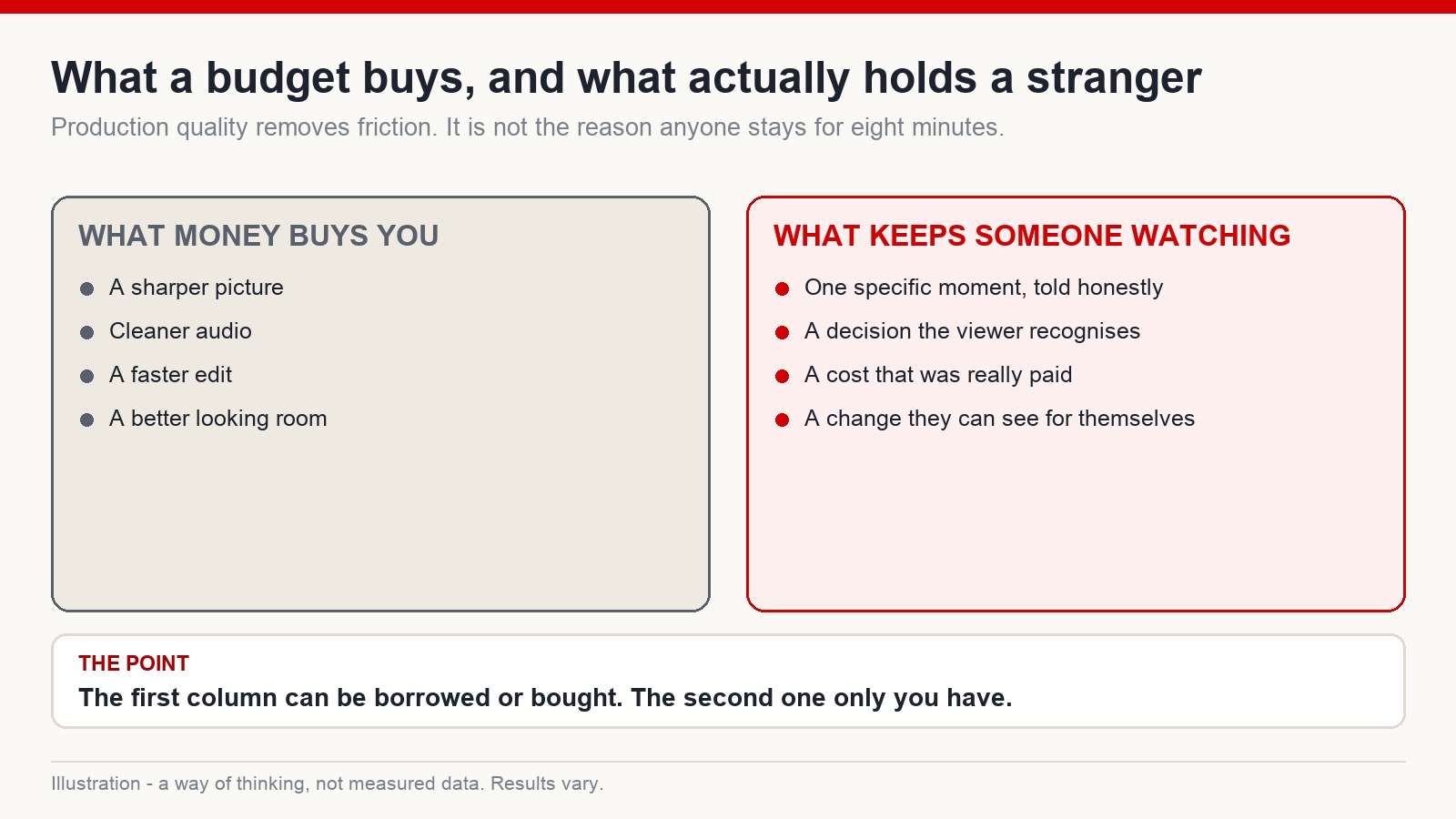
The thing you think disqualifies you is the material
Money buys a sharper picture, cleaner audio, a faster edit and a nicer room behind you. Every one of those things removes friction. Not one of them is the reason a stranger gives you eight minutes of a life they will not get back.
People stay for a specific moment, told honestly. A decision they recognise. A cost that was actually paid by somebody. A change they can see for themselves rather than being told about.
That is the whole trade. The first column can be bought or borrowed later, when you have a reason to. The second column is the only thing on the platform that cannot be copied from you, because nobody else was standing where you were standing.
So the honest starting question is not “what niche is profitable”. It is: what do I know that cost me something to learn?
Step 1: Build a story inventory before you hunt for topics
Before you open a keyword tool, open a blank page and empty your own timeline onto it. I ask every creator I work with to do this first, and it takes about forty minutes.
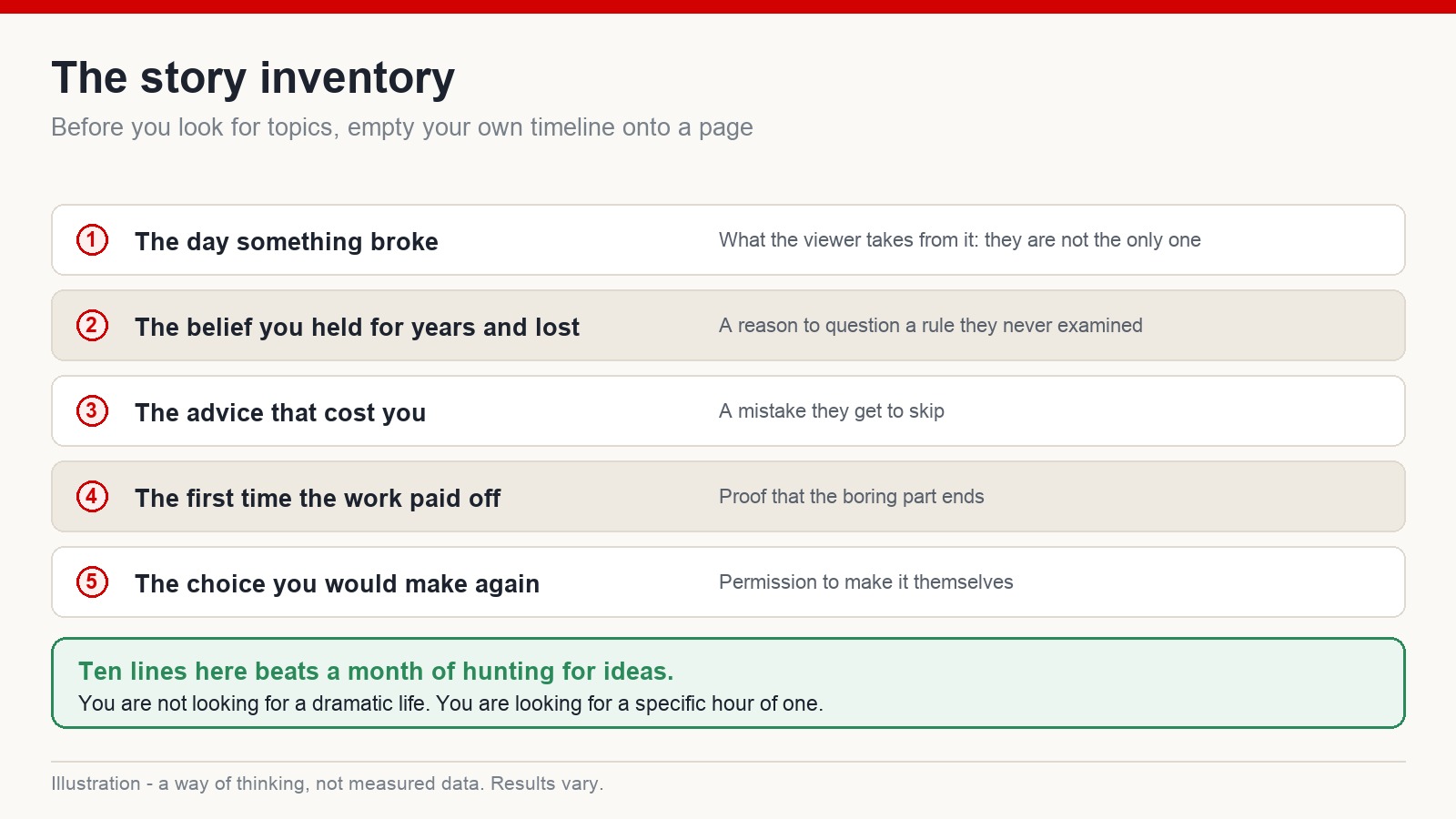
Five prompts do most of the work:
- The day something broke. A job, a plan, a relationship with a piece of work. What a viewer takes from it: they are not the only one.
- The belief you held for years and lost. This gives someone a reason to question a rule they have never examined.
- The advice that cost you. A mistake they now get to skip.
- The first time the work paid off. Proof that the boring stretch has an end.
- The choice you would make again. Permission to make it themselves.
Write ten lines under those headings and you will have more usable ideas than a month of scrolling through trending pages. And notice what you are actually looking for. Not a dramatic life. A specific hour of one.
The inventory has a second job, too. It is your defence against running dry in month four, which is when most channels stop. Ideas that come from a trend expire with the trend. Ideas that come from your own timeline do not.
Step 2: Pick one viewer, not a topic
Here is where most beginner channels quietly break. They pick a subject — cooking, fitness, money, productivity — and then wonder why nothing lands. A subject is not a person, and the algorithm distributes to people.
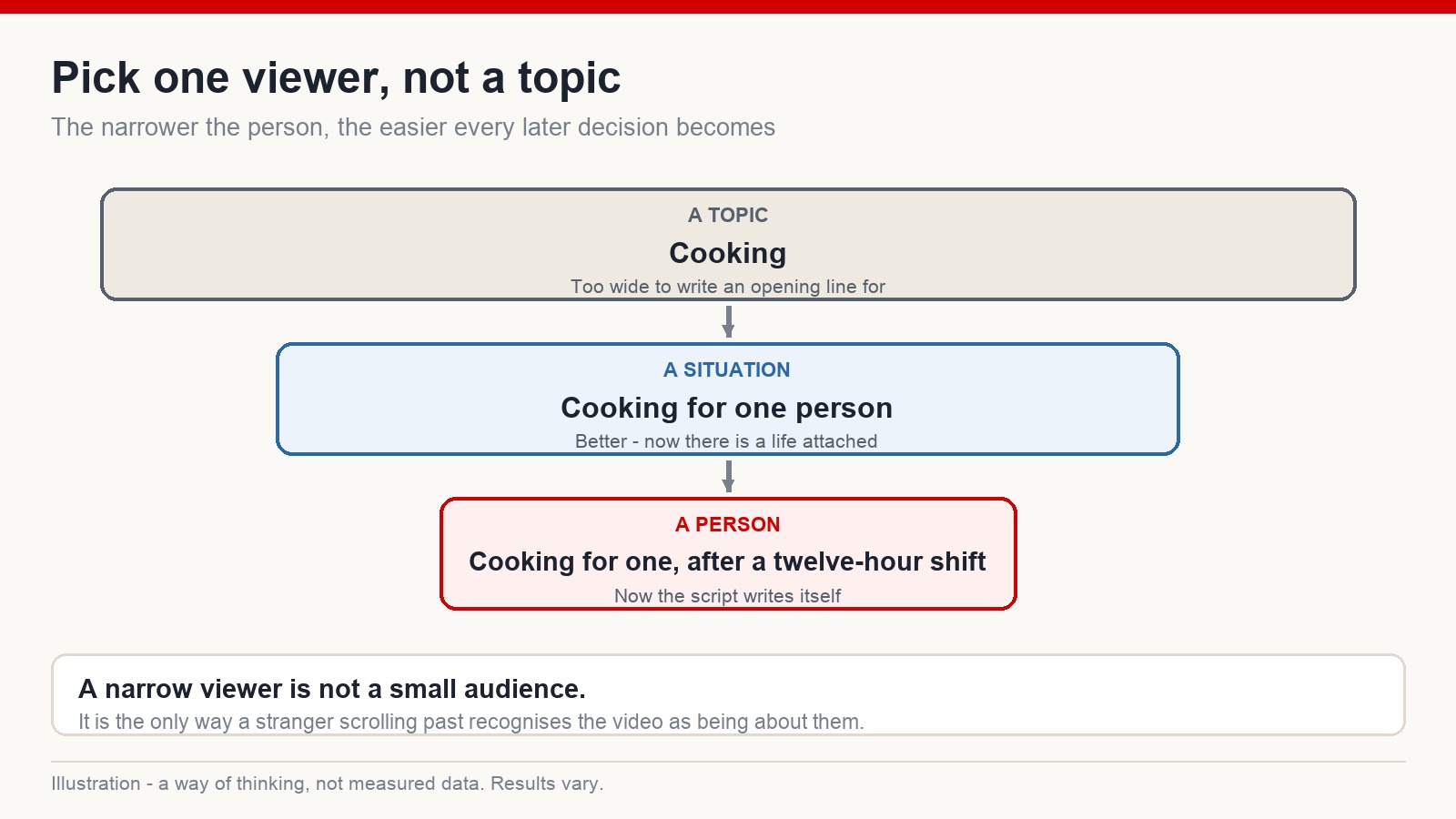
Watch what happens as you narrow:
- Cooking — too wide to write an opening line for.
- Cooking for one person — better, because now there is a life attached.
- Cooking for one, after a twelve-hour shift — now the script writes itself, and so does the title, the thumbnail and the decision about what to cut.
A narrow viewer is not a small audience. There are a lot of people finishing long shifts. Narrowness is simply the only way a stranger scrolling past recognises the video as being addressed to them rather than to everyone, which is the same as nobody.
Write your viewer down in one sentence and keep it above your desk. Every future argument you have with yourself — should this section stay, is this joke worth it, is this title too plain — gets settled by that sentence.
Step 3: Give every story the same five-beat shape
Storytelling sounds like a talent. In practice, for this kind of channel, it is a shape you reuse until it becomes automatic:
- Situation. Where you were, in concrete detail. One room, one moment, no summary.
- Break. The thing that stopped working, and the exact moment you noticed.
- Decision. What you chose, including the option you rejected. This is the beat beginners skip, and it is the one that carries the viewer.
- Cost. What it actually took. Time, money you did not have, evenings, being wrong in public.
- Change. What is different now, described honestly and without inflation.
If a story has no cost beat, it will not hold anybody, and you should feel free to drop it. And if the change beat is bigger than what really happened, cut it back. Viewers forgive small outcomes. They do not forgive a story that quietly gets better than the truth, and they can smell it long before they can explain it.
Step 4: Shoot it on the phone you already carry
A modern phone records a better picture than the cameras a lot of successful channels were built on. Free editors handle cuts, text, music and captions. If you are going faceless, the same is true with a screen recording, stock footage or simple motion graphics over a voice track.
The two things worth caring about at the start are both cheap. Sound, because people will tolerate an average picture and will not tolerate an unpleasant voice track — record in a room with soft furniture, keep the microphone close, and do not film beside a window facing traffic. And the first thirty seconds, because that is where the viewer decides.
Do not open with a greeting and a summary of your channel. Open at the moment of the break. “The invoice came back rejected for the third time” is an opening. “Hi everyone, welcome back to the channel, today I want to talk about invoices” is a door closing.
Step 5: Package the promise, not the plot
The thumbnail is not a summary of the video. It is a promise of one feeling, and it has about a second to make it.
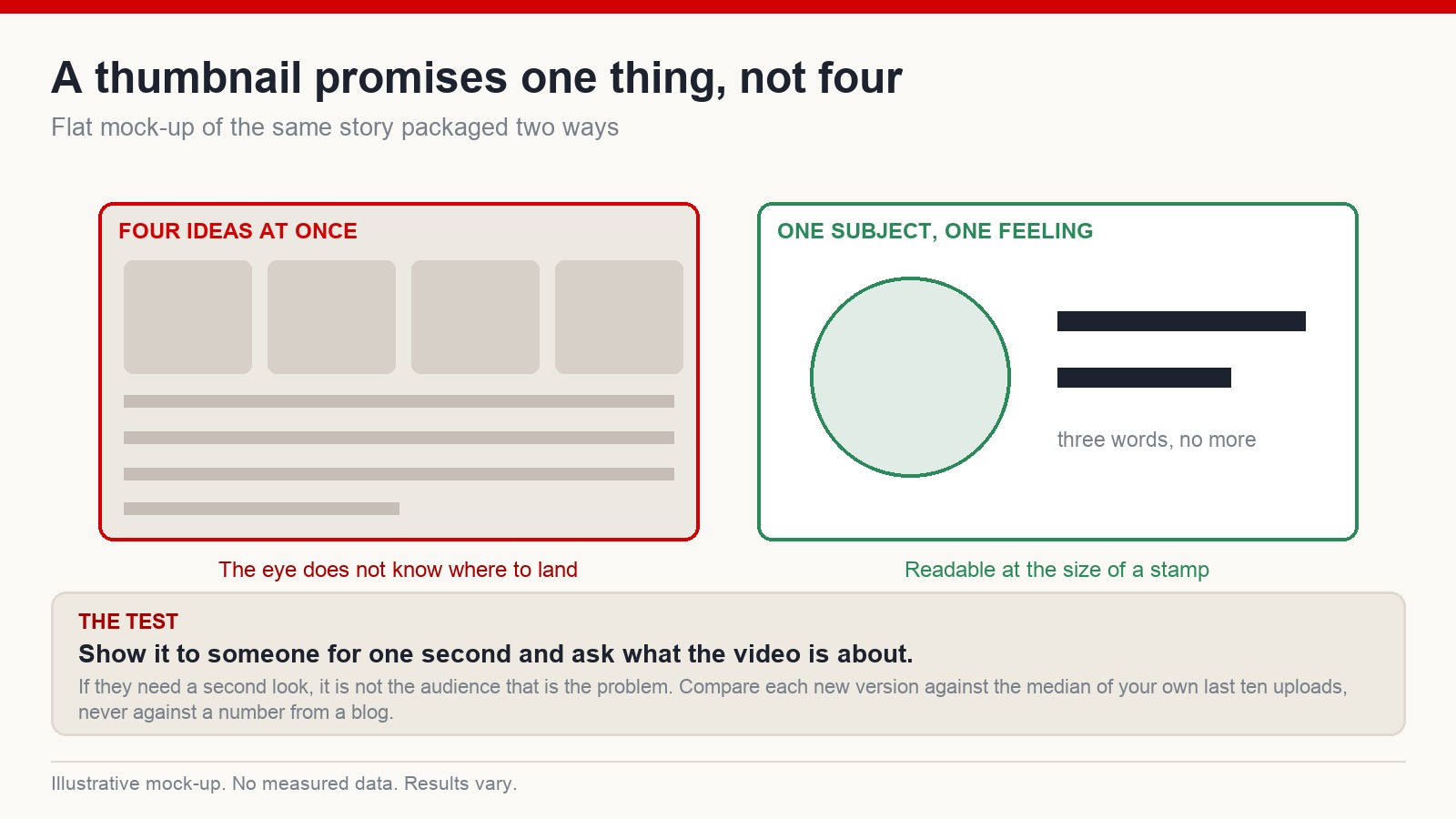
Beginner thumbnails try to carry four ideas: a subject, a location, a result and a full sentence of text. The eye does not know where to land, so it lands somewhere else. One subject, one feeling and no more than three words of text will beat it almost every time, mostly because it survives being shrunk to the size of a stamp on a phone screen.
The test costs nothing. Show it to somebody for one second and ask what the video is about. If they need a second look, the packaging is the problem, not the audience.
And when you compare versions, compare them against the median of your own last ten uploads. Not against a click-through number you read on a blog. Those numbers come from other niches, other countries and other years, and held up against them a perfectly healthy small channel looks like a failure.
Step 6: Write titles a human would say out loud
Two rules have served me for nine years, and they pull in opposite directions, which is the point.
The title has to be findable. Say what the video actually is, in the words a viewer would type or speak. If the video is about starting with no equipment, the phrase “no equipment” should be in there, not implied by a metaphor.
The title has to be human. Read it aloud. If you would be embarrassed to say it to a friend, it is written for a machine, and machines do not watch videos to the end.
Where the two rules meet you get something plain and specific: a real subject, one concrete detail, no year, no shouting. Leave the year out on purpose — a story-driven video can still be earning attention two years from now, and a date in the title quietly kills it.
The first ten stories are calibration, not a payday
This is the stretch where nearly everyone quits, and it is because they misunderstand what the first ten uploads are for.
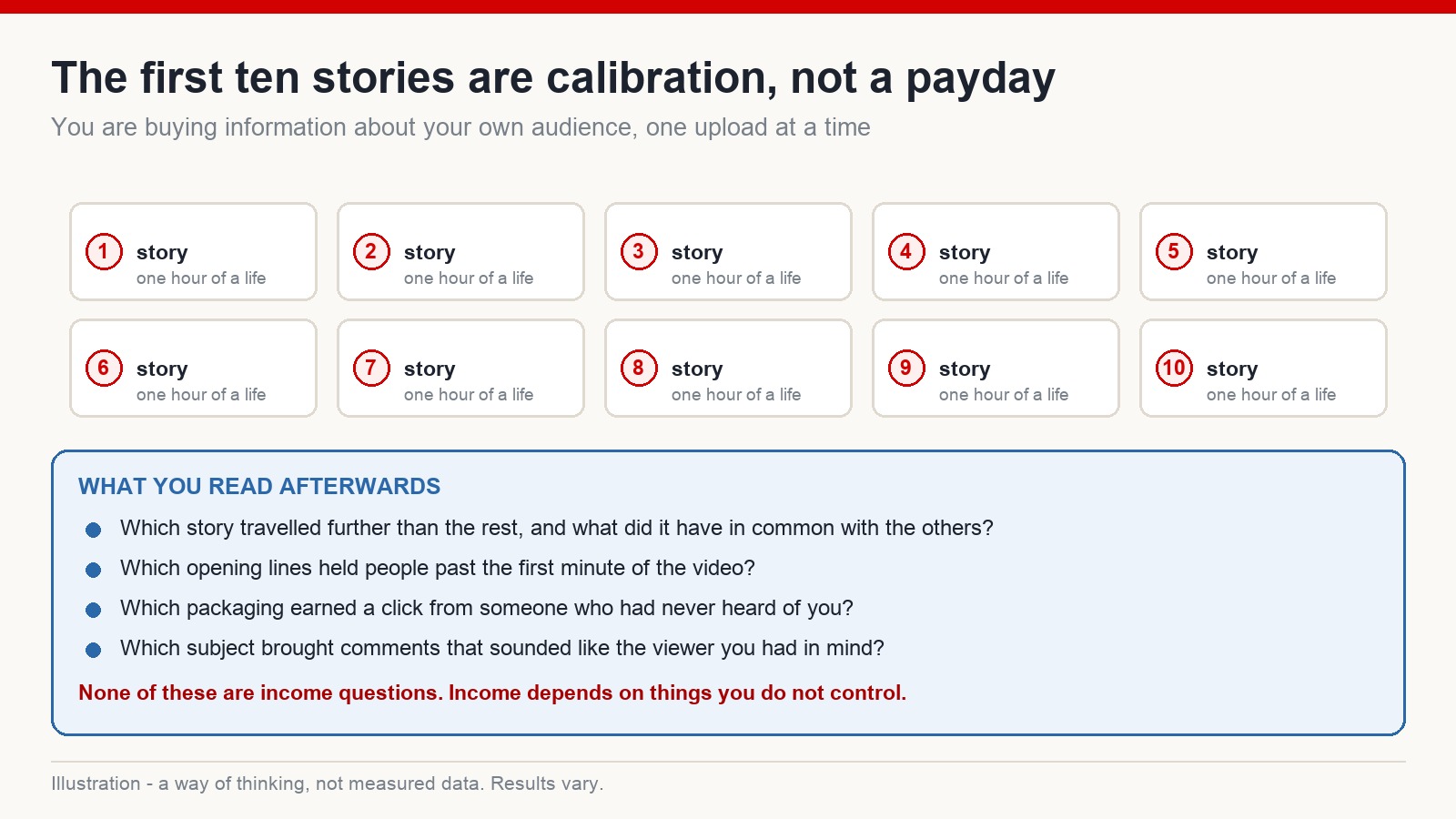
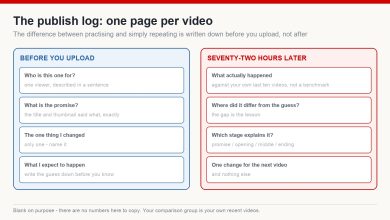
They are not there to earn. They are there to buy information about your own audience that you cannot get any other way. After ten, you can finally read something honest:
- Which story travelled further than the rest, and what did it have in common with the others that did?
- Which opening lines held people past the first minute?
- Which packaging earned a click from someone who had never heard of you?
- Which subject brought comments that sounded like the viewer you wrote down in step two?
None of those are income questions. Ten videos is not a business result; it is a first read on a signal. Judge that read, change one thing, and publish again.
What this approach does not promise
It would be easy to end a piece like this with a number. I am not going to, because I do not know your niche, your language market, your consistency or your luck, and neither does anyone who quotes you a figure.
What I can say plainly: platform requirements for monetisation change, recommendation behaviour changes, and outcomes vary enormously between creators doing very similar work. Plenty of people follow a sensible process for a year and stay small. Some find a subject that travels in month three. Treat any specific income claim you read — including in videos about this exact topic — as marketing until proven otherwise.
What a process protects you from is not failure. It is the far more common ending, where you quit at video seven because you had no way of telling the difference between a bad idea and an idea that had simply not been given enough data yet.
Why story-driven video is worth the effort anyway
A video is a strange kind of asset. You make it once. If the subject is not tied to a news cycle, it can keep finding new people for years, while you are asleep, doing something else, or making the next one.
That is the real argument for building this from your own life rather than from whatever is trending. Trend videos have a shelf life measured in weeks. A well-told account of something that actually happened to a person — a decision, a cost, a change — has the same shelf life as the problem it describes, and most human problems do not expire.
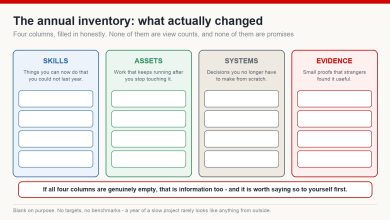
You also end up with things that are harder to see than views: a skill you can rent out, a body of work that argues for you, an audience that arrived because of something true rather than something clever. None of it is guaranteed. All of it is unavailable to the person still waiting for a better camera.
Frequently asked questions
Can I really start a YouTube channel with only a phone?
Yes. A current phone plus a free editor covers filming, cutting, captions and music. Spend your first upgrade money on sound rather than picture, because viewers abandon bad audio far faster than they abandon an average image.
What if my life is not interesting enough for a storytelling channel?
Interesting is not the standard — specific is. Nobody needs a dramatic biography; they need one hour of a life described in concrete detail, with a real decision and a real cost in it. Do the story inventory before you conclude you have nothing.
How do I choose a niche if I have several stories from different areas?
Choose the viewer rather than the subject. If the same person would plausibly watch all of your stories, you already have a niche even when the topics look unrelated. If they would not, pick the viewer whose problem you understand best and park the rest.
How many videos should I publish before deciding whether this is working?
Ten, published at a pace you can hold in a bad week rather than a good one. Fewer than that and you are reading noise; changing everything after three uploads is the most common way beginners destroy their own evidence.
Does using a personal story mean I have to show my face?
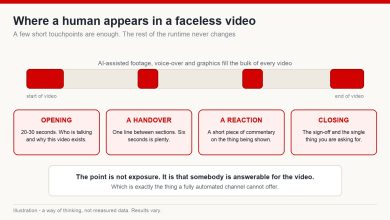
No. Most of the channels I build are faceless. A voice track over stock footage, screen recordings or simple graphics carries a first-person story perfectly well, and it lets you tell true things you would not be comfortable telling on camera.
If you want a structured way to build a story-driven channel for an English-speaking audience, that is what I teach at mmoyoutube.com.