Ten Faceless YouTube Niches That Work for Beginners (and How to Narrow One Down)
After nine years of making YouTube channels, one pattern has held up better than any other: most people who fail do not fail at editing, and they do not fail for lack of tools. They fail because they picked the wrong niche before they made anything.
I have watched creators publish fifty videos and stay flat — nothing reaching recommendations, retention weak, the channel never quite qualifying for monetisation. I have also watched someone change nothing except the niche and start seeing real traction within a few months.
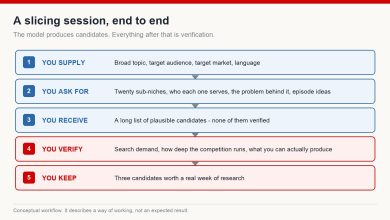
So if you are planning a faceless channel for an English-speaking audience, the niche decision outranks your editing skill. Below are ten that suit a beginner, and then the part that matters more than the list: how to narrow whichever one you pick.
Why faceless channels became viable
The production stack collapsed
Every stage of making a video now has a category of tool sitting under it: research, scripting, narration, visuals, assembly. One person can run the whole line without a camera, a studio or any on-screen presence.
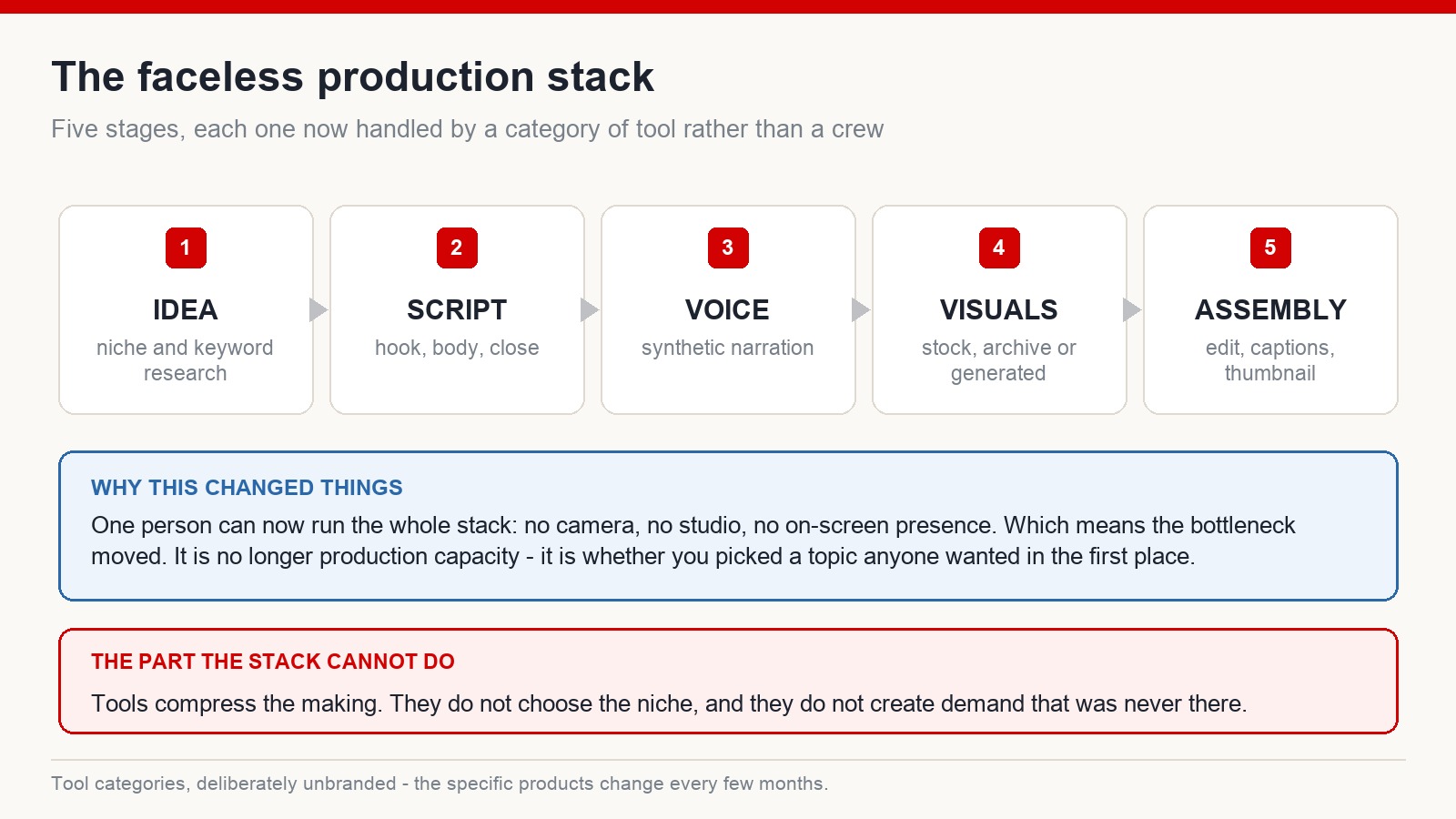
Which means the bottleneck moved. It is no longer production capacity. It is whether anyone wanted the topic in the first place.
Short-form pushes distribution hard
A lot of faceless channels now build their first audience through Shorts, particularly with strong openings and content that holds attention to the end. When that works, browse and suggested traffic follow.
Viewers care about the content, not the presenter
The old assumption was that a creator had to be a face. That is no longer true in most informational and entertainment formats. If the video is genuinely engaging and holds people, a faceless channel scales perfectly well.
Ten niches worth considering
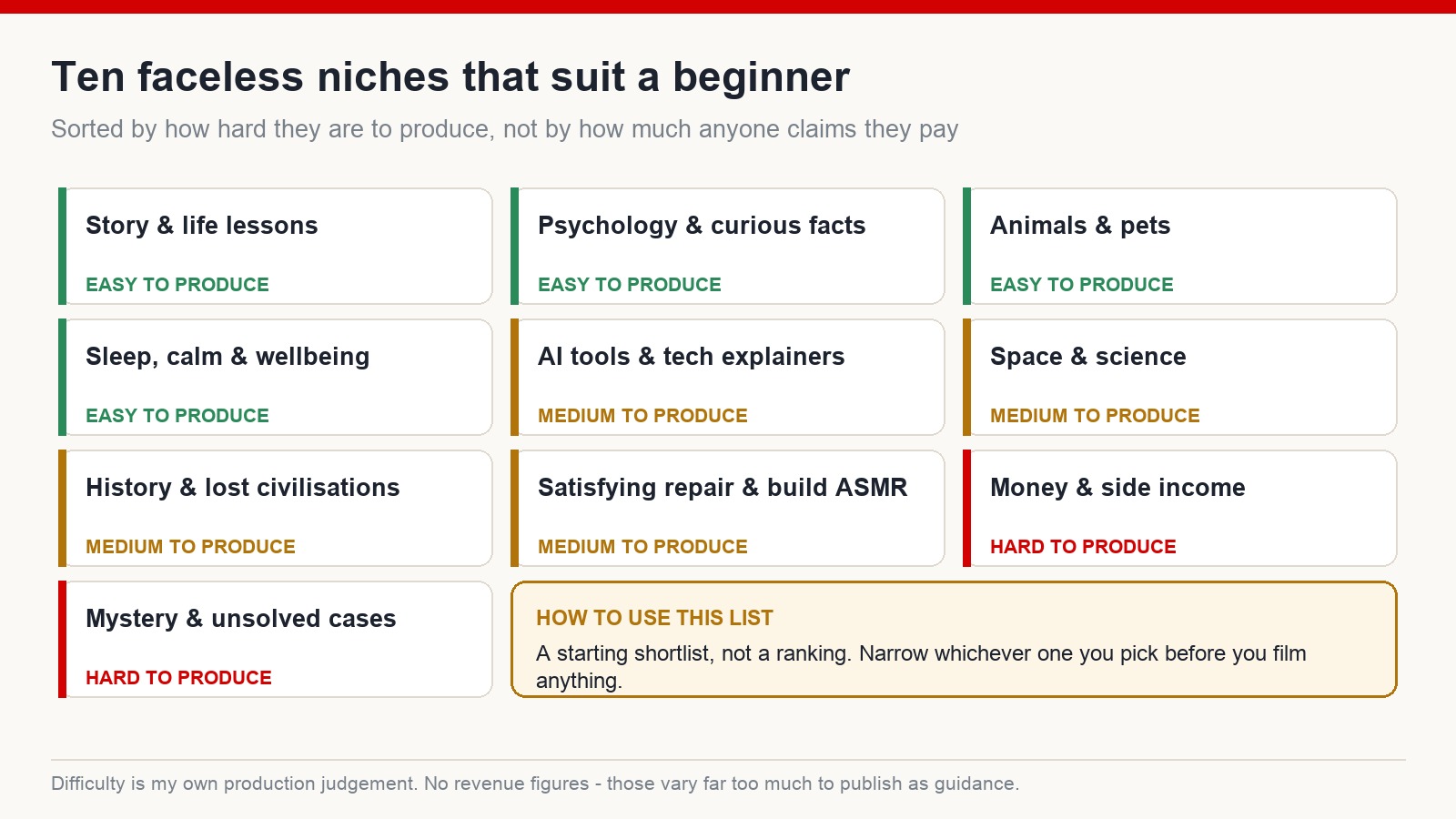
1. Story and life lessons
The easiest entry point I know of. Short meaningful stories, hard-won lessons, journeys through difficulty, quiet philosophy. The format that performs best right now is a short story with a genuine turn at the end.
It works because it runs on empathy and curiosity, and because it does not expire. A good story video can keep pulling views for years.
2. Psychology and curious facts
The “I have to know” category. Why do people gravitate towards conflict? Why do we remember the person who hurt us? Why does the brain enjoy aimless scrolling? Click-through tends to be strong when the thumbnail is doing its job, it adapts easily to short form, and the audience is enormous.
One warning: do not lift foreign-language content wholesale and republish it. Change the angle, add your own narrative, package it differently. Reused content is exactly what gets a channel excluded from monetisation.
3. Money and side income
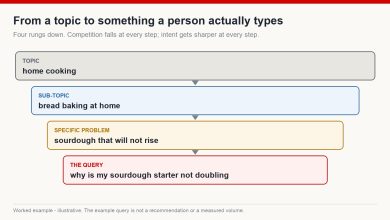
Advertiser interest here is among the strongest of any category, which is precisely why the competition is brutal. A beginner should not attempt “make money online” as a whole. Go one level down: automation tools for a specific profession, digital products for a specific craft, a specific free tool used properly.
Treat this one carefully. Anything touching people’s finances deserves accuracy, sourcing and an absence of promises.
4. Animals and pets
Consistently underrated. Cats, dogs, monkeys, ducks, small pets — the audiences are loyal and the emotional pull is immediate. You can work with licensed stock footage, animation, or your own creative treatment of compiled material. It suits short form especially well.
5. Sleep, calm and wellbeing
Rising steadily. Sleep, stress, recovery, gentle movement, longevity — all with real search volume behind them.
A caution that belongs here: this category touches people’s health directly. Stay close to reputable sources, avoid medical advice you are not qualified to give, and never promise that anything cures anything. Honest content is also the only kind that survives long term in this niche.
6. History
Suits generated and archival visuals extremely well. Conflicts, ancient empires, historical mysteries, the lives of significant figures. Get the storytelling right and watch time in this niche is exceptional.
7. Space and science
Entertainment and learning in one package. The visuals can be genuinely cinematic, retention holds, the audience is global, and almost nothing about it dates.
8. Satisfying repair and construction
Sounds impossibly narrow, performs surprisingly well. Road repairs, tiling, miniature builds, before and after. The appeal sits in the sound and the sense of completion, and people rewatch it.
9. AI tools and technology
Growing fast on the back of the whole AI wave. New tools, practical walkthroughs, useful sites, automation tips. Advertiser interest is solid, affiliate revenue is straightforward, and a community forms easily around it.
10. Mystery and unsolved cases
Strong click-through, long watch time, and a natural fit for faceless production. It does need discipline: stay away from the sensational end of the spectrum and anything likely to run into community guidelines.
The part that decides everything: how you narrow it
The list above is a shortlist, not a strategy. What you do next is what matters.
Do not build anything this broad
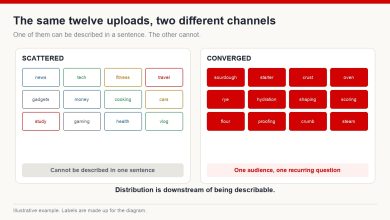
“I will make a motivation channel” is not a niche. It is a category with hundreds of thousands of entrants.
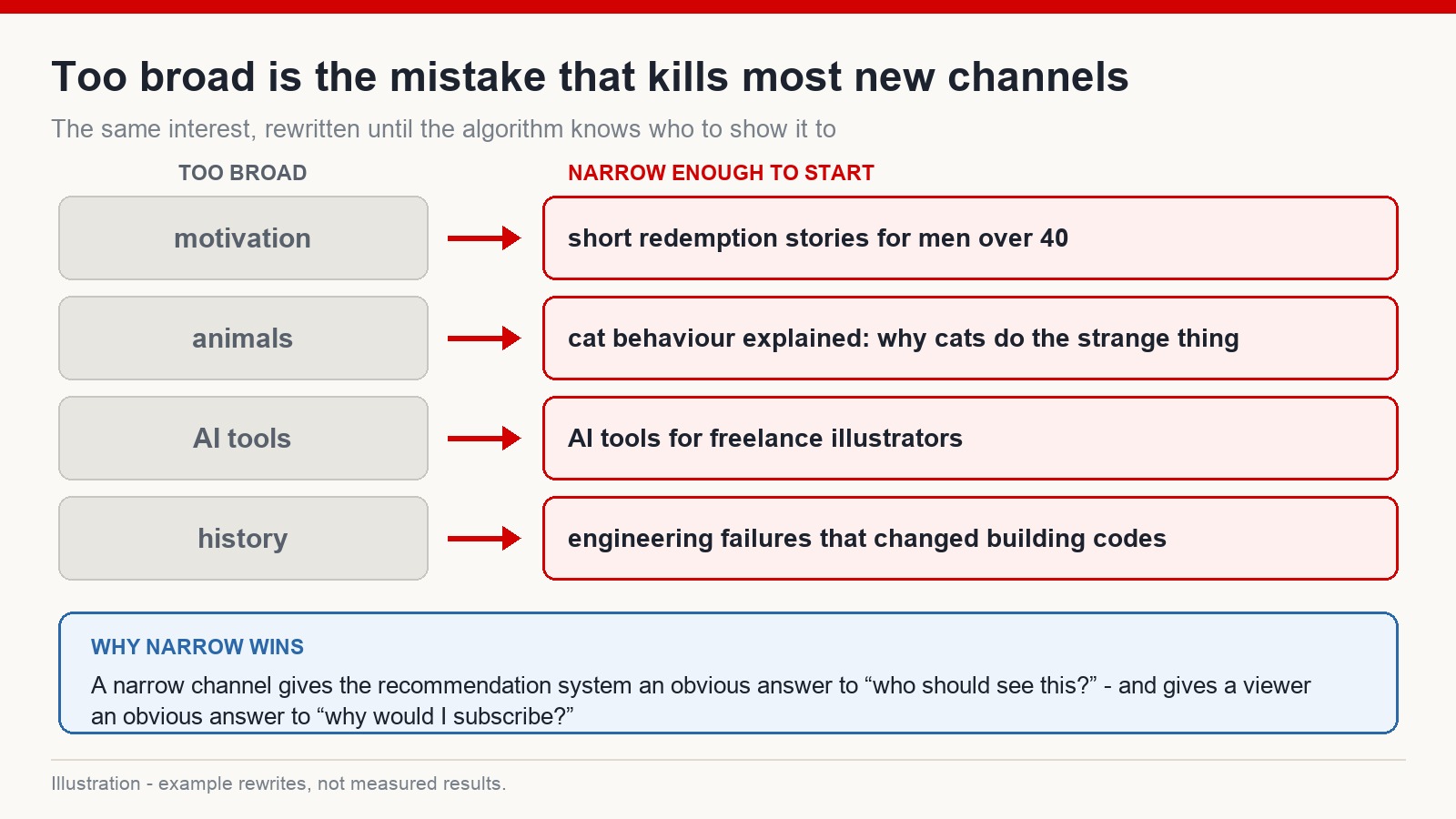
A narrow channel gives the recommendation system an obvious answer to “who should see this?” and gives a viewer an obvious answer to “why would I subscribe?” Those two answers are worth more than any editing trick.
Look for a small channel that is already winning
This is the check I run before committing to anything. Find a channel with few subscribers, opened recently, whose recent videos are clearly outperforming its size. That is evidence the niche still has room for a newcomer.
A giant channel proves the demand exists. It proves nothing about whether you can enter. The small one is the useful signal.
Learn the packaging, do not copy it
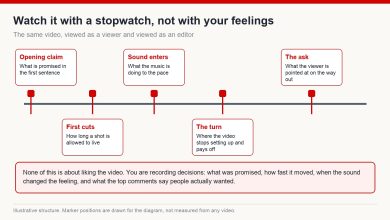
Study hooks, thumbnails, pacing and story structure, then build your own version. Detection of near-duplicate content is considerably better than it used to be, and rebuilt copies are not a durable strategy.
Understand why market choice affects revenue
Advertising rates vary enormously between markets. Audiences in high-rate markets such as the United States, the United Kingdom, Germany and Japan generally attract higher revenue per thousand views than low-rate markets do — which is why so many creators outside those countries build English-language channels using synthetic narration.
That is a structural difference in advertising, not a promise about income. What you actually earn depends on the niche, the audience, the season and the quality of your work.
What to do this week
- Pick one niche from the list — the one you can plausibly produce every week.
- Narrow it until it names a specific audience and a specific recurring question.
- Find three competitors in that narrow version, including at least one small and recent channel.
- Write down the repeating format they all use.
- Make your first video with a better hook and a clearer script than theirs.
Where this leaves you
Faceless YouTube is no longer a passing trend. It has settled into a genuine model for building a content business. But the niche decides most of the speed of that business.
Choose well and everything downstream gets easier: videos travel further, retention improves, advertiser interest is better, and the model is straightforward to scale. Choose badly and no amount of effort compounds.
So do not try to do everything. Pick one narrow niche, test the format, sharpen the hook, work on retention, and scale what is already working. YouTube rewards understanding an audience far more reliably than it rewards volume. Outcomes still vary, and platform policies change — treat any plan as something you revise rather than something guaranteed.
If you would rather work through this as a guided programme than piece it together alone, that is what I run at mmoyoutube.com.
Frequently asked questions
Which niche should a complete beginner start with?
Storytelling, psychology and AI tools are usually the easiest three to begin with, because sourcing material and writing scripts for them is manageable from week one.
Can a faceless channel be monetised?
Yes, provided the content is genuinely valuable, is not reused from elsewhere, and shows real creative work. Those are the general requirements, not a guarantee — approval depends on the channel, the niche and the platform’s current policies.
Does YouTube ban AI-generated video?
No. The platform does not prohibit AI in production. It does expect the result to be original and useful, and disclosure rules apply to realistic synthetic content.
Which niches attract the most advertiser spend?
Finance, business and technology generally attract the highest advertiser interest. That does not automatically make them the best choice for a beginner, since they are also the hardest to produce credibly and the most competitive.
Do I need to speak English to build for an English-speaking audience?
Not necessarily. Synthetic narration handles the voice. Your script still has to read naturally, so budget time for the writing rather than assuming the tool solves it.
How narrow is narrow enough?
Narrow enough that you can name the viewer and the recurring question in a single sentence. If you cannot, go one level down and try again.