7 YouTube Hooks That Give a Viewer a Reason to Stay Past the Opening
Most videos do not fail because the content is bad. They fail in the first few seconds, before the content ever gets a chance.
I have watched this happen to videos I was proud of: careful editing, a real argument, hours in the script — and the retention graph still falls off a cliff before the half-minute mark. The audience did not reject the video. They never got far enough in to have an opinion about it.
What follows are seven YouTube video hook patterns I use on faceless channels for English-speaking audiences, with example lines written the way I would actually record them. I have been making YouTube videos since 2017, and the opening is the part of the process I rewrite most often.
Why the first thirty seconds decide everything after them
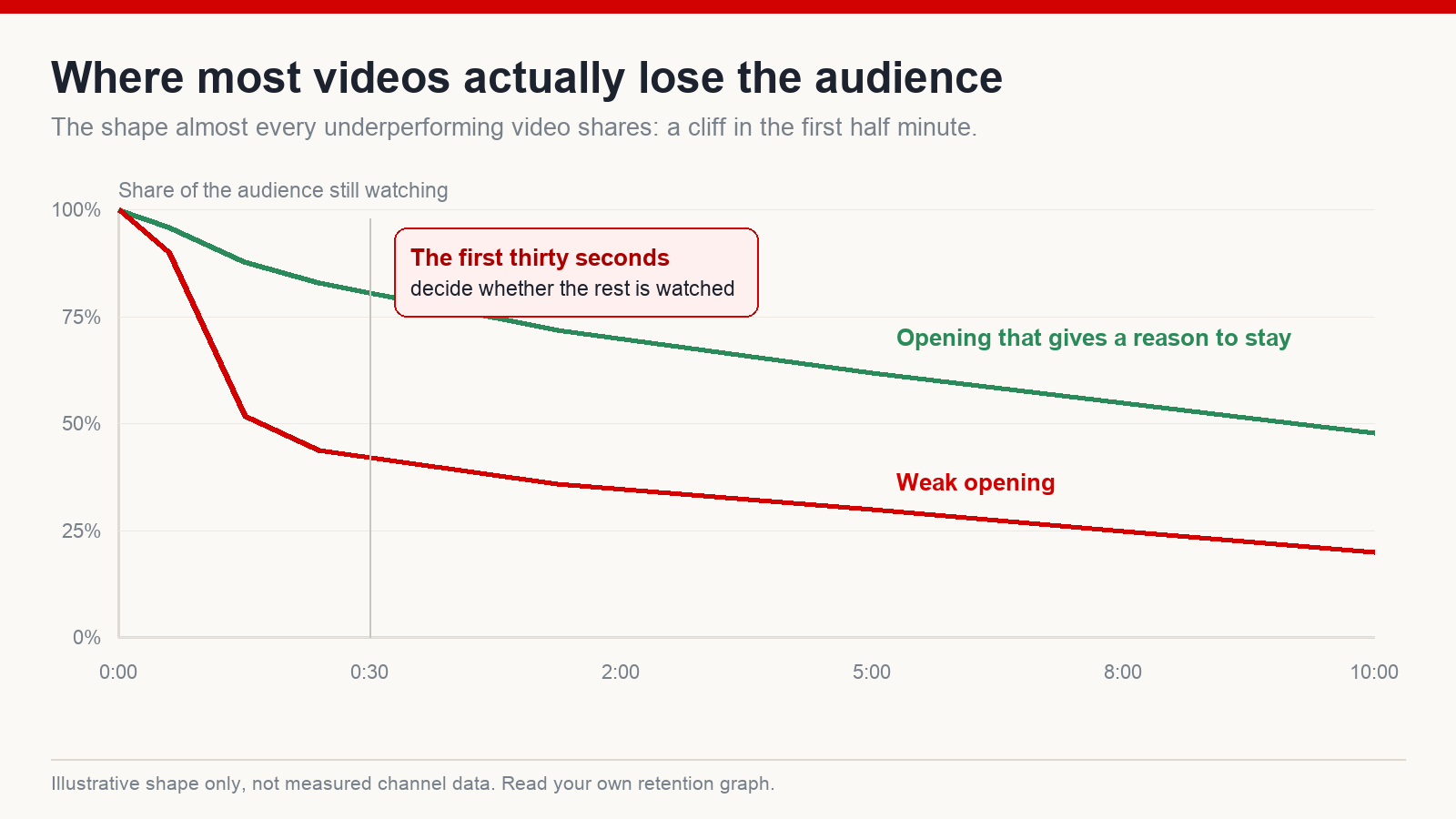
The platform tests a video on a small audience before it commits to anything. What it is watching is simple: did people click, did they stay, did they leave early. Only when a video holds its first viewers does distribution keep opening up.
So the opening is not the introduction to your video. It is the reason a stranger does not leave. If your analytics show a steep drop in the first half minute while impressions plateau, the script’s opening is where I would look first — before SEO, before thumbnails, before anything about the algorithm.
1. The pain point
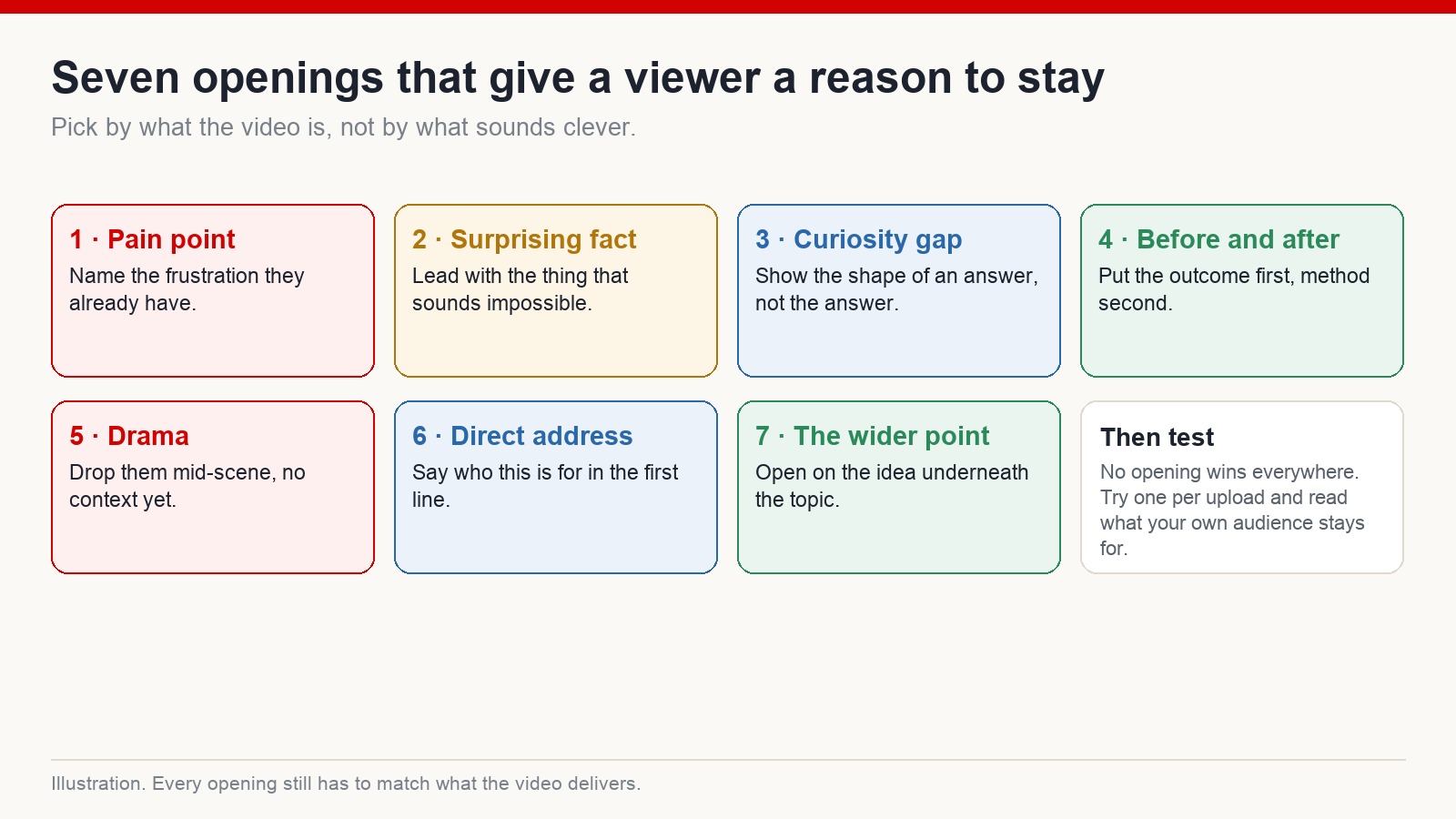
Name the frustration the viewer already has, in their words, before you offer anything.
“You have been uploading on schedule for months and the numbers have not moved. I know exactly what that feels like, and I know what was causing it on my channel.”
It works because being understood is disarming. The viewer stops evaluating you and starts listening. Strongest for skills, software, business and self-improvement subjects.
2. The surprising fact
People stop for things that sound impossible. Lead with the anomaly, not the context.
“This channel has not uploaded in over a year and it is still one of the most-watched things in its category. I went looking for why.”
One rule, and it is not optional: the surprise has to be true and checkable. If you open with a number you cannot support, the audience leaves the moment they realise, retention collapses, and the video gets treated as bait. Use your own verified figures or none at all.
3. The curiosity gap
The most-used opening on the platform, and still the most reliable. Show the shape of an answer without giving the answer.
“There is one thing almost every channel in this niche does in the first ten seconds, and it is quietly costing them their audience.”
Human attention is very bad at leaving an unfinished thought alone. Open the gap, then keep it open long enough to matter — and close it before the video ends, or you have written bait rather than a hook.
4. Before and after
Show the outcome first and the method second. Viewers do not commit to a process; they commit to a result they want.
“This is what my retention graph looked like before I changed how I write openings. This is what it looks like now. Here is everything I changed.”
Powerful for tutorials, transformations and tool demonstrations. It only works with something you can genuinely show, so if you have no before, do not invent one.
5. Drama
Drop the viewer into the middle of a scene with no setup at all.
“He had about thirty seconds before the water reached the engine, and no way to reach the door.”
Made for documentary, wildlife, survival, mystery and story formats. One thing matters more than the writing here: say it, show it. If the narration describes a chase and the screen holds a still landscape, the tension evaporates instantly. A frozen frame during a dramatic line is one of the fastest ways to lose people, and it is worse on Shorts than anywhere else.
6. Direct address
Say who the video is for in the first line. You will lose some viewers immediately, which is the point — the ones who stay are the ones the video was built for.
“If you are running a faceless channel and you have never looked at your own retention graph, this one is for you.”
It sharpens the audience rather than the click. Fewer people start the video, more of them finish it, and more of them subscribe.
7. The wider point
Open on the idea underneath the topic instead of the topic. Slower, and remarkably sticky when the subject deserves it.
“We treat failure as the end of an attempt. It is usually the first honest piece of information you have been given.”
Suited to motivational, essay, podcast and long-form storytelling. The viewer stops watching a video and starts listening to a person.
The three-part opening
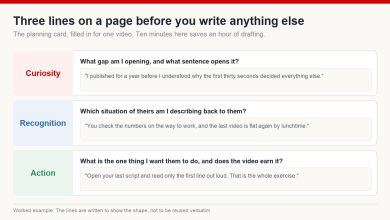
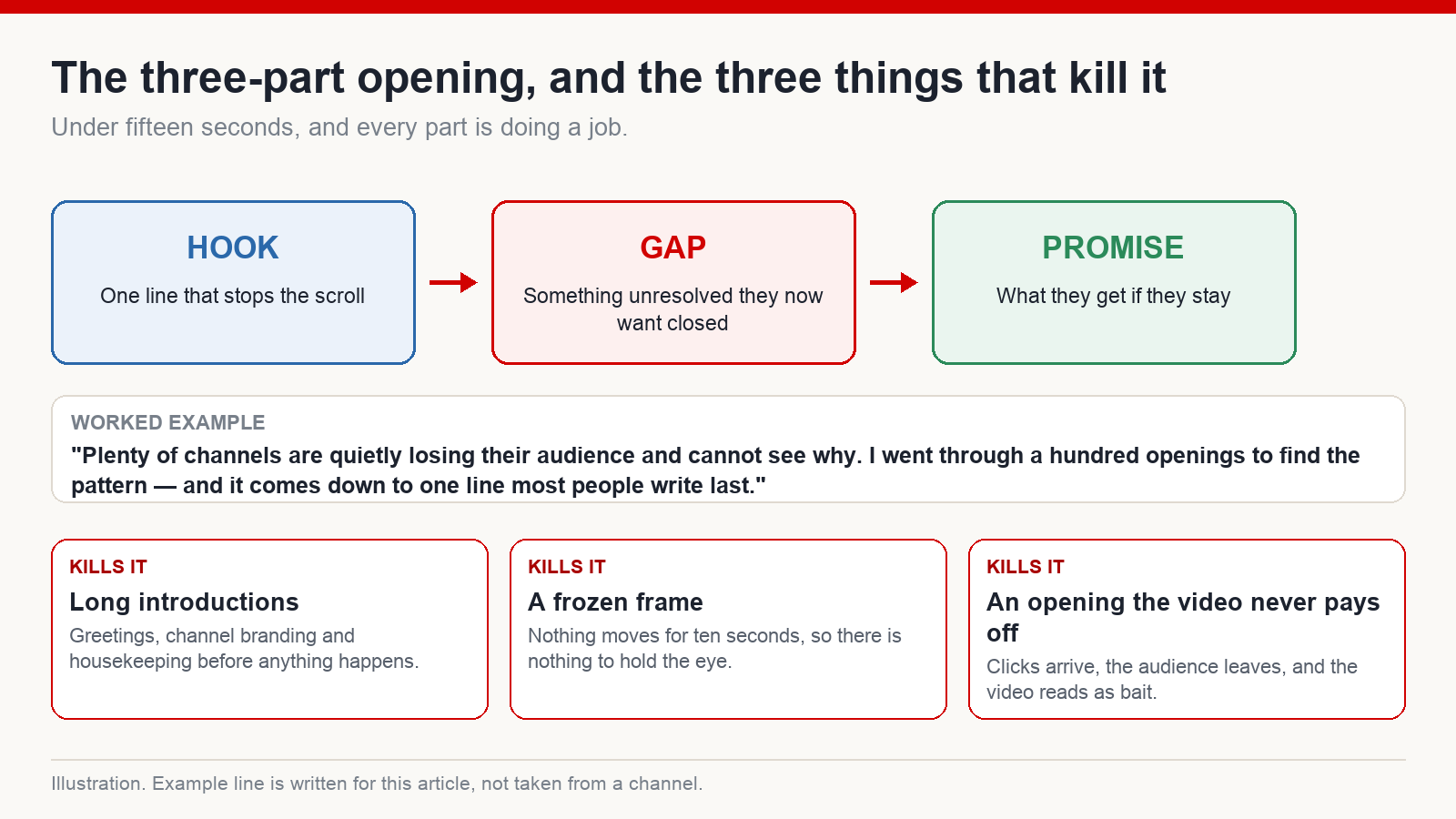
Most openings I keep have the same three moving parts, all inside about fifteen seconds:
- Hook — one line that stops the scroll.
- Gap — something unresolved the viewer now wants closed.
- Promise — what they get if they stay.
Written out, it sounds like this:
“Plenty of channels are quietly losing their audience and cannot see why. I went through a hundred openings looking for the pattern — and it comes down to one line most people write last.”
A checklist for the opening
- The hook lands in the first three to five seconds.
- No greeting, no channel branding, no housekeeping.
- One emotion is clearly identifiable.
- Something is moving on screen the whole time.
- There is a gap the viewer wants closed.
- It is obvious who the video is for.
- The video actually pays off what the opening promised.
Three things that kill an opening
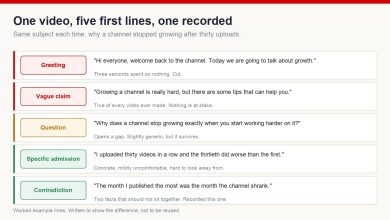
A long introduction. “Hey everyone, welcome back to the channel, before we start” — the audience is already gone. Whatever the video is about should begin in the first sentence.
A static picture. Ten seconds of an unmoving frame while narration explains something is an invitation to leave, particularly on short-form.
An opening the video never pays off. The click rate might look good for a week. Then people arrive, realise the promise is not being kept, and leave — and a video with good clicks and poor watch time is a video the platform stops showing.
How to actually pick one
None of these is the best hook. The right one depends on your subject, your format and what your particular audience responds to, which nobody can tell you in advance.
So test one per upload and compare against your own recent videos rather than against any published benchmark. Try a pain point, then a curiosity gap, then drama, and read your own opening-thirty-seconds curve each time. After ten videos you will know which one your audience stays for, and that answer is worth more than any general rule — including this article.
Frequently asked questions
Is the hook more important than the content?
No. The hook only decides whether anyone stays long enough to find out whether the content is good. Both have to work.
Do Shorts need a hook?
More than anything else. Short-form is decided in the first second or two, and there is no room to build up to a point.
Should I use clickbait to raise the click rate?
Use curiosity, not deception. Clicks that arrive on a false promise leave immediately, and the resulting watch time tells the platform the video is not worth showing.
Which hook type performs best?
There is no fixed answer. Rotate through curiosity, pain point, surprise and story, and let your own retention data decide.
If you want the full process for building a faceless channel for English-speaking audiences, that is what I teach at mmoyoutube.com.