YouTube RPM Optimization: Why Chasing Views Is Costing You Money
There is one belief almost every new creator carries into a faceless channel, and it quietly costs them a year: more views means more money.
It sounds obvious. Then you actually publish. You hit a few hundred thousand views on a video and the revenue line barely moves. Meanwhile another channel in your niche, with far less traffic, is doing fine. Nothing about that feels fair until you understand the number sitting underneath it.
That number is RPM. And it is not just a figure in your YouTube Studio dashboard. It is the honest answer to the only question that matters once monetization is on: what is a thousand views on my channel actually worth?
I have been building YouTube channels since 2017, most of them faceless and aimed at English-speaking, German and Japanese audiences rather than my own home market. Almost everything I got wrong in the early years came down to optimizing for the view counter instead of the value behind it.
RPM vs CPM: two numbers people constantly mix up
RPM stands for Revenue Per Mille – your revenue per 1,000 views, after YouTube has taken its share and after all the messy reality of ad fill, skipped ads and non-monetized playbacks.
CPM is a different animal. That is what an advertiser pays to reach 1,000 ad impressions. It is an input, not your income.
Creators love quoting CPM because it is the bigger, more flattering number. But CPM is the advertiser’s cost. RPM is your paycheck. Only one of them appears in your bank account.
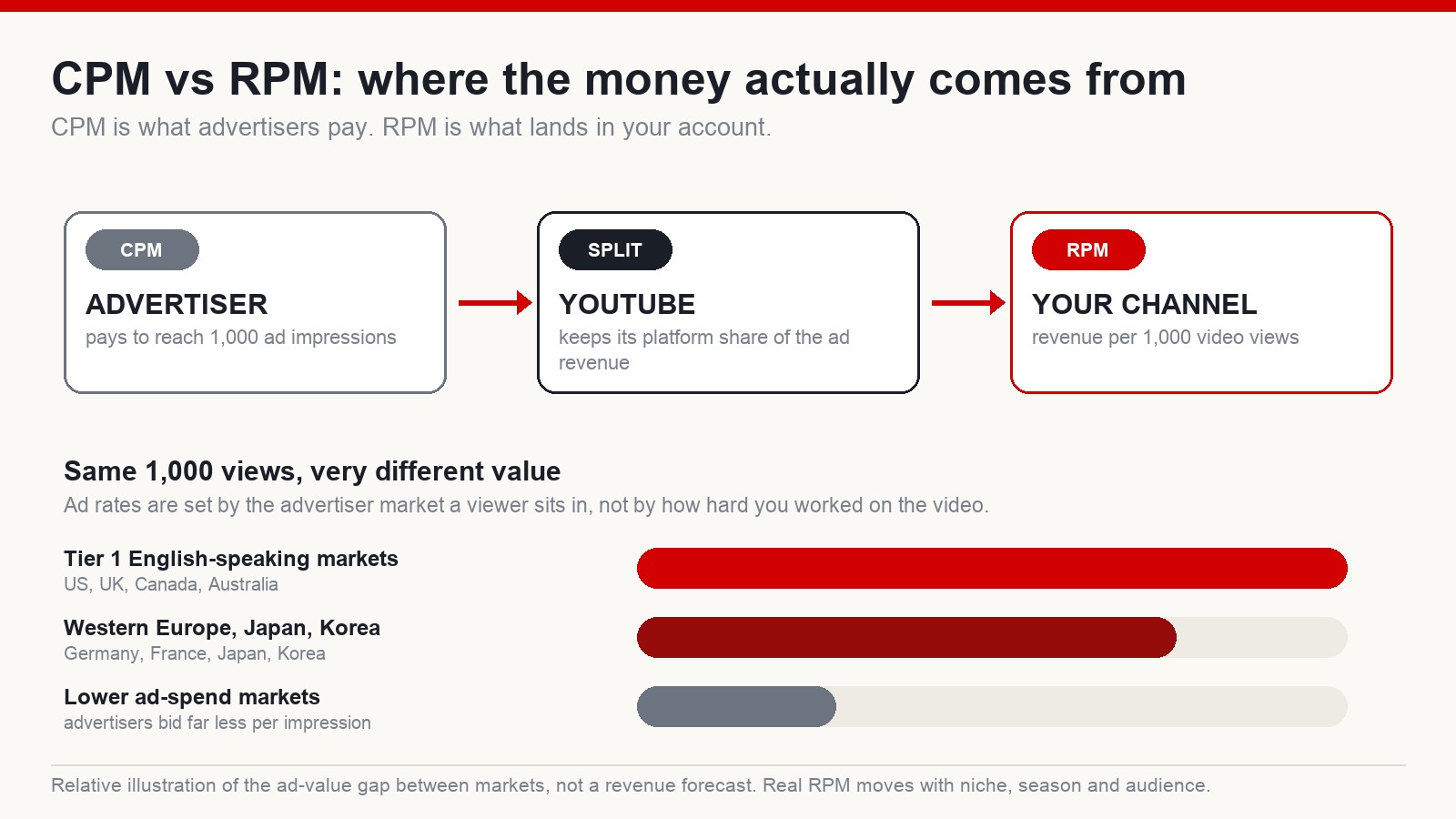
Here is the part that reframes everything: not every view is worth the same. A view is not a unit of currency. It is a person sitting inside an advertising market, and advertising markets are wildly unequal.
Advertisers in the United States, the UK, Canada, Australia, Germany, France, Japan and South Korea bid a lot per impression, because the people watching have the spending power to justify it. In markets where ad budgets are thin, the same 1,000 views can be worth a fraction of that.
This is why creators who have been at it a while keep circling back to the same idea: build for a high ad-value audience from the start, not as an upgrade you attempt later.
Why a big channel can still have a small RPM
I have reviewed a lot of channels where the creator was working genuinely hard. Daily uploads. Loud thumbnails. Aggressive titles. Views climbing.
Then monetization switched on and the numbers were deflating – because the traffic was coming almost entirely from low ad-spend regions. Nothing was broken technically. The audience was simply not the audience advertisers were paying to reach.
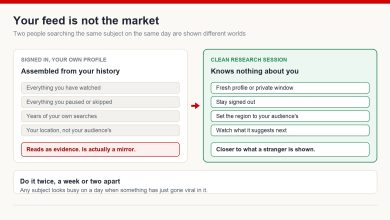
The fix is not to work harder on the same content. It is to answer a question most people skip on day one: who am I making this for?
AI removed the language barrier – it did not remove the research barrier
The good news is that language is no longer the wall it was five years ago. You do not need fluent English, Japanese or German to run a channel aimed at those audiences. AI tools will write and adapt scripts, translate, generate voiceovers, produce captions, tighten titles and help you dig through keyword data in a language you do not speak.
But I want to be blunt about the limit, because a lot of people find it the expensive way: AI is a production tool, not a judgement tool. It will happily help you make the wrong video, faster and in four languages.
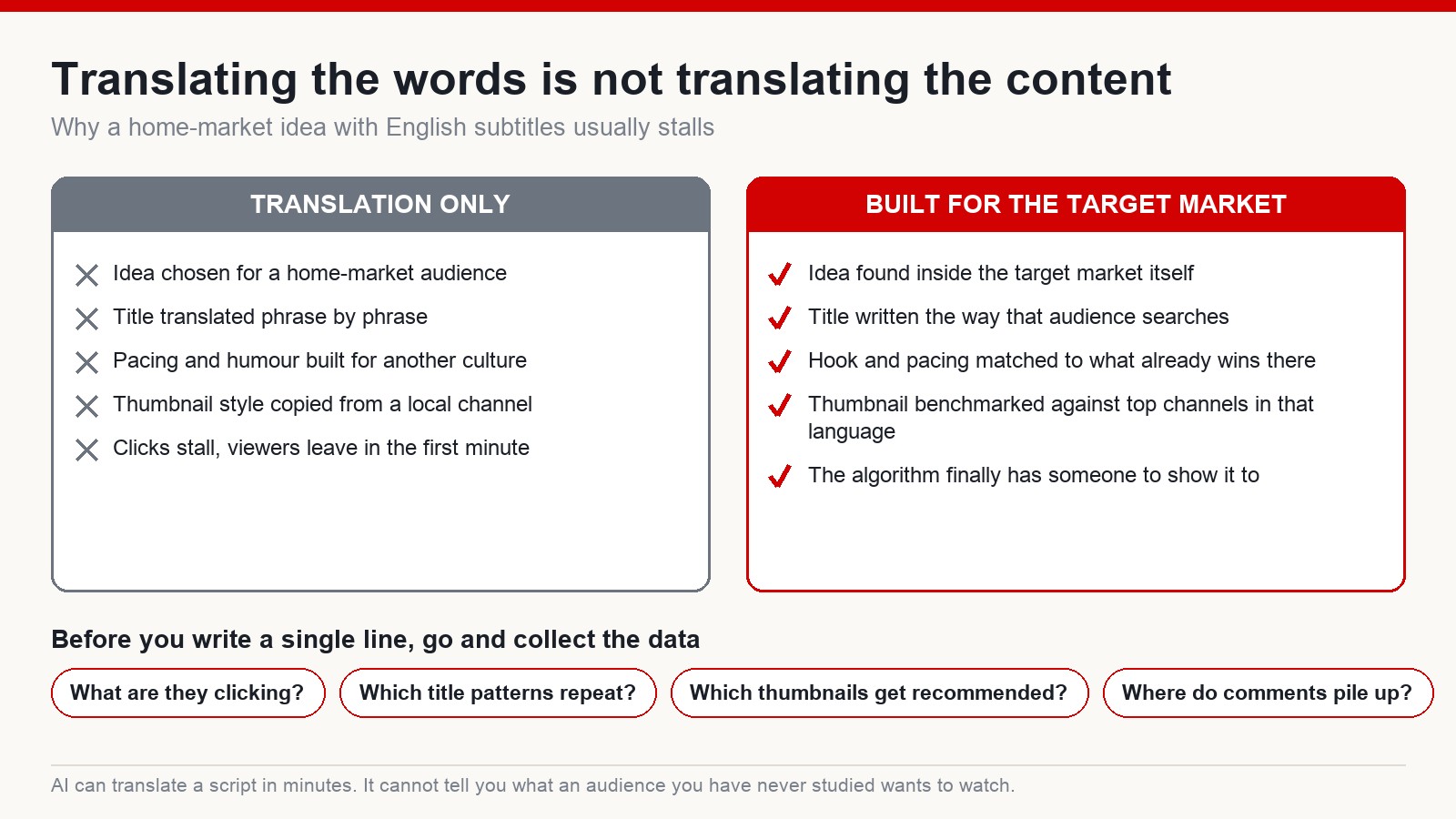
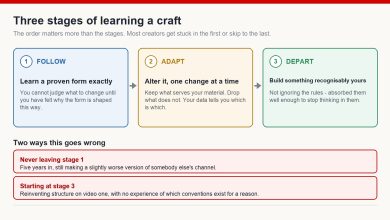
The most common failure I see is what I’d call the translation trap: take an idea that works in your own market, run it through a translator, add an AI voice, publish. It looks efficient. It rarely travels.
Audiences are not interchangeable. American viewers get hooked differently. Japanese viewers tolerate a different pace. German viewers search with different phrasing. Translating the language while leaving the underlying content thinking untouched produces videos that are technically in English and culturally from somewhere else. The algorithm has nobody obvious to recommend them to.
So before writing anything, go and gather actual evidence in the target market:
- What are they clicking on right now?
- Which title structures repeat across the winners?
- Which thumbnail styles keep showing up in recommendations?
- Which videos are pulling unusually heavy comment activity?
- Which topics come back again and again across different channels?
That is data. Everything else is a guess wearing a confident voice.
The number in the title does more work than you think
One pattern holds up remarkably well across English-language niches: specific numbers pull clicks. Five secrets. Seven mistakes. Ten facts. Thirty days. A hundred rare moments.
A number does something a vague title cannot. It sets the scope. The viewer instantly knows the shape of what they are about to receive, and a brain that can picture the payoff is a brain that clicks.
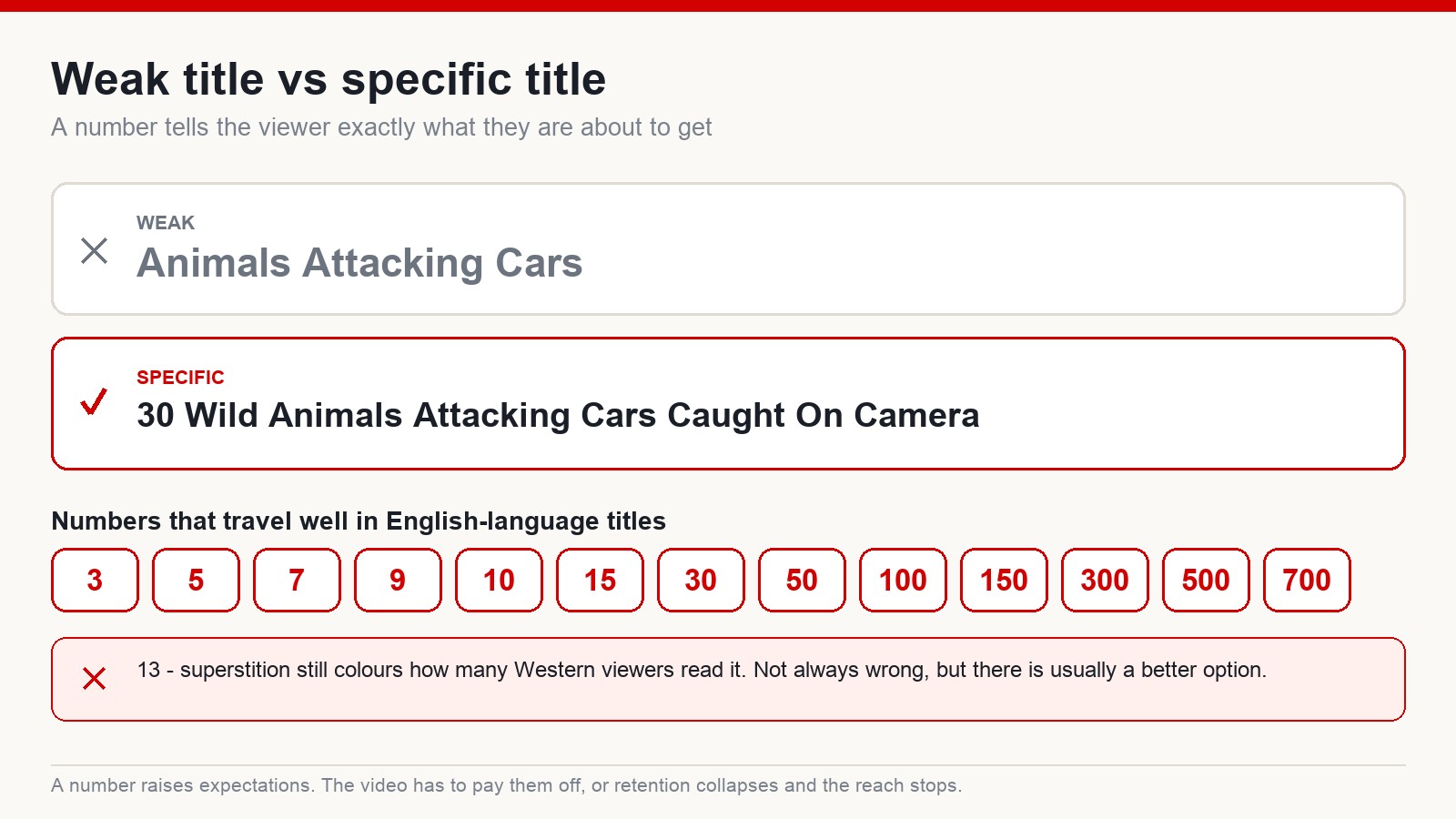
Compare these two:
Animals Attacking Cars
30 Wild Animals Attacking Cars Caught On Camera
Same subject. The second one is concrete, it promises volume, and it plants an image before the viewer has even clicked.
Numbers that tend to read well in English titles: 3, 5, 7, 9, 10, 15, 30, 50, 100, 150, 300, 500, 700. I am generally careful with 13 for Western audiences – superstition still colours how it lands. It is not automatically wrong, but if another number does the same job I will take the other number.
One warning that costs people real reach: a number is a promise. Say ten and deliver four thin points, and retention drops off a cliff. YouTube reads that as a bad recommendation and stops making it.
Two kinds of titles, and the version that beats both
I split titles into two families.
1. The emotional title
Built for feeling and curiosity: Shocking, Most Dangerous, Caught On Camera, You Won’t Believe, Unbelievable Facts. For example: 50 Most Dangerous Animals Caught On Camera.
Paired with a strong thumbnail, this style can move fast. But it lives or dies on what happens after the click. YouTube is not only reading your click-through rate – it is reading whether people stayed. Viewers who bail after ten seconds tell the system your title oversold the video, and distribution stops.
2. The search title
Built around real demand: How to Start a Faceless YouTube Channel in 2026. Less dramatic, far more durable. It picks up search traffic, keeps earning suggested views over months, and gives you genuine evergreen content instead of a spike.
3. The blend
The strongest titles use the keyword as the foundation and layer emotion on top: I Built a Faceless YouTube Channel in 30 Days Using AI. There is a real search term in there, a specific timeframe, a named tool, and the implicit promise that a person actually did this. Search intent plus a reason to care.
Slicing competitor titles into keywords
You cannot optimize RPM by intuition. You need input. The most practical routine I use is to take titles that are already winning in the target market and break them into their component phrases.
Say a video is performing well with: 100 Most Shocking Moments Caught On Camera. Slice it:
- shocking moments
- caught on camera
- most shocking moments
- viral moments caught on camera
- unbelievable moments
- real moments caught on camera
Then run those fragments through a keyword tool – vidIQ, TubeBuddy, Google Trends, whatever you already pay for – and look at search volume and competition side by side.
For a new channel I usually avoid the biggest terms entirely. The zone I aim for sits roughly between 1,000 and 10,000 monthly searches: large enough to matter, small enough that established channels are not automatically crushing you.
Get more specific, not broader. Instead of wild animals, try:
- wild animals attacking cars
- elephant attacks car caught on camera
- dangerous animal encounters in Africa
Narrow terms have less traffic and much better odds of reaching the exact person who wants that video.
The funnel runs backwards from what beginners assume
New creators tend to imagine viewers arriving in this order: topic, then video, then thumbnail. On YouTube it is the reverse.
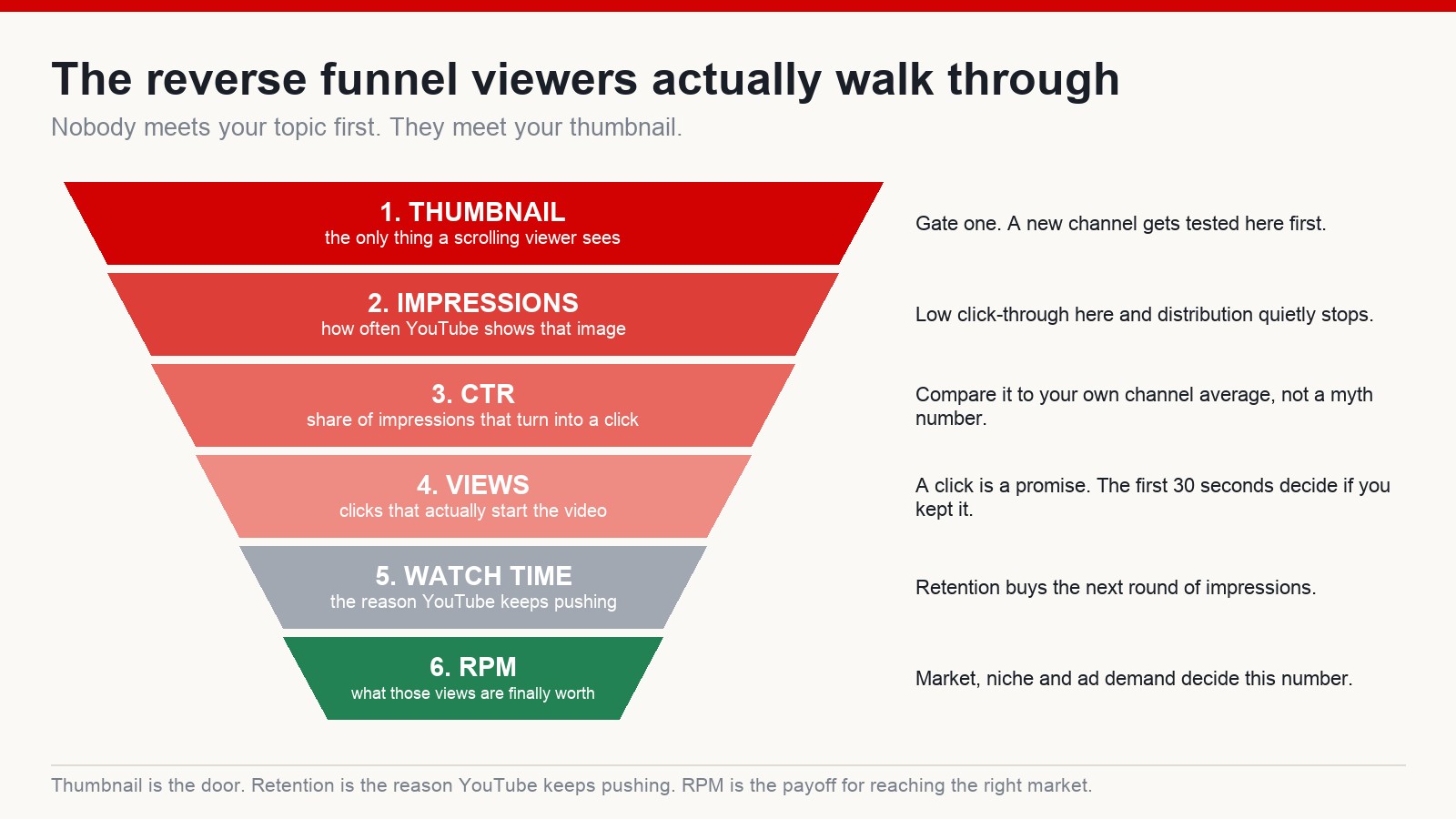
They see a thumbnail. If it stops them, they read the title. If the title holds, they click. Only then does your topic exist to them at all.
This matters enormously for a young channel, because YouTube’s first test is a small batch of impressions. If your thumbnail cannot convert those into clicks, the video is quietly shelved before your content ever gets a hearing.
Which gives you the chain in plain terms: the thumbnail is the door, retention is the reason YouTube keeps opening it, and RPM is what those views are worth once you have reached the right market.
A thumbnail that is accurate beats a thumbnail that is pretty
Attractive is not the goal. Instantly legible is the goal. A viewer scrolling at speed should understand in under a second why this video is worth their time.
If the video is about an elephant charging a vehicle, the thumbnail needs the elephant, the vehicle, the moment of tension, a readable background, minimal text and strong contrast. That is it.
The part people underrate is alignment. Keyword, title and thumbnail should all be telling one story:
- Title: 30 Elephant Attacks Cars Caught On Camera
- Thumbnail: an elephant bearing down on a vehicle
- Keywords: elephant attacks car, elephant attack caught on camera, wild animal attacks car
When those three agree, people click with accurate expectations and then stay because the video is what they were promised. That is how you raise click-through rate without misleading anyone – which also happens to be the version that survives long term.
High RPM is a system, not a lucky video
Viral videos do involve luck. But channels that earn consistently are not running on luck, they are running on a set of decisions made before the camera rolled:
- which niche carries genuine advertiser demand
- which markets they are deliberately targeting
- which title structures earn clicks in that language
- which thumbnails stop the scroll
- which topics can be produced repeatedly without burning out
- which videos can stay relevant for years
- which keywords have volume without brutal competition
That is a content machine rather than a hobby, and it is the difference between publishing and building.
If you want it as one line: strong RPM = the right market + the right niche + a title that earns the click + a thumbnail that stops the scroll + retention that justifies more reach.
Remove any one element and the whole thing sags. Tier 1 traffic with weak retention will not get pushed. A beautiful thumbnail pointed at a low-value market still pays badly. A brilliant title on a thin video just teaches viewers to leave early. YouTube evaluates the chain, not the individual link.
Niches that work well for faceless channels
If you are choosing a direction with ad value in mind, these categories tend to hold up:
Wildlife and nature
Visually strong, easy to build compelling thumbnails around, works across languages: wild animals caught on camera, animal attacks, rare animal moments, animal rescue stories.
Mysteries and strange facts
Curiosity does the heavy lifting: strange facts, mysterious places, unsolved mysteries, ancient discoveries.
Personal finance
Advertiser demand here is real, which is exactly why the bar is higher. This is territory where careless content does actual harm, so treat it seriously: cite sources, stay general, avoid anything resembling individual financial advice, and do not present outcomes as guaranteed. If you are not prepared to research it properly, pick something else.
AI tools and online business
Fast-moving and crowded, but still expanding: AI video tools, faceless YouTube automation, online business ideas. The same honesty rule applies – describe what a tool does, not what it will earn someone.
The trap of picking a niche purely for its RPM
This is worth saying plainly. Do not choose a niche only because the ad rates look good.
Finance pays well. It also punishes shallow work quickly, because that audience can tell. AI will help you produce faster; it will not give you understanding you never had. A niche you cannot stand researching becomes a niche you abandon in month four.
Look for the overlap of three things: decent ad value, a subject you can keep studying for a year without resenting it, and demonstrable audience demand. That intersection is where a channel actually scales.
A practical starting sequence
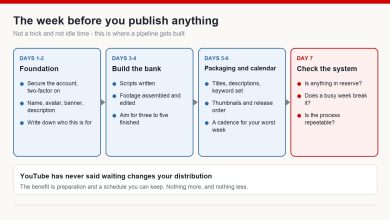
If you are at zero, this is the order I would follow.
Step 1 – Choose the market before the topic
Resist “what do I want to make?” for a moment and ask which markets combine solid ad value with room for a newcomer. English-speaking countries, Germany, France, Japan and Korea are the usual candidates.
Step 2 – Choose a niche with branches
A good niche has sub-topics. “Animal moments” splits into animal attacks, animal rescues, rare footage, animal fights, animals helping humans, animals caught on camera. More branches means more production runway before you run dry.
Step 3 – Mine competitor titles
Find ten channels performing well in that market. Pull their thirty best titles. Slice them into phrases, check volume, and shortlist terms you can realistically compete for.
Step 4 – Test thumbnails before you scale
Do not commit to one hundred videos in a single visual style you have never validated. Publish, watch click-through rate, watch retention, note which videos browse traffic picks up, note which topics come back with better RPM.
Step 5 – Rebuild what won
When a video outperforms, take it apart. What was the hook in the opening seconds? What made the thumbnail work? What structure did the title use? Which sub-topic was it? Which countries watched? What did the RPM look like? Then produce variations of that same format. This is how faceless channels scale without gambling on every upload.
Make YouTube decisions with data, not vibes
RPM is not random. It is the downstream result of where your audience lives, which niche you picked, how you packaged the video and who you actually attracted.
Chase raw views and you can work extremely hard for a disappointing return. Understand RPM – market, niche, title, thumbnail, retention – and the job changes shape. You stop publishing into fog and start making decisions you can defend.
None of this comes with guarantees. Platform policies shift, ad rates move with the season and the economy, and two channels running the same playbook can land in different places. What you can control is whether your choices are informed.
If you want the full step-by-step system I use for building faceless channels aimed at high ad-value markets, that is what I teach at mmoyoutube.com.