Psychology or Personal Finance: Which Niche Is Actually the Better Bet?
Spend a week in any creator community and two niches come up in the same breath: psychology and personal finance. They are the standard answer to “what pays well”, repeated so often that most people never ask what the answer is based on.
Both are genuinely good subjects for a faceless channel. Neither of them pays anything on its own. Revenue per thousand views is an outcome produced by several inputs at once – who is watching, where they live, what they came to do, what advertisers are spending that month – and the topic is one input among several. Picking the topic and expecting the rest to follow is the most common way this advice gets misapplied.
What is worth comparing is not which one earns more. It is how differently the two behave once you are the person publishing every week.
Why these two get named at all
They share a set of properties that make them attractive regardless of any revenue argument.
Viewers arrive with a long-running interest rather than a passing one. Episodes stay relevant for months or years, which means a library keeps working after you have stopped adding to it. There are commercial sectors with a real reason to reach that audience. And both subjects subdivide almost infinitely, which matters when you need a hundred episodes and not five.
That combination is what people are actually pointing at when they call a niche lucrative. It is a description of durability, not of a rate.
Where the comparison lands
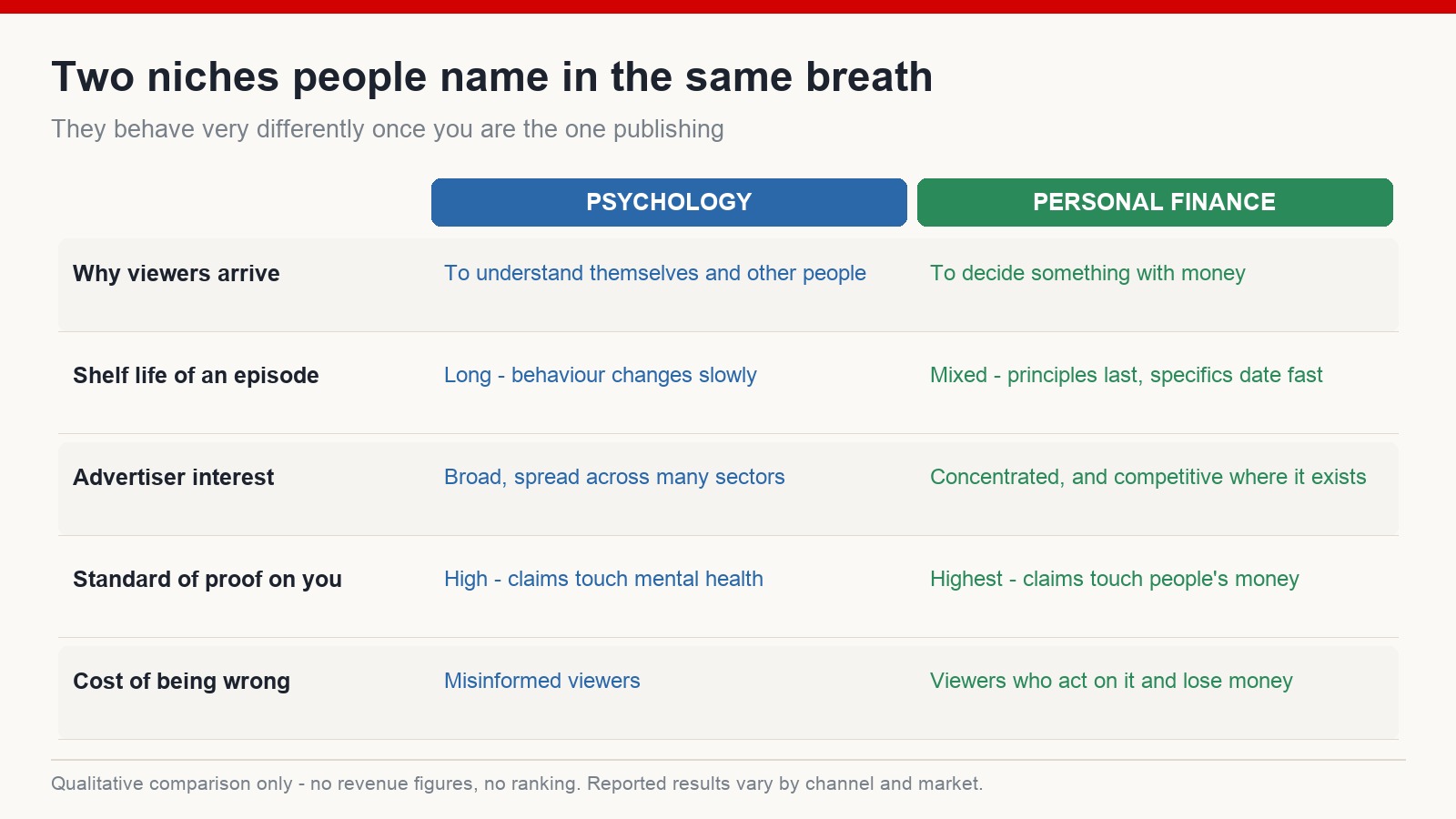
The row that matters most is the last two. Both of these subjects reach people at moments when they are deciding something, and that is exactly why they attract advertiser interest – and exactly why the editorial burden on you is heavier than it would be in entertainment.
Psychology: long shelf life, and one specific trap
Human behaviour changes slowly, so a well-made episode about attention, habits, communication or motivation can still be finding viewers years later. That is a real advantage and it compounds.
The trap is that psychology is unusually easy to do badly in a way that still performs. Confident claims about personality types, manipulation tactics, or what a partner’s behaviour “really means” get watched enthusiastically and are frequently untethered from any actual research. The format rewards certainty; the subject rarely supports it.
The practical version of this: distinguish between describing a study, describing a general pattern, and offering your interpretation – and say which one you are doing. When the subject drifts toward mental health specifically, the standard rises again. Content that sounds like it is diagnosing the viewer is a problem whether or not anyone ever complains about it.
Personal finance: the strongest intent, and the heaviest obligation
Nobody watches a budgeting video by accident. That intent is why the niche is valuable and why it is unforgiving.
The workable version is education: how a mechanism works, what the terminology means, how to think about a category of decision, what the trade-offs are. The unworkable version is anything that functions as personal advice – what a specific viewer should buy, hold, or do with money – because you know nothing about their situation and they will act on it anyway.
Two more practical constraints. Specifics date fast: rates, rules, thresholds and product details go stale, which means either you avoid them or you accept a maintenance job on your own back catalogue. And regulation exists. What you are allowed to say about financial products varies by country and by how your content is framed, and it is not something to guess at.
The obligations that come attached
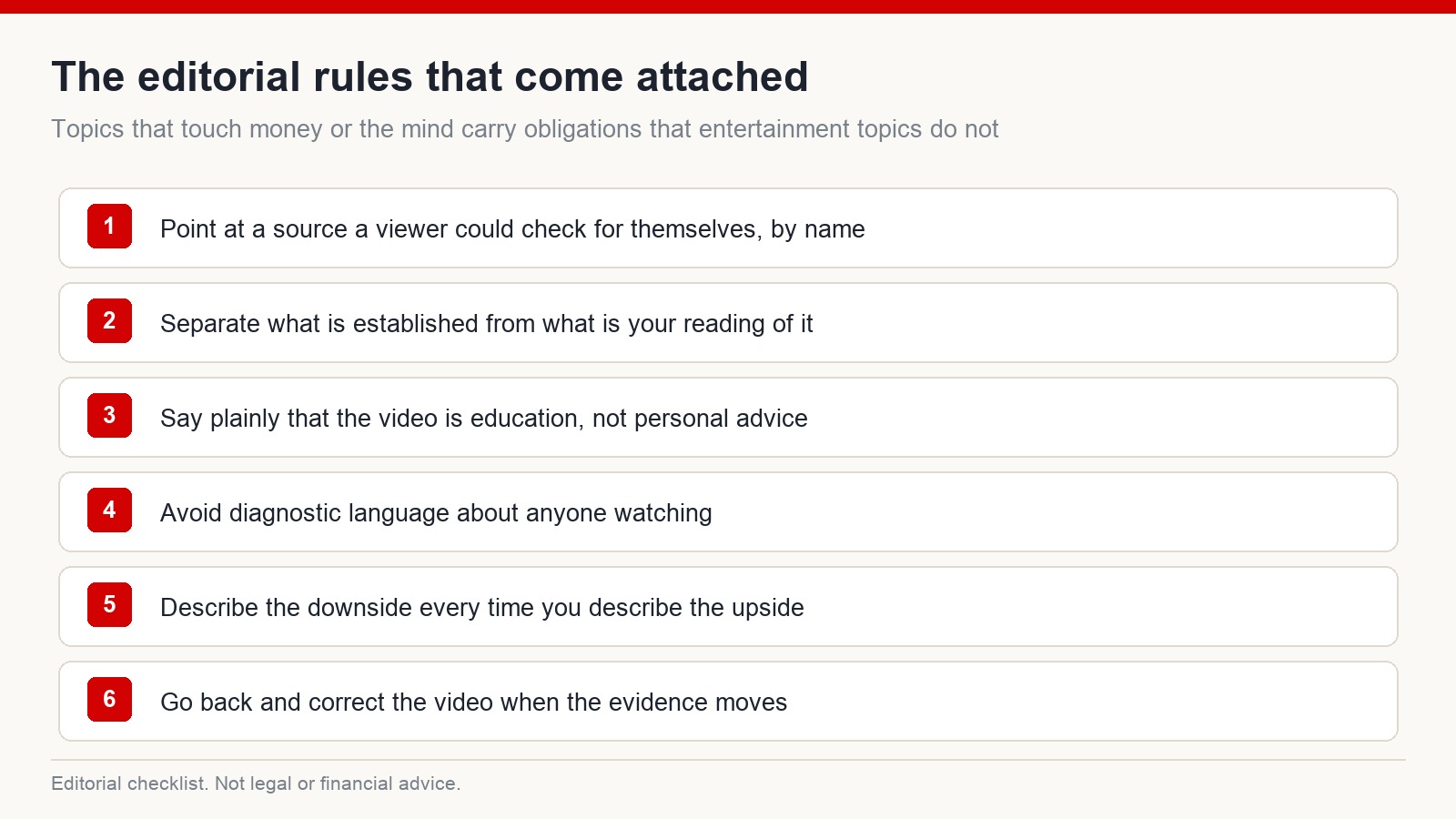
None of this is a reason to avoid either subject. It is a description of the work. Both niches are attractive precisely because they matter to people, and things that matter to people carry a duty of care that a compilation channel does not.
The version of this that has served me best: describe the downside every time you describe the upside, and be willing to go back and correct a video when you were wrong. A channel that visibly corrects itself builds a kind of trust that no production value substitutes for.
What neither niche gives you
Neither one comes with a rate. What you will earn from a thousand views in either subject depends heavily on where the audience is – advertising is priced very differently in high-priced ad markets such as the United States, the United Kingdom, Germany or Japan than in markets where advertisers spend far less per head. The same video, the same view count, materially different outcomes.
It also depends on the season, on the specific sub-topic, and on how the audience behaves. Anyone quoting you a figure for a niche is quoting one channel’s month, and that number will not transfer.
Which is worth saying plainly: results vary, nothing here is a projection, and platform monetisation policies change.
The better question
“Which niche earns more” is unanswerable and, more importantly, unhelpful. The version that leads somewhere is: which of these could you still be making properly in two years?
Both subjects demand a lot of reading. Psychology asks you to handle research honestly when the sloppy version performs better. Finance asks you to keep a library current and to resist the pull toward specific advice, which is exactly what the most engaged part of the audience will keep asking for. If neither of those sounds like something you would enjoy, the revenue argument will not carry you through episode thirty.
Pick the one where you can be genuinely careful without it feeling like a constraint. That is the only version of either niche that lasts.
Where this leaves you
Both are strong subjects for a faceless channel aimed at English-speaking audiences. Neither pays by virtue of being chosen. The revenue conversation is downstream of audience, retention and geography, and the editorial standards are the entry fee for working in subjects that touch people’s money and their minds.
If you want the wider process – research, format, and building for an international audience – it is set out at mmoyoutube.com.
Frequently asked questions
Is psychology or finance the higher-paying niche?
There is no published ranking, and any figure you are shown comes from one channel in one month. Both attract advertiser interest, but what you actually see per thousand views depends far more on audience location, sub-topic and retention than on the label.
Can a beginner make finance content responsibly?
Yes, if it stays educational: how things work, what terms mean, what the trade-offs are. State clearly that it is not personal advice, cite sources a viewer can check, and be careful about anything that regulators treat as a recommendation.
Is pop psychology content a problem?
It can be. Confident claims about personality, manipulation or what someone’s behaviour reveals often go well beyond what the research supports. Separate evidence from interpretation, and avoid language that sounds like diagnosing a viewer.
Should I make videos longer to increase revenue?
Length is one factor and a poor one to optimise for on its own. Stretching a video past its natural length costs retention, and retention is what got the video distributed in the first place. A shorter video people finish is not the weaker option.