Niche Keywords: How to Make a New Channel Easy to Classify
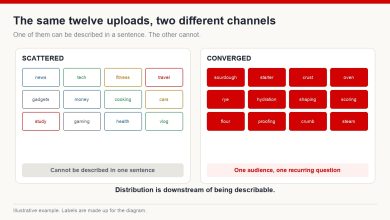
A new channel’s biggest problem is not competition. It is ambiguity. Nobody – not a viewer, not the recommendation system – can tell what it is for. Competition is a fight you can lose; ambiguity means you are not in the fight at all, because the platform has nothing to match you against.
Keywords are how you fix that. Not as a trick to rank, and not as something you sprinkle over a description after the edit is done, but as the vocabulary that makes a channel legible to a machine that only has text to work with.
The sign over the door
Imagine two small restaurants on the same street. One has a sign that says FOOD. The other says HAND-PULLED NOODLES. The second one has deliberately turned away most people walking past, and it will do better, because the handful who wanted exactly that now know where to go – and everyone who mentions it to a friend knows what to say about it.
A channel called something broad, describing itself in broad terms, publishing broadly, has put up the FOOD sign. Everything downstream of that gets harder for reasons that never show up in the analytics as a single obvious problem.
The ladder from a topic to something a person types
The useful move is to keep descending until you reach language a real person would actually use.
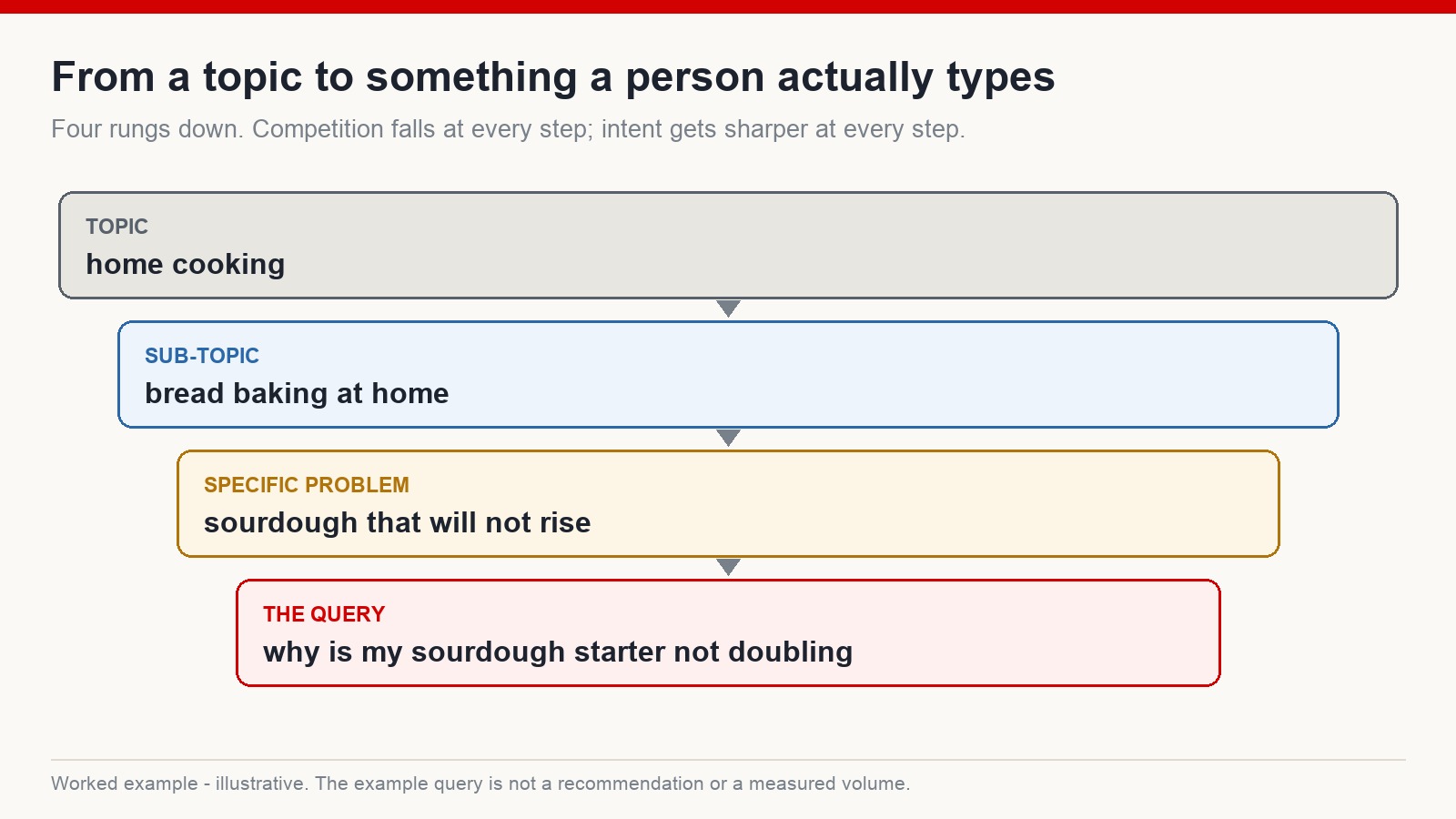
A topic is a category. A sub-topic is a slice of it. A specific problem is what someone is stuck on. And the query is the sentence they would type at eleven at night when the thing has gone wrong. Each rung down means fewer competitors and a much clearer signal about who the video is for.
Most people stop one rung too early. They get to the sub-topic, feel that it is specific enough, and start filming. The rung below it is where the language stops sounding like a category and starts sounding like a person.
Two kinds of keyword, and why a new channel needs both
Not every phrase behaves the same way, and the distinction is worth holding onto.
Demand keywords are phrases people type into a search box. They have a floor: as long as the problem exists, someone is searching, and a video that answers it well can keep collecting views for a long time. They rarely explode.
Curiosity keywords are the opposite. Nobody searches for them – they work when the feed puts them in front of someone who did not know they wanted it. They can travel much further, and they decay much faster.
A channel built entirely on demand phrases tends to get ignored by the feed. A channel built entirely on curiosity has no floor at all: when the feed cools, everything stops. Early on, demand phrases are the more reliable place to start, because they let a video be found by someone actively looking rather than waiting to be chosen.
Where the term has to appear
Once you have the phrase, it has to be present in the places a classifier can read. Not stuffed – present, in language that would survive being read aloud.
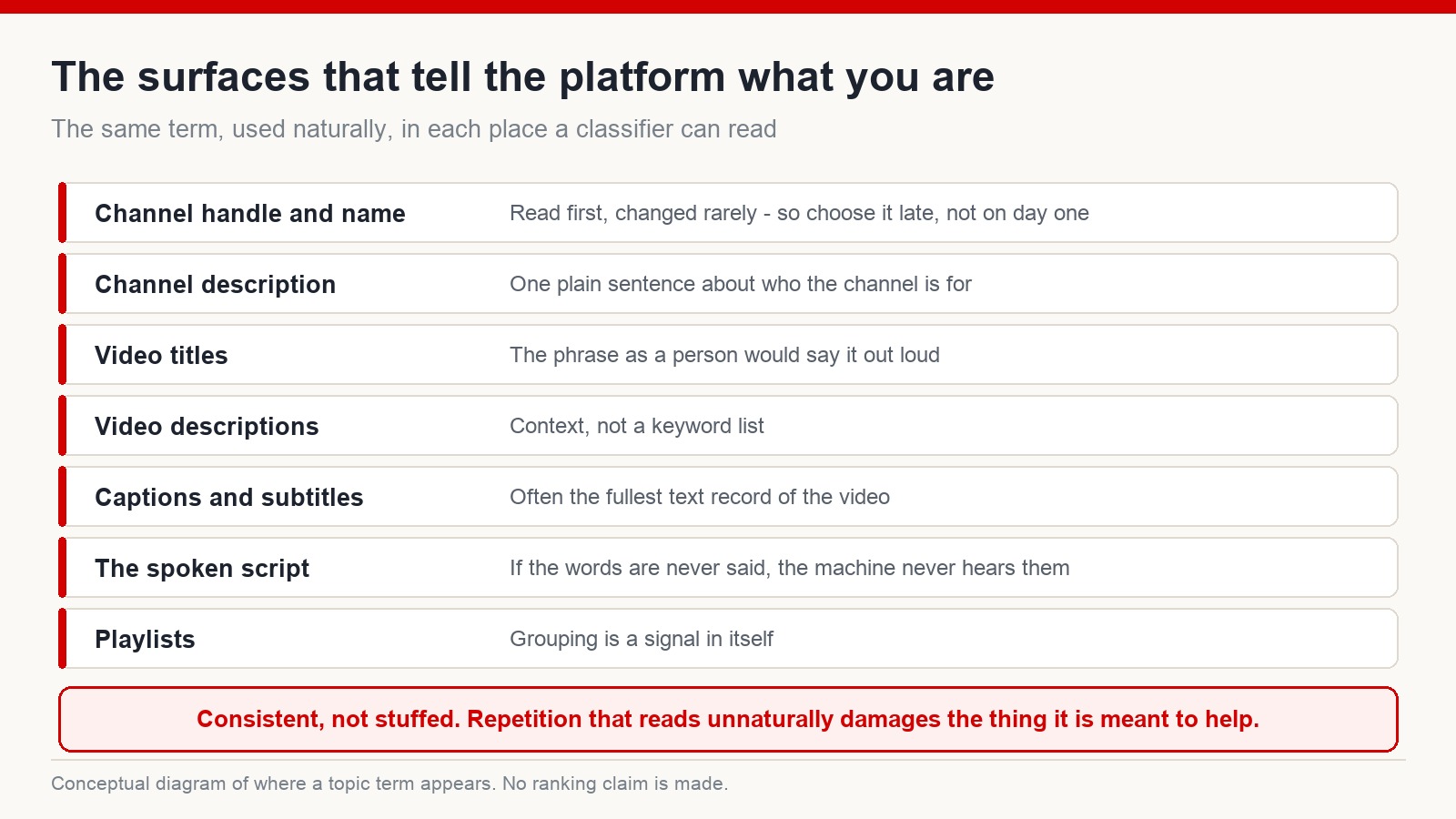
Two of these get neglected almost universally. The first is captions – often the fullest text record of what a video actually contains, and generated from what you said, which means sloppy audio produces a sloppy record of your own topic.
The second is the script itself. If the subject of your channel is never spoken out loud in the video, the only places it exists are the fields you typed. Saying the thing plainly, once, in the first thirty seconds, is not keyword stuffing. It is the least you can do for a system that is trying to work out what it just watched.
The failure mode is stuffing, and it is obvious from outside
The temptation, once you understand that the words matter, is to put more of them everywhere. It reads badly, it makes titles that nobody wants to click, and it works against the thing it is meant to help – because the signals that decide whether a video keeps being shown come from human behaviour, not from field contents.
The test I use: read the title and description aloud. If you would be embarrassed saying them to a person, they are over-optimised.
Keywords get you into the room. They do not win it.
This is the part that gets skipped, and it is the part that decides outcomes.
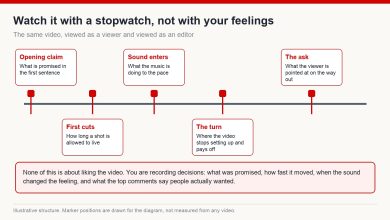
Good keyword work helps the platform understand what a video is and who might want it. That is where its job ends. Whether the video keeps being distributed after that comes down to what people do when they see it: whether they click, whether they stay, whether they finish, whether they come back. No amount of correct labelling survives a video people leave.
Which is why “I found a low-competition keyword” is not a strategy on its own. It is a door. What is behind the door still has to be worth walking into.
Five mistakes worth avoiding
- Choosing the phrase with the largest volume rather than the one you can plausibly be the best answer to.
- Stopping at the sub-topic rung instead of descending to the query.
- Writing for the search box and not for a person – titles that read like database entries.
- Changing the channel’s subject every few weeks, so the accumulated signal never settles.
- Treating keyword research as a launch task rather than something you redo as the topic moves.
Where this leaves you
The goal is not to rank. The goal is to be describable – to have a channel where the platform, a viewer, and you would all give the same one-sentence answer to what it is about. Everything about distribution gets easier once that is true, and almost nothing works properly until it is.
If you want the fuller process for building faceless channels aimed at English-speaking audiences, it is laid out at mmoyoutube.com.
Frequently asked questions
Should a new channel pick a broad topic or a narrow one?
Narrow, in almost every case. A narrow subject gives the platform something specific to match you against and gives a viewer a reason to subscribe. Breadth is something you earn later, once there is enough history for the channel to survive an off-topic video.
Can I rely on a keyword tool alone?
No. Tools estimate. They are useful for comparing phrases against each other and for spotting demand you had not considered, but the numbers are not measurements and should not be treated as one.
Does good keyword work mean the video will get views?
No. It makes a video findable and classifiable. Whether it is distributed further depends on how people respond to it – the thumbnail, the opening, and whether they stay. Keywords open the door; retention decides what happens next.
How often should I redo this?
Periodically, and always before starting a new content line. Language moves, competitors arrive, and a phrase that was underserved a year ago may be crowded now. It is maintenance, not a one-off task.