Likes Without Retention: When Engagement Numbers Mean Nothing
There was a period when the shortcut worked. A few extra likes, a handful of comments, some views from wherever you could get them, and a video would get pushed further than it deserved. Everyone who was around then remembers it, which is why the advice keeps circulating years after it stopped being true.
What changed is not that the platform got stricter about counting. It is that the counting became less important. A thousand likes on a video that nobody watched past the first minute is not a strong signal being ignored – it is a weak signal contradicted by a stronger one. I have been publishing since 2017, mostly faceless channels for English-speaking audiences, and this is the single most expensive misunderstanding I see in new creators.
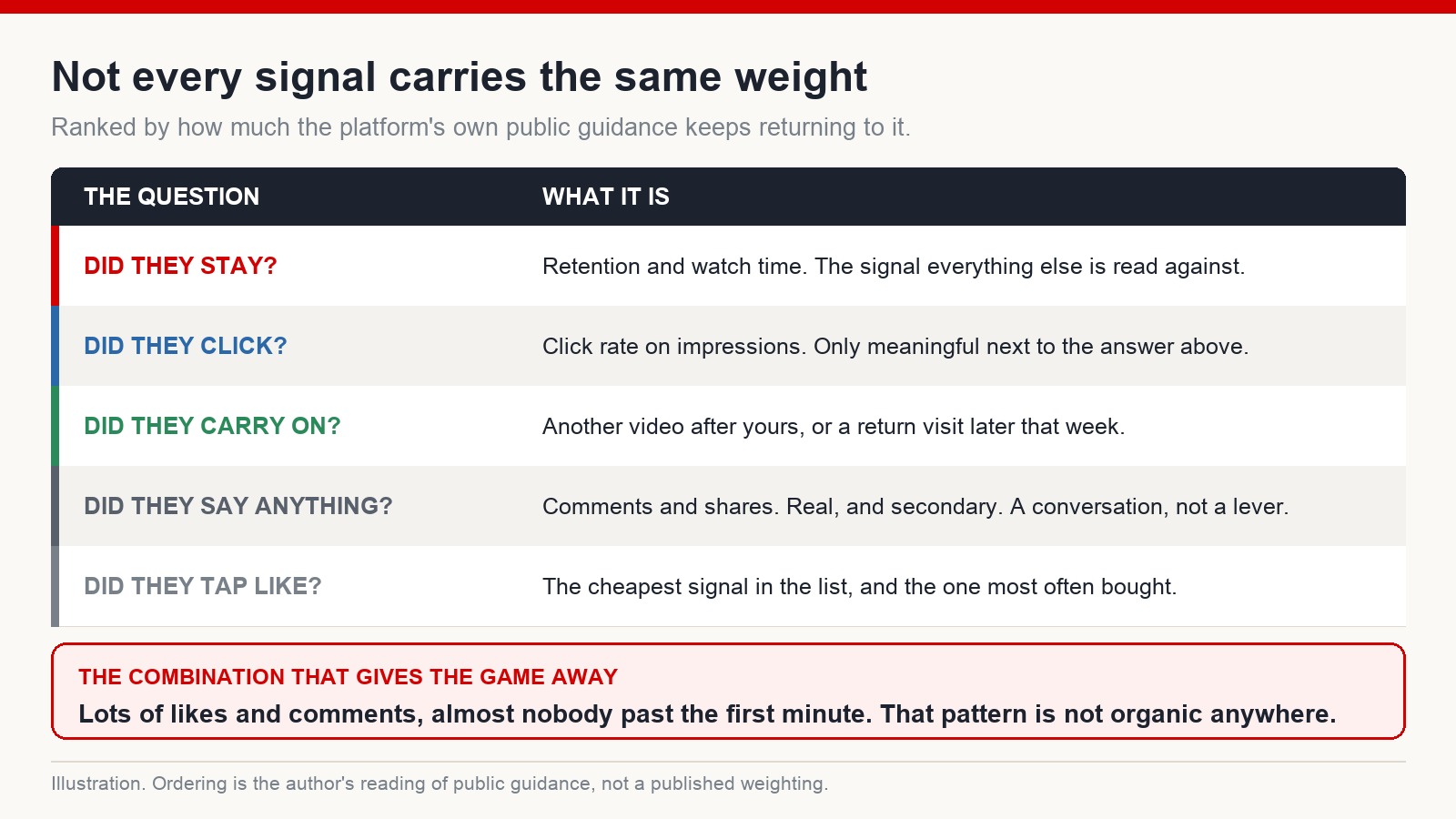
Engagement is a symptom, not a lever
Think about what a like tells anyone. Somebody tapped a button. It costs nothing, it happens in a second, and it can be produced at scale by people who never watched anything. Now think about what a completed watch tells you: a person gave you eight minutes of a finite life. One of those is easy to fake and the other is not, and the platform’s public guidance has spent years pointing at the second.
The order I work with, roughly: did they stay, did they click, did they carry on afterwards, did they say anything, did they tap like. Retention and watch time first, because everything else is read against them. Click rate next, meaningless on its own – a thumbnail can win clicks it cannot pay off. Then whether the session continued. Comments and shares are real and they are secondary. Likes are the cheapest thing in the list and, not coincidentally, the thing most often bought.
This ordering is my reading of what the platform keeps returning to publicly, not a published weighting. But the practical consequence holds regardless: engagement follows from people staying, and manufacturing it in the other direction produces a shape that does not occur naturally.
The shape that gives it away
An hour of nothing, then a thousand interactions in a few minutes. Comments that cycle through the same three phrases. High likes and comment counts sitting on top of a retention curve that collapses in the first thirty seconds. An audience map that bears no relationship to any topic the channel covers.
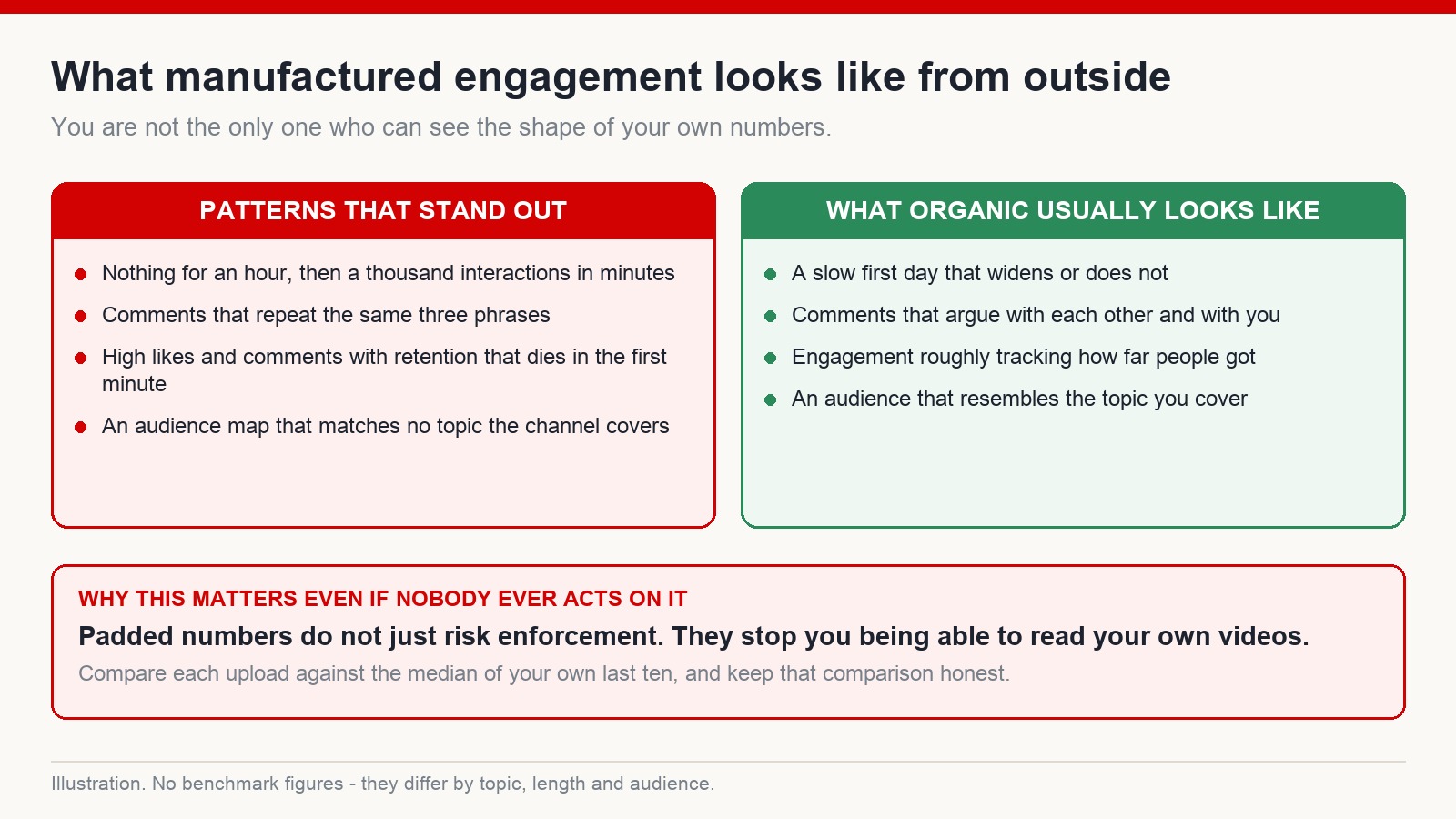
Organic engagement looks different, and less impressive. A slow first day that either widens or does not. Comments that argue with each other. Engagement roughly tracking how far people actually got into the video. An audience that resembles the subject you cover.
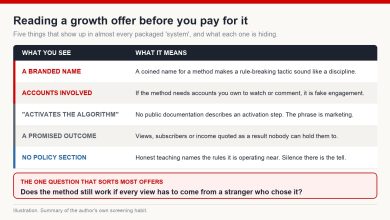
Two things follow. The obvious one is policy: buying, trading or manufacturing interactions is fake engagement under YouTube’s spam and deceptive practices rules, and the documented consequences run from having those metrics removed to having videos taken down to losing the channel on repeated cases. This includes the softer versions people tell themselves are different – engagement pods, groups where creators watch each other’s videos to be watched back, and interactions from accounts you control yourself.
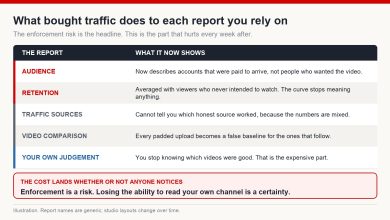
The less obvious one is that you have blinded yourself. Once padded traffic is in the numbers, your retention curve averages people who wanted the video with people who did not, your audience data describes accounts rather than viewers, and every inflated upload becomes the baseline for judging the next one. Enforcement is a risk you might dodge. Losing your own instruments is guaranteed.
What raises engagement without any of that
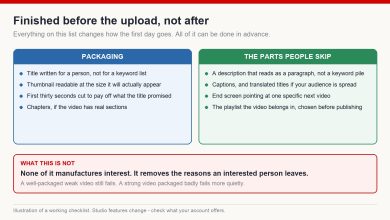
Fix the click before you worry about the comment. Most videos that feel like an engagement problem are a packaging problem. If people are not clicking, or are clicking and leaving inside a minute, no comment tactic will rescue that. A thumbnail that is readable at the size it actually appears, and an opening that pays off what the title promised, do more for engagement than every prompt you could write.
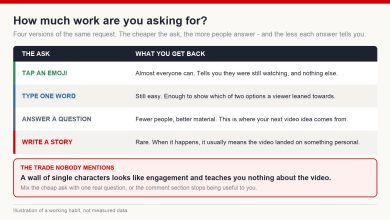
Ask questions that have more than one answer. “Let me know what you think” produces nothing because there is nothing to disagree with. “I’d have done the opposite here – would you?” produces replies, and the replies produce replies. Discussion between viewers is worth more to you than a stack of one-word responses, because it is the only version you can actually read.
Use a short clip as a doorway. Cutting the strongest thirty seconds into a short and letting it point at the full video brings people who have already sampled what you do. They arrive with an expectation the video can meet, which is the opposite of what bought traffic does.
Be present for the first day, then stop. Answering comments properly while the video is new is worth doing – not because replies are a growth lever, but because early conversations set the tone of the whole thread and often hand you the next video’s topic. Half an hour of real attention. Then leave it alone.
Close the loop in the next video. Take a question from the comments and answer it on camera. Name the thread it came from. People who see that their input produced something come back, and that returning-viewer behaviour is worth more than anything the comment count shows.
How to tell whether it is working
Not by comparing your numbers to a figure from someone’s blog post. Those figures come from a different topic, a different video length and a different audience, and they are usually rounded up for effect.
Compare against yourself. Take the median of your last ten uploads on that channel – comments and likes per thousand views, average percentage viewed, whatever you care about – and read each new video against it. When something moves, change one variable at a time and give it several uploads before you decide anything. A single video swings for reasons that have nothing to do with what you changed.
And read engagement next to retention, always. Engagement that rises while retention falls is not a win. It usually means the ask got louder while the video got weaker.
If your numbers are already padded
Stop entirely rather than tapering, because partial traffic keeps the data unusable. Leave the old videos up – deleting them removes the honest views and the real comments too, and undoes nothing. Publish three or four clean uploads and treat the median of those as your first real baseline. If the channel has already received a notice, read what it names, fix that, and use the appeal route it points to rather than starting a fresh channel, which is its own violation and tends to follow you.
Do likes and comments still matter?
They are real signals and they are secondary. They tell you something about how people felt, but they are read in the context of whether those people stayed.
Is it safe to ask viewers to comment a specific word?
Asking your audience to participate is normal. What crosses the line is producing the engagement yourself, or arranging exchanges where people interact purely to be interacted with in return.
What about engagement pods and creator support groups?
Groups where members watch and comment on each other’s videos to reciprocate are engagement trading, which sits inside the fake engagement rules. Groups where people who share your topic happen to gather are a completely different thing.
My video has good engagement but low retention. What does that mean?
Usually that the packaging promised something the video did not deliver, or that the strongest material arrives too late. Look at where the retention curve drops and watch that part of your own video honestly.
How long should I wait before judging a change?
Several uploads, measured against your own recent median. One video is noise, and reacting to noise is how people end up changing everything at once and learning nothing.
The short version
Engagement is what happens when people stay. It is not a dial you turn to make them stay. Get the click honest, get the first minute right, ask one question worth answering, be present while the video is new – then read the result against your own history rather than somebody else’s benchmark. Anything that produces interactions without producing interest is not a shortcut past that work. It is a way of paying for the privilege of not knowing whether your videos are any good.
If you want the rest of the process for building a faceless channel aimed at an English-speaking audience, that is what we work through at mmoyoutube.com.