How YouTube Works Out Which Country Your Channel Is For
Every creator who decides to make videos for an audience in another country runs into the same question within about a week. How does the platform know who I am aiming at? What stops my English-language video being shown to people who will never watch past the first line?
It is a fair question, and the vacuum around it gets filled with named methods. Every few months a system circulates – it always has a name, it is always described as the thing serious creators use quietly – promising to lock a new channel onto a foreign market. I have watched several of these come and go. The mechanism they describe is usually vague, and the part that would matter is always missing.
So it is worth going through what actually determines the audience a video lands with, and why the shortcut version of the answer is both wrong and risky.
The pitch, and the part it leaves out
The pitch is broadly the same each time. Configure the channel a particular way, arrange some early viewing activity from the target country, and the recommendation system concludes that this is who you serve. From there, the story goes, distribution follows.
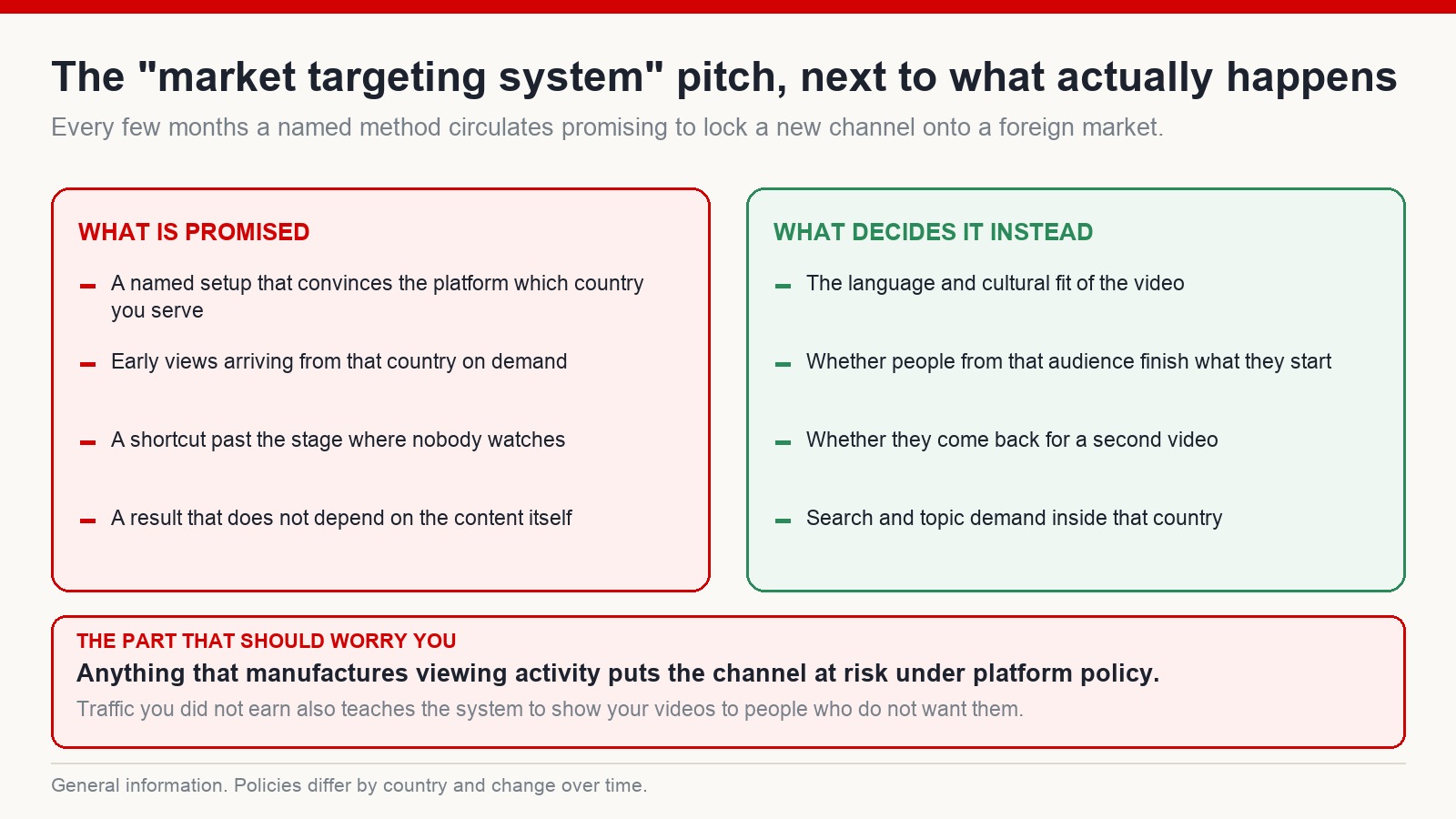
Two things are wrong with it. The first is practical: distribution responds to whether people watch, and manufactured activity does not produce people who watch. Arrange for a video to be opened by an audience that has no interest in it and you have not taught the system that you serve that country – you have taught it that people in that country open your videos and leave. That is a worse position than starting from nothing.
The second is about risk. Anything that manufactures viewing activity falls foul of platform rules on artificial engagement, and the consequences land on the channel rather than on whoever sold the method. That is a poor trade on an asset you intend to keep for years.
What actually tells the platform who a video is for
There is no single field that decides it. The signals stack, and they are not equally weighted.
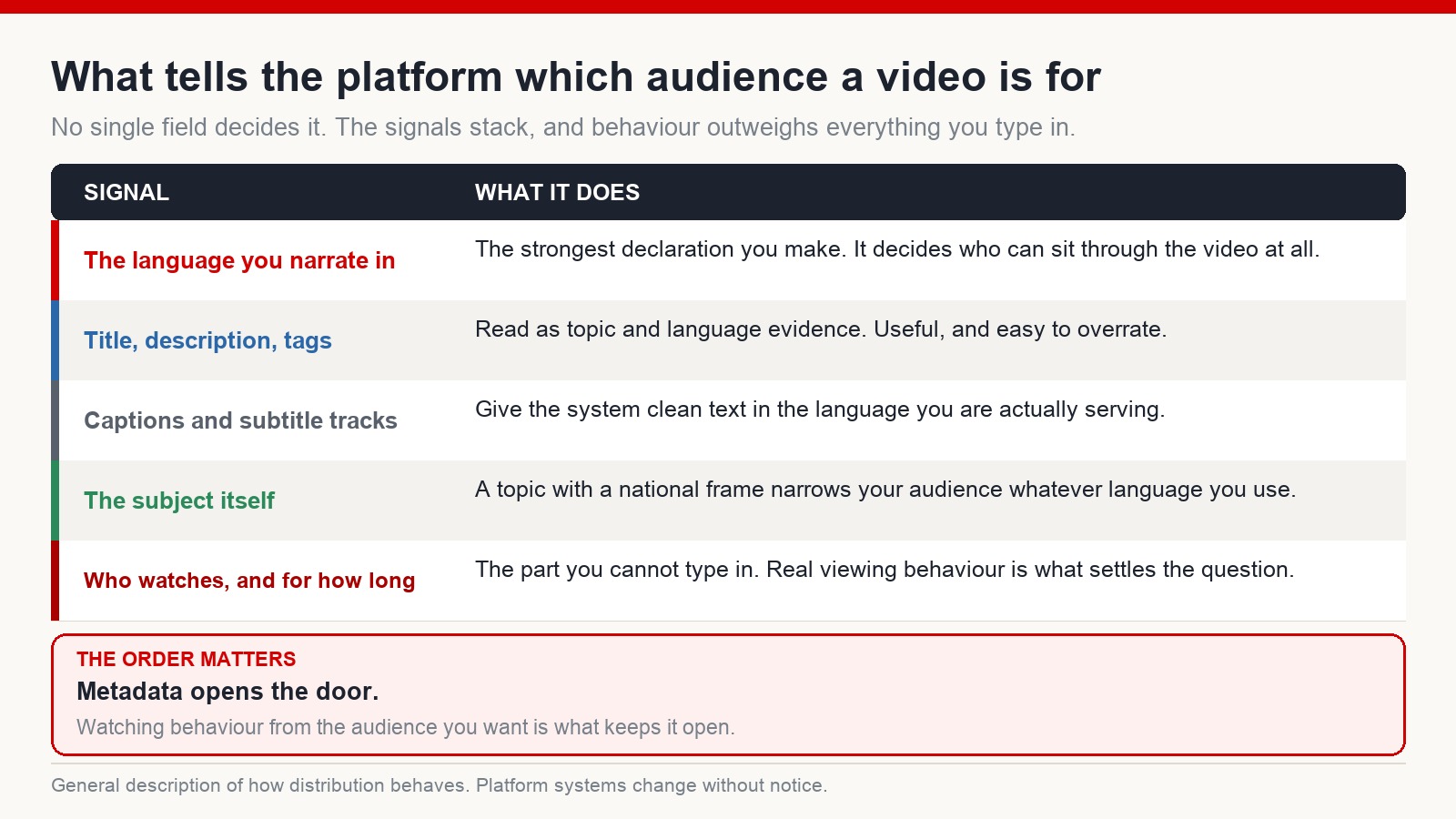
The language you narrate in is the strongest declaration you make, because it decides who is physically able to sit through the video. Title, description and tags are read as evidence of topic and language – useful, and consistently overrated by beginners who spend an afternoon on tags and ten minutes on the opening.
Captions matter more than most people expect: an accurate subtitle track hands over clean text in the language you are actually serving. The subject itself is a signal too, and an easy one to get wrong. A topic framed around one country’s institutions, prices or holidays narrows your audience whatever language you use.
Then there is the part you cannot type into a form. Who watches, how long they stay, whether they come back. That is what settles the question, and everything above it is just the platform’s first guess before real data arrives.
Three decisions that do the work
Pick the language deliberately
If you are aiming at the United States, the United Kingdom, Canada or Australia, English is the obvious choice. If you are aiming at Brazil, Germany or Spain, the local language will almost always outperform English in those markets. This sounds too simple to state, but a surprising number of channels aim at one market and publish in a language that market does not use.
Research demand inside that country, not in general
Search behaviour is local. The phrasing people use, the sub-topics they care about, the formats that dominate a niche – all of it varies by market, sometimes dramatically. Look at what is already working in your niche in the country you are targeting, in that country’s language, before you decide what your first ten videos are.
Fit the culture, do not translate into it
This is where most cross-border channels quietly fail. The same subject is told very differently to an American audience than to a Japanese or German one: how long you take to get to the point, how much context you assume, how direct you are, what counts as an ordinary example. Content that has been translated rather than written for the audience reads as slightly off, and viewers cannot always say why – they just leave.
The trap this whole question sits in
The reason named systems keep finding buyers is that they answer an uncomfortable question with a comfortable one. “How do I reach an audience abroad” is hard and slow. “Which setting reaches an audience abroad” sounds solvable this afternoon.
Meanwhile the things that actually decide it get neglected. Whether the topic has an audience. Whether the packaging earns a click. Whether the first minute holds. Whether anyone comes back. No configuration compensates for those, and no amount of technical signalling makes a video work in a market that does not want it.
What to do in the first months
Publish in the language of the market. Study what already performs in that niche inside that country. Write captions and metadata properly, once, and then stop thinking about them. Make videos that a person from that audience would finish, and pay attention to which ones they finish.
That is slower than a named system and it is the only version that compounds. After thirty or forty videos the platform will have a very clear picture of who you serve, built out of real viewing behaviour rather than a configuration you hoped would be read a certain way. If you want the structured route for building an English-language faceless channel, that is what I work on at mmoyoutube.com.
Frequently asked questions
How does the platform decide which country to show my video in?
It combines several signals – narration language, metadata, captions, subject matter – and then adjusts based on who actually watches and how long they stay. Behaviour outweighs anything you enter manually.
Can I force my videos to be shown in a specific country?
Not directly, and services that claim to do it usually rely on manufactured activity that breaches platform rules. You influence it by publishing in the right language about subjects that market searches for.
Do tags and descriptions matter for reaching a foreign audience?
They help the system make its first guess about topic and language, which matters most when a video has no viewing history. They cannot rescue a video that the target audience does not want to watch.
Is it enough to translate my existing videos?
Translation makes content accessible; it does not make it appropriate. Pacing, examples and how much context you assume all differ by market. Content written for the audience consistently outperforms content converted for it.
How long before the platform understands who my channel serves?
There is no fixed number, because it depends on how quickly you accumulate consistent viewing data. Publishing consistently on one theme for one audience gets you there considerably faster than switching subjects every few videos.