Too Shy for the Camera: How the Fear of Being Seen Pointed Me at Faceless Channels
A message came in close to midnight: “I really want to do this, but I can’t put myself on camera. People I know will see it and laugh at me.”
I read it and felt slightly winded, because I have written that message. Not sent it – there was nobody to send it to – but I have certainly thought it, standing in front of a camera that made me feel ridiculous, in a period that ended in complete failure.
So here is the honest version of what happened to me, for anyone stuck at the same door.
Five years of trying to be on camera
When I started on YouTube I took one idea as given: if you want people to watch, you have to appear. Your face has to be in the video. You vlog. That is how it works. I spent close to five years inside that assumption.
I borrowed money for a camera, a microphone, lights, all the gear I was told was necessary to look professional. The money went. That part I could live with.
The part I could not live with was what happened when the record light came on. I am, by temperament, a shy person. In front of a lens I became a stiff, awkward version of myself who forgot his own sentences halfway through them. Everything that was fine in a conversation went wooden the second it was being recorded.
And people said so. Comments about how I looked, how I sounded, how provincial I seemed, how I clearly had no talent for presenting. I was already forcing myself to perform; I was also swallowing that.
What I had at the end of it was debt and nothing else. I remember lying awake wondering whether I had picked the wrong road entirely. That is the whole reason I went looking for a different one.
2021: what if the face was never the requirement?
When I rebuilt, I refused to repeat the same assumption. I asked something I had somehow never asked in five years: why do I need to be in the video at all? Viewers want something from the video. Is my face genuinely the thing they came for?
It was not. So I moved to faceless production – no host, no presenter – and used AI tools to help produce it.
The relief was immediate and slightly embarrassing. No more performing. No more dreading that someone I knew would come across it. No more comments about my appearance, for the simple reason that there was nothing to comment on. The shyness that had been my central handicap for five years abruptly stopped being relevant to the job.
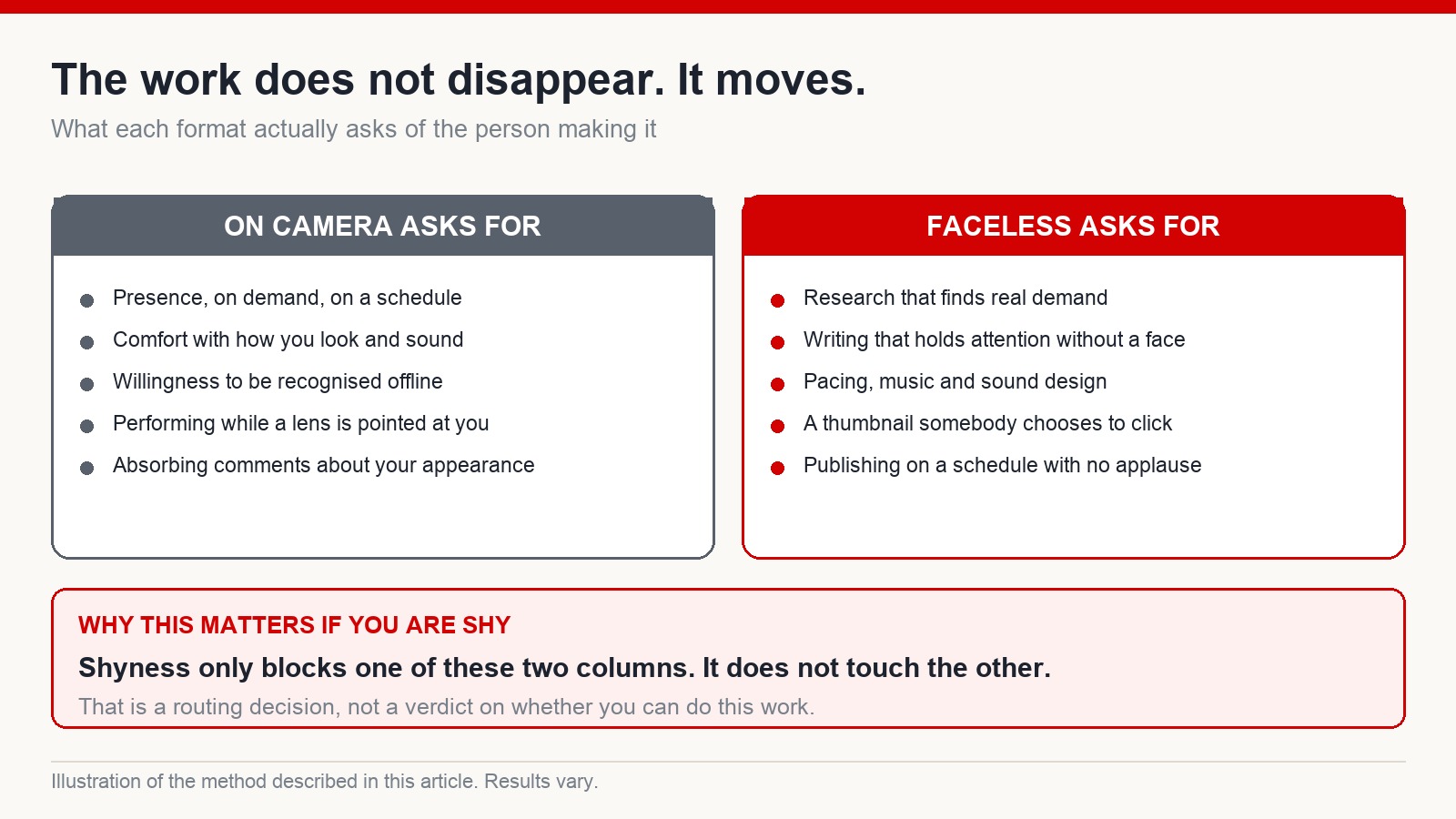
The work does not disappear. It moves.
This is the part people get wrong in both directions. Faceless is not a cheat code, and it is also not a lesser version of the job.
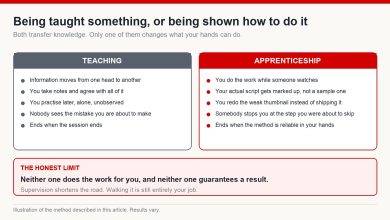
On-camera work asks for presence on a schedule, comfort with how you look and sound, willingness to be recognised in a supermarket, and the ability to absorb remarks about your appearance without it wrecking your week.
Faceless work asks for something else entirely: research that finds real demand, writing that holds attention with no personality to lean on, pacing and sound that keep someone watching, a thumbnail that earns a click without a face in it, and the discipline to publish on schedule while nobody applauds.
Notice what shyness does. It blocks the first column completely and the second one not at all. That makes being camera-shy a routing decision rather than a verdict on whether you can do this work.
What came after, told carefully
By 2022 the faceless videos were finding viewers, and then income. I remember watching a number go up without having stood in front of a camera to earn it, and thinking: this road is real.
What followed was slow and unglamorous. The debts I had accumulated during the bad years took several more years to clear, and they were cleared by producing steadily rather than by any single video changing my circumstances. I am not going to put a figure on it or turn it into an overnight story, because it was neither.
The reason I mention it at all is narrow: a shy person who had failed publicly, with a camera he could not handle, was still able to build something. Not because he became confident. Because he stopped competing in the event he was bad at.
What faceless does not fix
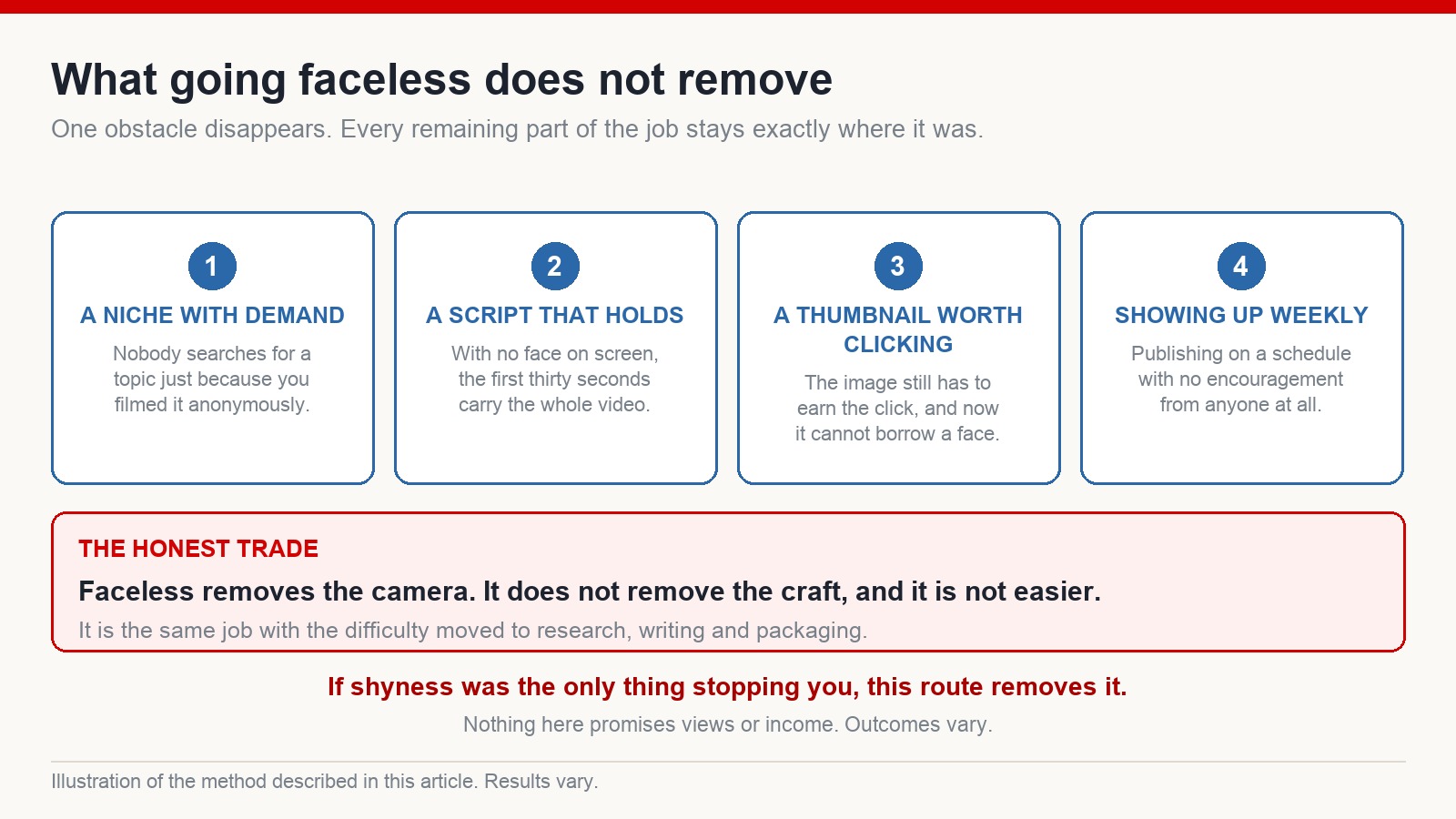
Be clear-eyed about this, because the format gets oversold.
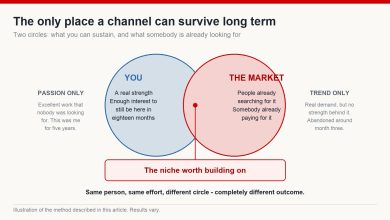
Going faceless removes the camera. It removes nothing else. You still need a niche people are actually searching for – nobody looks for a topic because it was filmed anonymously. You still need an opening that holds, and with no face on screen the first thirty seconds carry more weight, not less. Your thumbnail still has to earn the click, and now it cannot borrow a human expression to do it. And you still have to publish week after week with no encouragement from anybody.
I also want to say plainly: none of this guarantees an income. My results are mine, they took years, and plenty of people work carefully in this format without it ever becoming a living. Platform rules change, competition arrives, niches saturate. What I can say is that if shyness was the specific thing stopping you, that specific obstacle disappears – and the rest of the job is learnable.
To the person still standing at that door
If you have read this far and the fear of being seen is still sitting there, I want you to notice something. That exact fear is what pushed me onto the best road I have found in this work. It did not disqualify me. It redirected me.
You do not have to be photogenic. You do not have to be well known. You do not have to be brave enough to perform for a lens. You have to start, in a format that fits the person you actually are rather than the person you assume a creator has to be.
If you want a structured English-language path for building a faceless channel – real practice, no promises about views or income – it is at mmoyoutube.com. I was where you are: broke, shy, and fairly sure I had picked wrong. That turned out not to be true.
Can a faceless channel really work without ever showing your face?
Yes – large parts of YouTube run that way, from compilations to documentary narration to explainer channels. What the format costs you is the shortcut that a likeable presenter provides; you have to build the same trust through research, writing and consistency instead. It is a real trade, not a free pass.
Is faceless content easier than being on camera?
Different, not easier. You skip performing and the exposure that comes with it, and you take on more research, scripting, editing and packaging. Anyone who tells you it is the easy route is selling something. It suits people who would rather do craft work than perform, which is a personality question, not a difficulty ranking.
What if my voice is the part I am self-conscious about?
Then do not use it. Plenty of channels run on text and music, and synthetic narration has become good enough for many formats. The important part is that the format has to be one you will still be doing in a year, and shame is the fastest way to stop.
Does staying anonymous limit how far a channel can grow?
It limits some routes – personal brand, sponsorships that want a face, speaking work. It does not limit audience size, which is decided by whether the content is worth watching. If you eventually want to be visible, you can always step forward later; it is much harder to take a face back.
How long before a faceless channel does anything?
Longer than the videos about it suggest, and nobody can give you a number honestly. My own restart took months before there was any real signal and years before the finances changed. Judge progress by whether each video is measurably better than your last ten, not by a date you invented.
Disclaimer: this article is personal experience, not financial advice and not a promise of any income or audience. Results vary widely between creators, and platform policies change.