Testing Thumbnails And Titles Without Guessing
For a long stretch I believed my videos underperformed because the content was not good enough. I would re-cut openings, rewrite scripts, spend another evening on the edit. Sometimes it helped. Often it did not, and it took me an embarrassingly long time to notice why: the videos were not being rejected. They were not being opened.
That is a different problem with a different fix, and the fix lives entirely in the two things a person sees before they decide anything – the thumbnail and the title. I have been making YouTube content since 2017, mostly faceless channels for viewers in the US, the UK, Germany and Japan, and packaging is the area where I have changed my mind most often.
What click rate tells you, and what it does not
Click-through rate is the share of people who saw the video somewhere and opened it. It is genuinely useful, because it is the one number that isolates the packaging from everything else about the video.
What it is not is a scoreboard with a passing grade. You will find articles listing exact percentages as average, good and excellent. Ignore all of them. The figure moves enormously with the topic, with where the impressions came from, with how big the channel is, and with whether the video was surfaced to subscribers or to strangers. A number that is unremarkable on a channel about software can be extraordinary on a channel about wildlife, and neither of them tells you anything about yours.
The only comparison worth making is against yourself. Take the median of your own last ten uploads. That is your baseline, it already accounts for your topic and your audience, and it moves as you improve. Everything below assumes that is the number you are measuring against.
Four conditions for a test that tells you something
Most thumbnail changes are not tests. They are hunches carried out under pressure, on a video that is not doing well, at the exact moment when the person making the change is least able to read the result calmly. Four conditions turn a swap into something you can learn from.
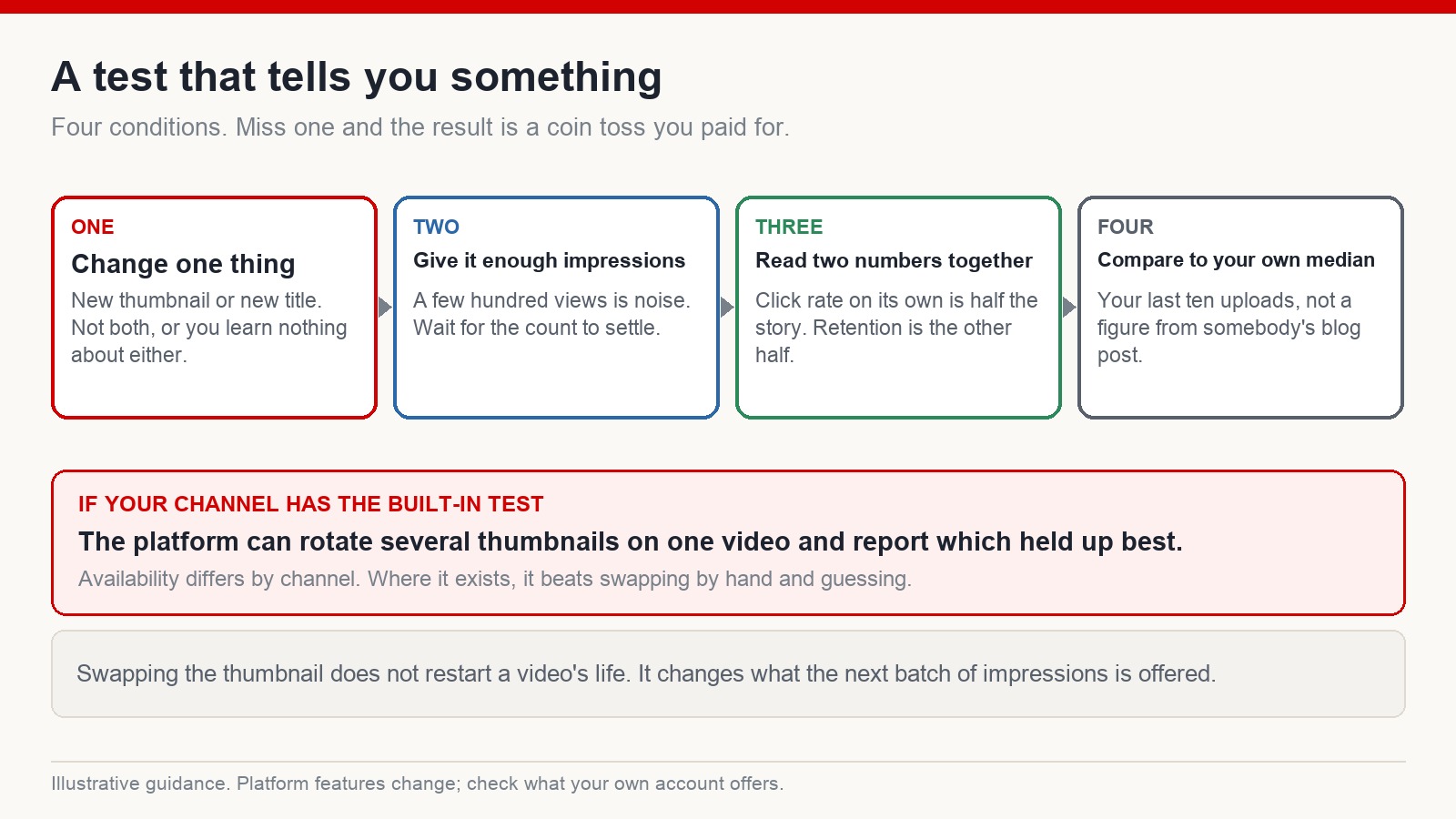
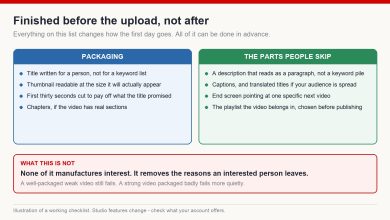
Change one thing. New thumbnail or new title, not both. If you change both and the numbers move, you have learned that something worked and you have no idea which half it was. That is not nothing, but it is not repeatable either, and repeatable is the entire point.
Give it enough impressions. A few hundred views is noise. Early figures swing wildly and then settle, and the swing has a way of pointing at whichever conclusion you were already hoping for. Wait until the number has stopped moving before you read it.
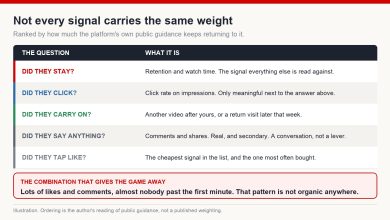
Read two numbers together. Click rate on its own is half a picture. It has to be read alongside how long people stayed, for reasons the next section covers.
Compare against your own median. Your last ten uploads, not a figure from somebody’s blog post – including this one.
If your channel has access to the built-in test that rotates several thumbnails on one video and reports which held up best, use it. It handles the messy part – showing the options to comparable audiences at the same time – which is exactly what a manual swap cannot do, because a manual swap compares Tuesday’s audience against Thursday’s. Availability differs by channel, so check what your own account actually offers rather than assuming.
The two numbers only mean something as a pair
Here is the failure that costs people the most, and it always looks like a win at first: the click rate goes up and the video does worse.
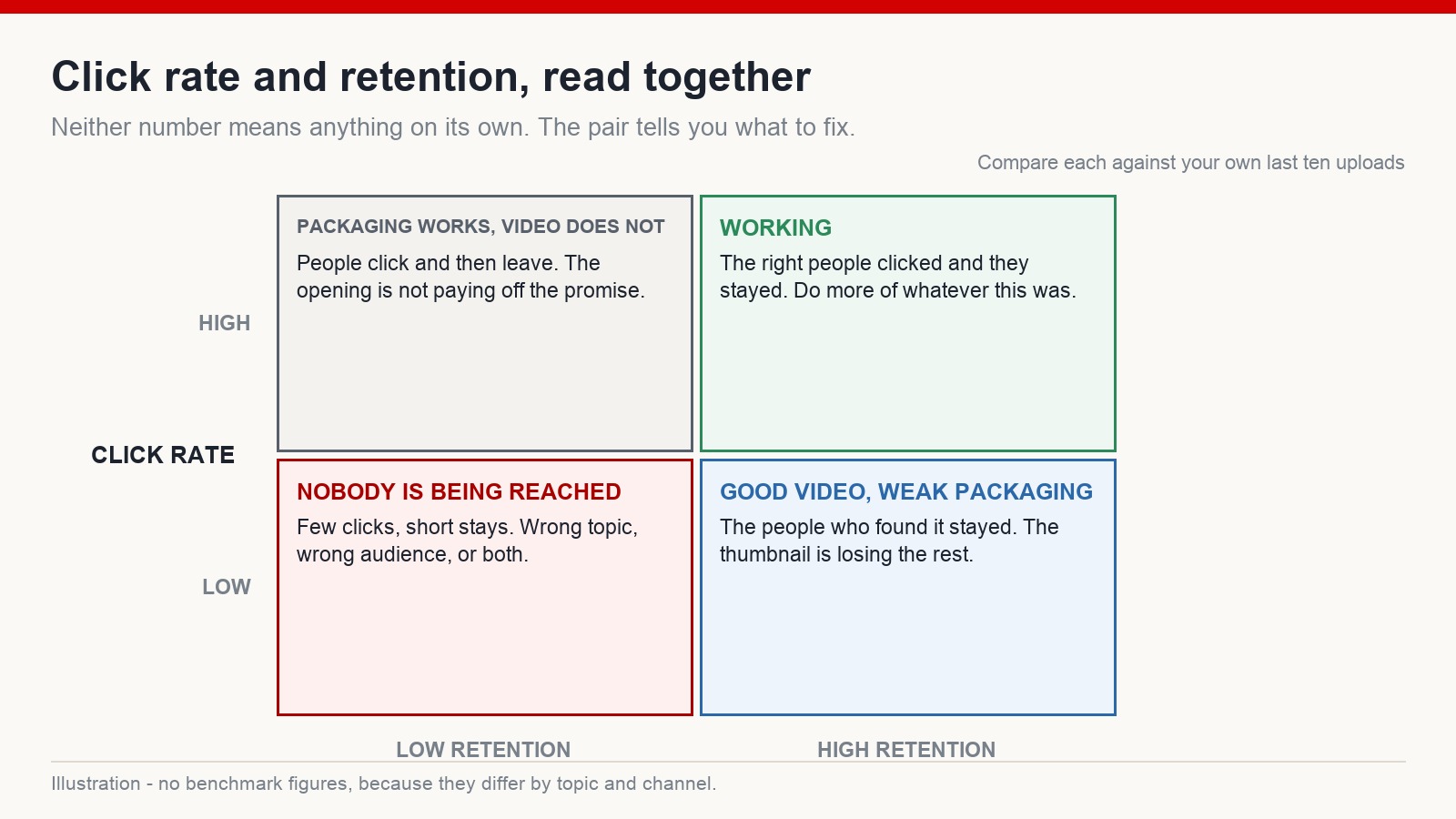
A thumbnail that promises something the video does not deliver will absolutely get clicked. People arrive, discover the video is about something else, and leave within seconds. You have taught the recommendation system that people who click this do not stay, and you have taught your audience that your thumbnails are not to be trusted. The second lesson is the expensive one, because it applies to every video you publish afterwards.
So read the pair. High click rate with people leaving early means the packaging is writing cheques the opening cannot cash – fix the opening, or fix the promise. Low click rate with people staying a long time is the happiest problem on this list: the video works and almost nobody is being given the chance to find that out, so the thumbnail is the only thing to change. Both low usually means the topic itself is not landing with the audience you are being shown to. Both high means stop analysing and go and make another one like it.
Titles that are found and also clicked
The common mistake is treating this as a choice. Either the title is stuffed with search terms, or it is a piece of bait with no searchable words in it at all. Both fail, in opposite directions.
A working title usually does three things at once: it contains the words a person would actually type, it makes a specific promise, and it leaves one thing unresolved. “A guide to lighting on a budget” does the first. “I was lighting everything wrong for two years” does the third. The title you want is closer to the second sentence with the first sentence’s vocabulary folded in.
Writing ten options before you choose one is a genuinely good habit, and it does not matter much whether you write them by hand or draft them with a writing tool – what matters is that the ten are actually different from each other rather than ten rewordings of the same angle. One straight and descriptive. One that names the mistake. One written from the viewer’s situation. One that states a result. One that asks the question the video answers. Then pick, and notice which kind you keep picking, because that is a pattern worth knowing about yourself.
When to change something, and what changing it does
A thumbnail swap does not restart a video’s life. It does not clear its history or give it a second launch. What it changes is what the next batch of impressions is offered, which means the effect is gradual and the older data stays mixed into the average you are looking at. That alone is a reason not to swap something after four hours of anxiety.
The moments genuinely worth revisiting a video: when the click rate is clearly below your own median and the impressions are healthy, which points at packaging rather than reach; when a video that used to perform starts sliding, which sometimes just means the thumbnail has aged; and when an older video suddenly starts picking up views again, because a video finding a new audience deserves packaging aimed at that audience.
The one shortcut I would avoid
Copying a successful competitor’s thumbnail closely – same layout, same colour treatment, same crop, same expression – is popular because it feels evidence-based. It is a poor trade for two reasons.
The first is that it does not work as well as people expect. The thumbnail was doing its job in the context of that channel, that audience and that title, and lifted out of all three it is just a picture. The second matters more: a thumbnail has to represent what is in the video. Where it does not, you are into territory the platform treats as misleading metadata, and “a bigger channel does it” is not a defence that has ever helped anybody.
Study what larger channels do by all means – what they choose to leave out, how much of the frame the subject occupies, whether the text is doing work or just decorating. Then build your own version of the underlying idea. Learn from it rather than reproducing it.
How long should I leave a thumbnail before judging it?
Long enough for the impressions to stop swinging. On a small channel that can be several days. Judging a change in the first few hours tells you about the first few hours and nothing else.
Is it bad to change a title after publishing?
No. Titles and thumbnails are the two parts of a video you can revise for free at any time. What is unhelpful is changing them repeatedly in quick succession, because you end up with data that cannot be attributed to any version.
What click rate should I be aiming for?
There is no universal figure, which is why this article does not give one. Aim to be above the median of your own last ten uploads, then move the median.
Should I use AI to generate thumbnails?
As a drafting tool it is fine. Two cautions: check the result for the mangled text and warped details these tools produce, and make sure the image still honestly represents the video. A generated image that implies something the video never shows is a misleading thumbnail regardless of how it was made.
Does a higher click rate always mean more views?
No. It means more of the people who were shown the video opened it. Whether the video is then shown to more people depends on what those viewers did next, which is why the pair of numbers matters more than either one.
Where to start
Take the video with your best watch time and your worst click rate. That is the one being failed by its packaging, and it is the cheapest improvement available on your channel – no filming, no editing, no upload. Change one thing, wait properly, and compare it against your own median rather than against anybody else’s numbers.
If you want the rest of the process for building a faceless channel for an English-speaking audience, that is what we work through at mmoyoutube.com. Results vary by topic and channel, and platform features change – check what your own account offers before relying on any of it.