The Content Machine: What Has to Be Written Down Before a Channel Can Scale
Ask most creators what scaling a channel means and the answer is some version of “publish more”. More uploads, more hours, more of the same work done faster.
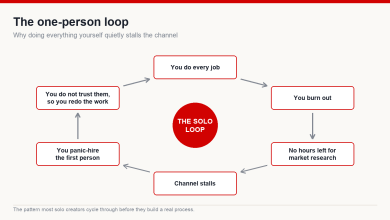
That is not scaling. That is the same job with the volume turned up, and it has a hard ceiling somewhere around the point where a person runs out of evenings.
Scaling means something narrower and less exciting: the channel stops depending entirely on one person’s attention. It is an operations problem, not a creative one, and it is mostly solved by writing things down before there is anyone to hand them to.
The test: what happens if you disappear for three weeks
A useful way to know where a channel really stands. If you stopped working today, how long would output continue at the same standard?
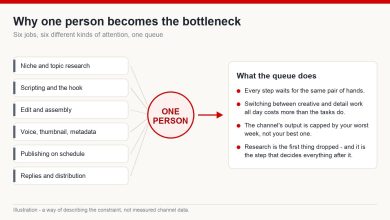
For most solo channels the honest answer is “until the buffer runs out”. Not because the work is difficult, but because none of it exists anywhere except in the operator’s head. The research judgement, the reason a title was phrased that way, the knowledge that this particular kind of opening does badly with this audience – all of it is undocumented, so nobody else can do it and it cannot be improved deliberately.
That is the actual constraint. Not hours, not tools, not budget.
Four layers that have to be written down
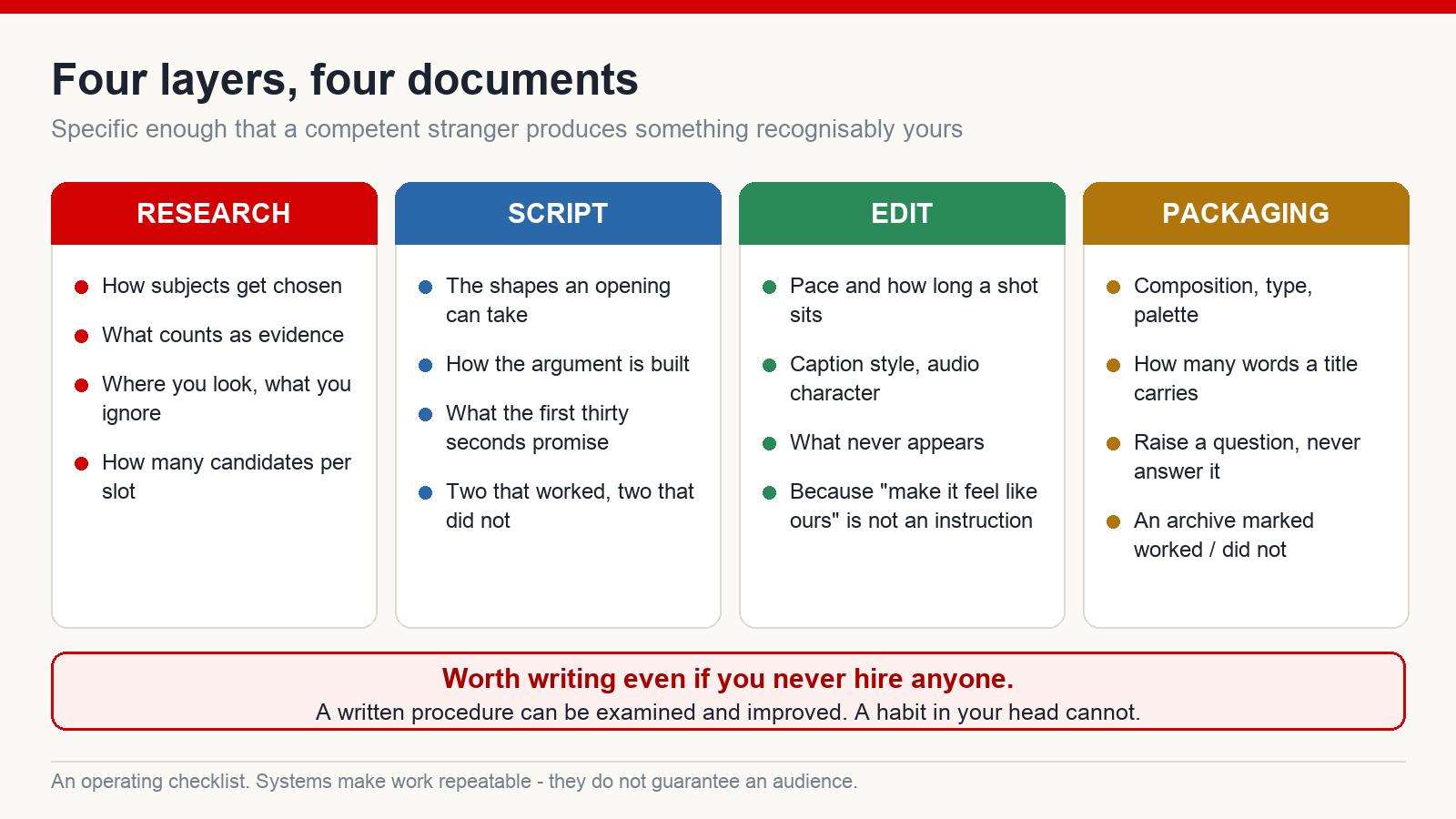
Everything a channel does breaks into four layers. Each has to become a document specific enough that a competent stranger could follow it and produce something recognisably yours.
Research. How subjects get chosen. What counts as evidence a topic is worth doing, where you look, which signals you trust and which you ignore, and how many candidates get shortlisted before one gets made. The output is not a list of ideas – it is the procedure that produces them.
Script. The shapes an opening can take, how the argument is structured, what the video promises in the first thirty seconds and where it delivers, and the rules about tone. This document should include examples from your own catalogue: two openings that worked and two that did not, with a sentence on why.
Edit. Pace, how long a shot sits before it cuts, caption style, what the audio should sound like, what never appears. The reason this needs writing down is that “make it feel like our other videos” is not an instruction anyone can act on.
Packaging. Thumbnail composition, type treatment, palette, how many words a title carries, and the specific thing a thumbnail must do – raise a question rather than answer one. Plus a small archive of your own past thumbnails marked as worked or did not.
The unglamorous truth is that writing these four documents is most of the work of scaling, and it is worth doing even if you never hire anyone. A written procedure can be examined and improved. A habit in your head cannot.
Depth beats breadth
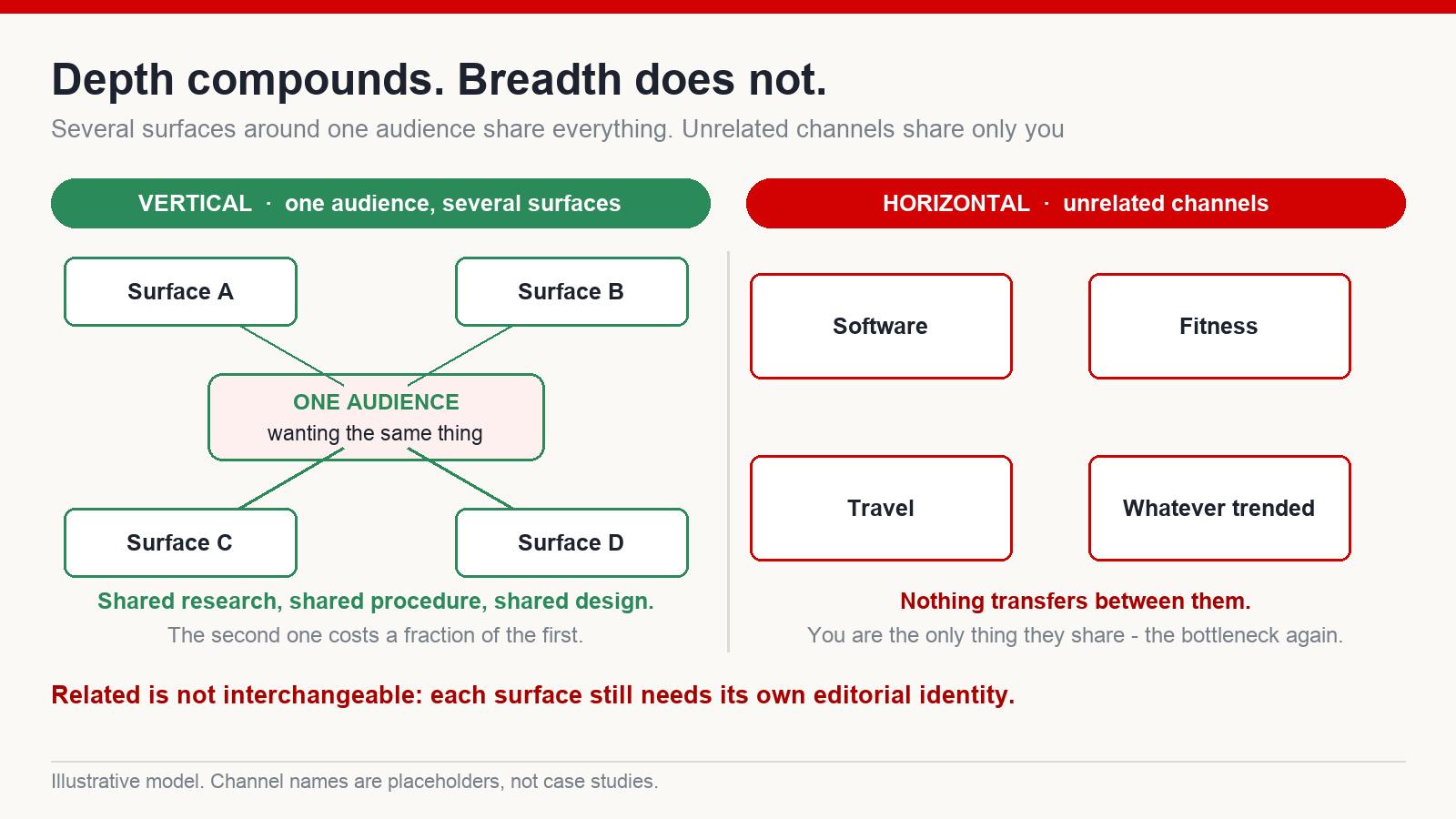
The other half of scaling is choosing what to scale into, and the common error is horizontal: one channel about software, another about fitness, a third about travel, on the theory that more shots mean more chances.
What actually happens is that nothing compounds. Every channel needs its own research, its own audience understanding, its own visual language, and the operator becomes the only thing they have in common – which puts you straight back into the constraint you were trying to escape.
The version that works is vertical. Pick a subject area you already understand, and build several surfaces around the same underlying audience. A group of channels serving people who want the same thing, approached from different directions, can share research, share procedures, share the accumulated knowledge of what that audience responds to, and share the design system.
The second channel in that model is enormously cheaper to run than the first. The second channel in a scattered portfolio costs exactly as much as the first did.
One caution worth stating: each channel still needs its own editorial identity – its own reason to exist, its own voice, its own audience it is speaking to. Related is not the same as interchangeable, and a set of channels that are visibly the same product with different names serves nobody.
Where AI genuinely helps, and where it does not
Generation tools shortened parts of this considerably. Research summaries, first drafts, alternative structures, variant titles, checking whether a script covered what it promised – all of that used to be hours and is now minutes.
What has not changed is the judgement layer. Someone still has to decide which subject is worth doing, what position the video takes, which example makes the point, and whether the finished thing is actually good. A model given the same brief returns work in the same shape every time, and a catalogue built entirely from those outputs reads as exactly what it is.
The pattern that holds up: use the tools to remove labour from the four documented layers, and keep a human decision at the top of each one. If a video uses synthetic voice or generated visuals in a realistic way, disclose it – the platform requires it and viewers who feel misled do not return.
Scaling too early makes the problems bigger
The most expensive mistake in this whole area is scaling before there is anything worth scaling. Hiring, opening additional channels and multiplying output while the core is still unproven does not accelerate anything – it just runs the unresolved problems in parallel.
Reasonable preconditions, none of which involve a specific number:
- You can describe your audience in a sentence, and it is a real description rather than a demographic.
- More than one video has worked, and you can explain why in terms other than luck.
- Results are steady enough that a bad week is recognisable as a bad week.
- The four documents exist and someone else has already produced something usable from them.
Until then, the leverage is in getting one channel to work properly. Multiplying a process you do not yet understand only multiplies the confusion.
The part nobody warns you about: people leave
Here is the structural feature of this industry that surprises everyone the first time. Once an editor or writer has worked inside your system for a year, they know how the whole thing works. They have seen the procedures, they have watched the results, and they can see that the barrier to entry is a laptop.
A meaningful number of them will start their own channel. This is not a betrayal and it is not preventable by secrecy – the knowledge is the job, and you cannot hand someone the job without handing them the knowledge.
What experienced operators do instead is change the arrangement. Revenue share on the channels a person is central to, a genuine stake for people who become core, or partnership on a new channel rather than employment on an existing one. The logic is simple: someone who benefits from a channel growing has a reason to still be there in three years, and a fixed fee for identical work does not create that reason.
It also changes how the work gets done. A partner asks whether the video is any good. A contractor asks whether the video is finished.
What a working system actually looks like
From the outside, a channel that has been through this looks suspiciously easy. Output stays regular, quality does not swing, and the person who started it appears to be doing very little.
What is not visible is the eighteen months of writing procedures, teaching them, fixing the parts that did not survive contact with someone else, and slowly moving from doing the work to reviewing it. That transition is the entire thing.
It is also worth saying that none of it guarantees an outcome. Systems make good work repeatable and bad work visible. They do not make an audience appear, and platform behaviour changes regardless of how well organised you are.
Frequently asked questions
Do I need a large team to scale?
No. Small groups with well-documented procedures routinely out-produce larger ones without them. The number of people matters far less than whether the work is written down.
When is the right time to start?
When several videos have worked for reasons you can articulate, results are stable enough to read, and you understand the audience well enough to describe it in a sentence. Before that, scale amplifies mistakes.
Should I run multiple niches at once?
Usually not. Related surfaces around one audience share research, procedure and design. Unrelated channels share nothing except you, which is the bottleneck you were trying to remove.
Can AI run the whole production?
It can shorten every layer, and it cannot make the judgement calls at the top of each one. Fully automated catalogues tend to read as fully automated, and mass-produced output is a monetisation risk as well as an audience one.
How do I keep good people?
Assume that anyone capable will eventually consider working for themselves, and make staying more attractive than leaving – shared upside, real ownership of an area, and work that gets more interesting rather than more repetitive.
The shift that matters
At some point the question changes from “what video should I make this week” to “does this system produce good videos without me in every step”. That is the whole transition, and it starts with writing down the four things you already do without thinking.
If you want a structured way to build that system for an English-speaking audience, that is what we work on at mmoyoutube.com.