YouTube Keyword Research: Why I Aim at a Narrow Search-Volume Band
A week of editing, and forty views three days later
Do you know the feeling of pouring most of a month into one video? I do. Sitting there cutting every scene, timing every beat to the music, rewriting the title back and forth until midnight. Pressing publish with my heart going. Then refreshing the page like a child waiting for fireworks – waiting for the bang, waiting for something to go up.
Three days later I opened the channel. Forty views. Nothing had gone off. Just me and a silent screen.
The first thought that arrived was: I must be bad at this, I must not have the knack. For years I made things and failed, made things and failed, carrying that bitter little belief around with me. If you are reading this with exactly that fear – that you will spend a week, a month, on a video and it will sink without anyone noticing – then I know where you are standing, because I stood there.
It took me a long time to see one thing, and I will say it straight away: I was not losing because the work was bad. I was losing because I chose the wrong number, before the camera was ever switched on. That number lives in keyword research, the step I used to dismiss as unimportant. It turns out it decides almost everything downstream.
To be fair about it: this work is unpredictable, and most people who learn a method never actually apply it. I am not promising you anything. But if you read to the end, I will give you the search-volume band I aim for every time I pick a keyword, and why it changed how I work.
The counter-intuitive part: low volume is where the room is
When I started I thought the way you probably think now: the more people searching a term, the better it must be, so aim at the biggest one you can find. Wrong, and wrong at the root.
Picture a main shopping street. A keyword with a million searches a month is that street – lit up, crowded, and fully occupied years ago. The million-view channels built their shopfronts there long before you arrived, and the platform keeps sending customers straight to them. You are a new channel setting out a folding table on the pavement for people to walk over. As I put it to the creators I work with: the high-volume terms were taken by the people who already have the views.
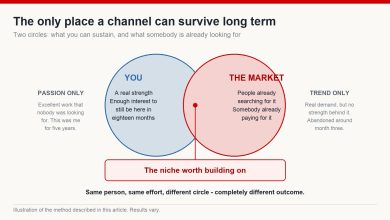
A low-volume keyword is a side street. Big traffic does not turn into it. Which is exactly why a new channel can get in, open a small place, build a few regulars, take a bite at a time – and then one morning realise you are the top result on that street without having noticed it happen. This is the belief underneath everything I do with niche selection: the smaller the niche, the bigger the opening; the smaller the keyword, the bigger the opening.
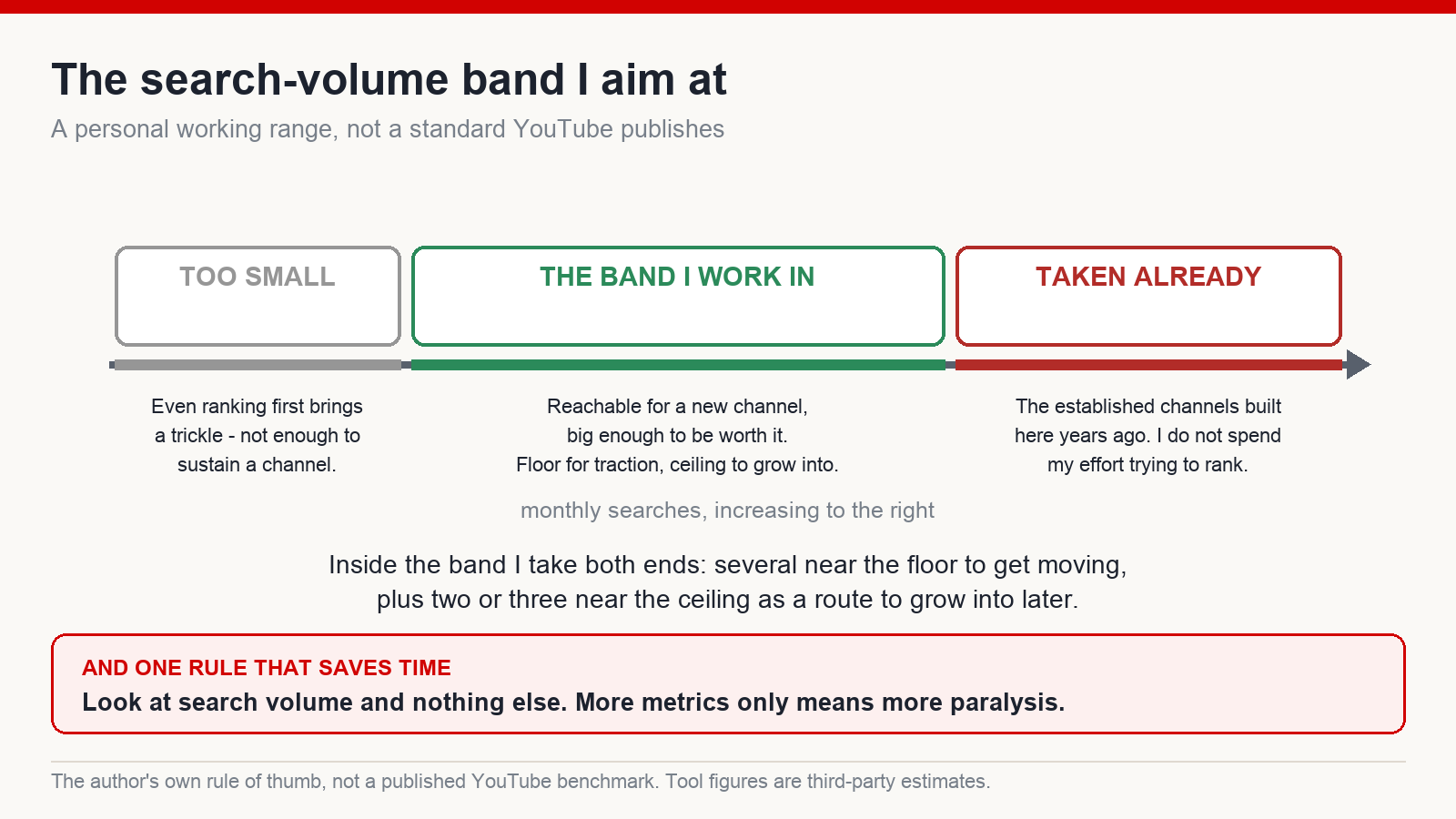
So how small is small? Here is the band you came for: roughly five thousand to fifty thousand searches a month.
Before you write that down, read this sentence carefully, because it matters more than the numbers. That band is my own rule of thumb, built from my own channels and the ones I have worked on. It is not a standard YouTube publishes, and it is not a law. It is a decision aid that stops me dithering, and it may need adjusting for your language and your subject. Use it as a starting position, not as gospel.
Inside the band I work two ends. The low end, around five thousand, is my floor – enough people looking to be worth serving, small enough to be reachable. The upper end, somewhere around forty to fifty thousand, is where I stretch once a channel has started biting. My habit is to take both: a handful of terms near the floor to get moving, plus two or three near the ceiling as a route to grow into later.
The very large figures I cross out. Once a term is up in the hundreds of thousands, I no longer think a new channel has a realistic shot at ranking on it, so I stop looking there. That is a judgement about where my effort is best spent, not a claim about how the ranking system works.
One more thing that runs against instinct: when I assess a keyword, I look at the search-volume figure and nothing else. Competition scores, relevance scores, overall scores – the tools show you a forest of metrics and I ignore all of them. One number. The tighter your criteria, the less paralysed you are, and the faster you decide.
Measuring it: one tool, one metric
I know the next question. “Fine, but how do I find out how many people search a term?” Correct question. You cannot guess it. You need a scale.
The scale I use is a browser extension that overlays search data on YouTube itself. Install one, type a keyword into YouTube, and a column appears down the side of the screen: monthly views on a given video, subscriber counts, revenue estimates, a heap of tags and related terms. On first sight it is overwhelming. Too many numbers.
This is where I want you to slow down. Out of that whole column, I look at one box: search volume, meaning roughly how many people type that exact phrase into YouTube in a month. That is it.
Competition score? Ignore. Relevance score? Ignore. Overall score? Ignore that too. When I started I weighed up every metric on offer, tangled myself in knots, and ended up choosing no keyword at all. More numbers, more paralysis. So I cut myself one rule: look at search volume, check whether it falls inside the band, move on.
Two honest caveats about the tooling. First, these figures are estimates produced by third parties, not official platform data – two tools can disagree about the same phrase, so treat the number as a rough reading rather than a measurement. Second, the free tier of most of these extensions only looks up one term at a time. For a beginner that is genuinely enough; you do not need to upgrade yet. Later, when you want to query several terms at once and have the tool spill out a batch of related phrases, that is when a paid tier starts to earn its keep.
One tool, one metric, one band. Simple enough that you no longer have an excuse not to start.
Three kinds of keyword, and how warm the person typing is
Two people walk into a phone shop. The first says “how much are phones”, eyes still wandering, asking to be polite before leaving. The second asks for one specific model, in one specific colour, at one specific storage size – that person had already opened their wallet in their head before they spoke. Keywords work the same way. Same subject, but how somebody types reveals everything: whether they are warm or cold.
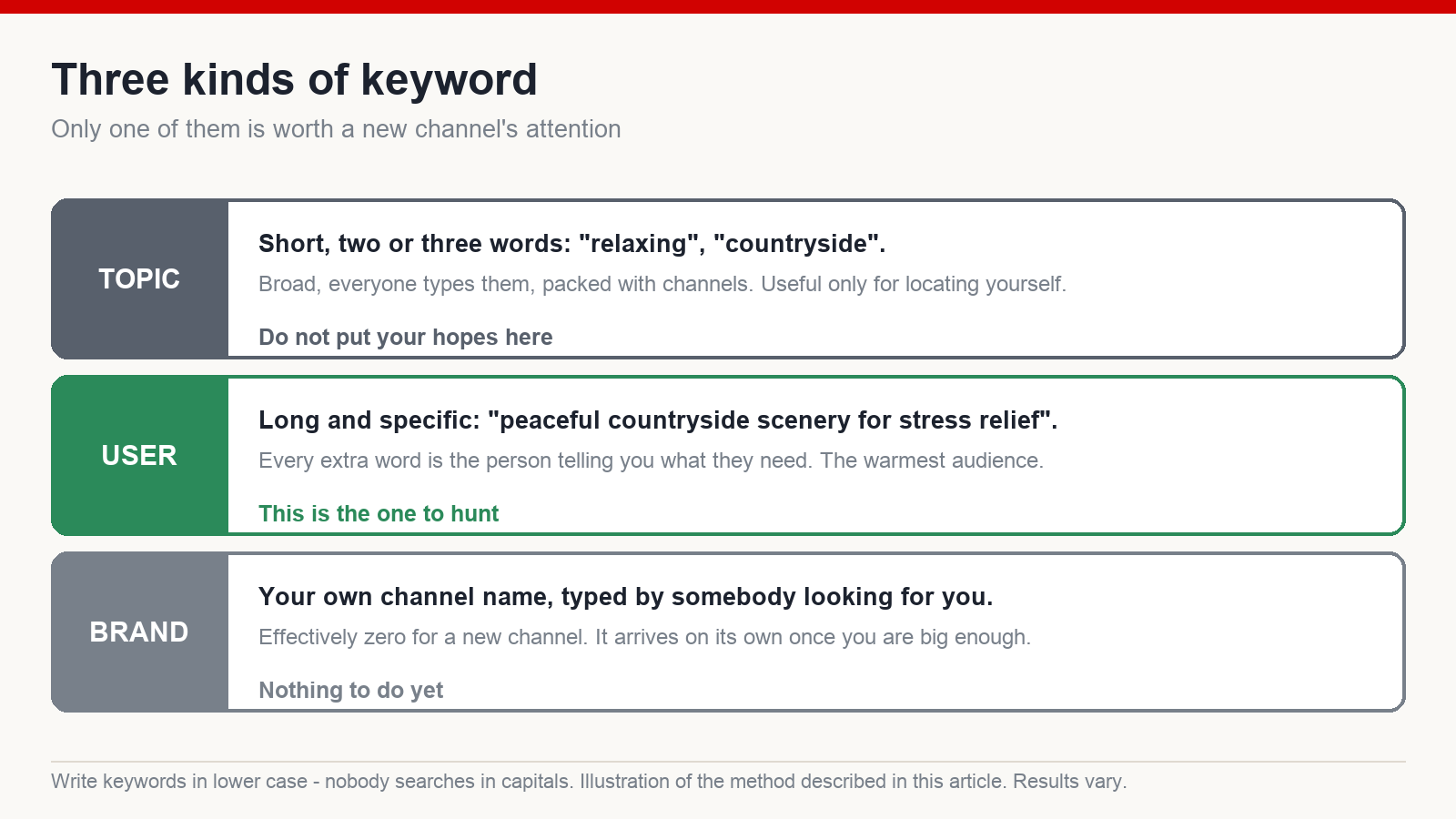
Before we get to temperature, you need to know which kind of keyword you are holding. I split them three ways.
Topic keywords. Short, two or three words: “relaxing”, “countryside”. Broad, everybody types them, and consequently packed with channels elbowing each other. These are useful only for working out roughly where you are standing. Do not put your hopes here; you will be flattened.
User keywords. Long, four words and up, and they have to match how people actually type: “relaxing sounds to sleep to”, “rain sounds for sleeping”, “peaceful countryside scenery for stress relief”. The more specific the better, because every extra word is the person telling you what they need. These are what I hunt.
Brand keywords. Your channel name – somebody typing you in to find you specifically. For a new channel this is effectively zero, so do not think about it. It arrives on its own once you are big enough.
Now connect it back to the shop. The more specific the phrase, the warmer the person. Somebody typing “peaceful countryside scenery for stress relief” genuinely wants to be soothed right now, which is a different human being from the one typing “countryside”. Warm means they want to watch immediately; lukewarm needs reheating; cold is not interested yet. Long user keywords are what pull the warm ones. That is where you plant your flag.
One small detail people forget: write in lower case. Nobody types a search in capitals. If you build your keyword list in title case you have quietly drifted away from how real people actually search.
And if you are writing in a second language, be careful about translating a phrase you like from your own language and assuming the result is what native speakers type. It very often is not. Check the phrase in a real search box and see whether it autocompletes; if nothing comes up, nobody says it that way.
The twist: search brings in almost none of the views
Now something that made me sit still for an afternoon when I first worked it out.
Videos with large view counts are not living on search. You probably assume people type a keyword, find your video, click, and that is how you climb. Not really. On my own channels, search accounts for only a very small slice of total views – a couple of percent at most. Nearly everything else arrives through two other doors: suggested videos, where the platform recommends you alongside something else, and browse, where the platform pushes you onto somebody’s home feed.
That figure is measured on my channels, not a general benchmark. Yours will differ – it moves with the niche, the format and the age of the channel. Go and look at your own traffic-source report rather than trusting mine.
At which point you may want to throw the laptop out of the window: “so what have I been picking keywords for?”
Stay with me. This is the good part.
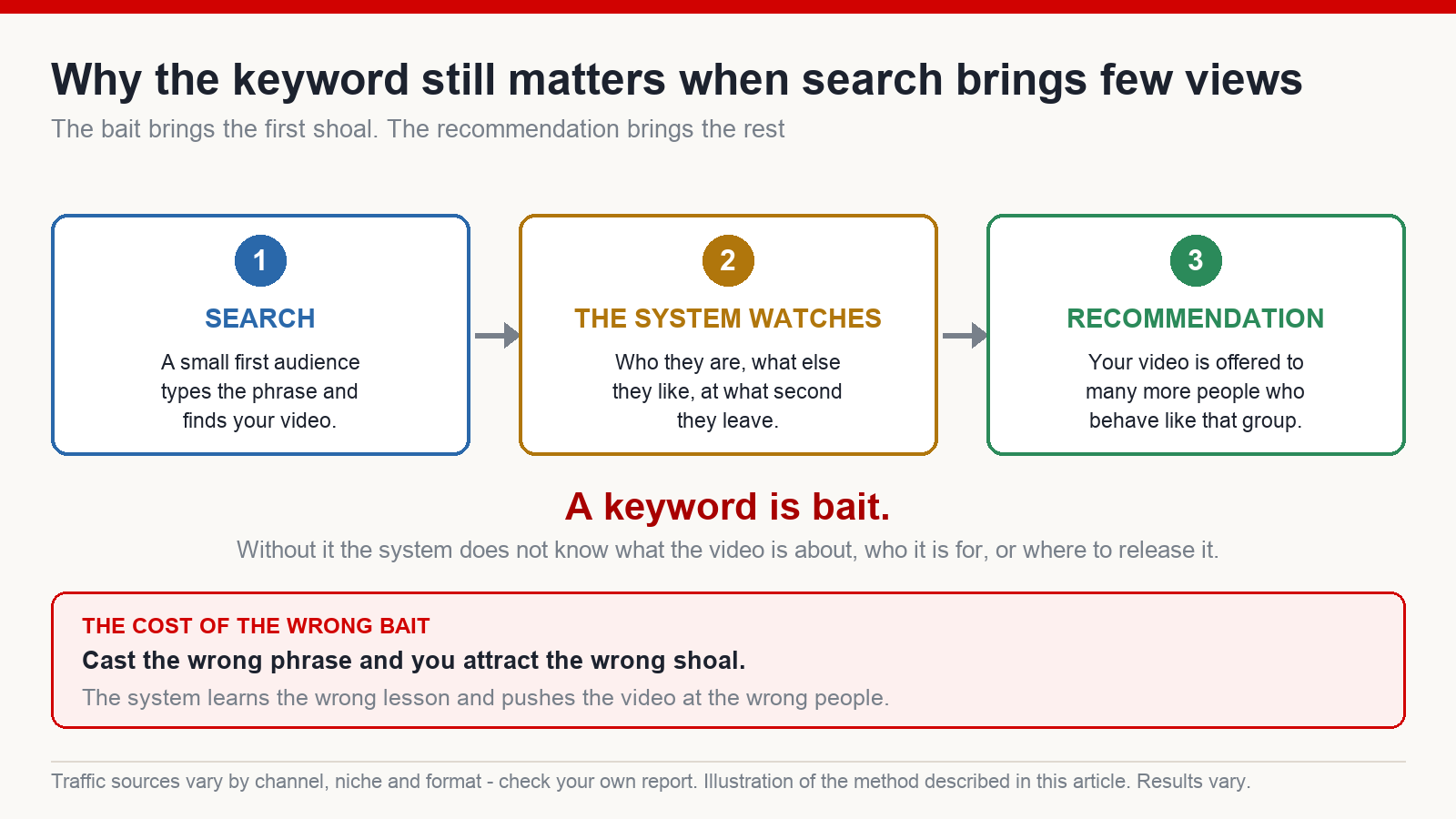
Where does the first audience for your video come from? Search. They type a phrase, see your video, click. And then the platform watches them: how old this group is, where they are, what else they like, at what second they leave. Once it has that picture, it takes your video and offers it to a large number of people who behave like that first group.
In other words, a keyword is bait.
You cannot bring in the first shoal without it. The first fish bite, and only then does the system learn which stretch of river your fish are in and start driving the rest of them toward you. Without bait the algorithm is blind – it does not know what your video is about, who it is for, or where to release it.
So do not read “search is a small share of views” and abandon the step. The opposite follows. Precisely because the growth comes from recommendation, the initial bait has to be right. Cast the wrong bait, attract the wrong shoal, the system learns the wrong lesson, and it pushes your video at the wrong people – a month of work sailing off downriver.
A worked example, and the tag trap
Enough theory. Let me open YouTube and type a phrase in lower case: learn cattle farming for beginners. Unglamorous? Completely. But unglamorous is where the room is. No large channel is sitting down to make an introductory video about keeping cattle, so that side street is still empty – and an empty street is exactly where a new channel can get in.
The extension spills its column down the right. I am not reading the competition score or the relevance score – remember, I glance at one box: search volume. Anything falling inside my band stays on the list; everything else is swept aside.
Then I scroll to the suggested tags. There is good material here: livestock care, starting a farming business, raising cattle, cattle breeding, herd health – all of it genuinely connected to the subject, all of it usable. And this is also where the trap is set.
Where exactly? The tool’s tag suggestions drift. You are talking about cattle and suddenly it hands you “sleep music” and “relaxation”. The volume looks appetising and plenty of people scoop it up. Do not. Put “sleep music” on a cattle-farming video and the algorithm has no idea who to show it to, so it shows it to nobody. Only take tags that genuinely belong to the subject. Fewer and right beats more and wrong.
Packed into four steps you can run the moment you close this page:
- Open YouTube with your extension installed and type your subject in lower case, because nobody searches in capitals.
- Filter, keeping only the keywords that fall inside your working band.
- Mix: a few terms near the floor, plus two or three near the ceiling – and favour user keywords, the long specific ones that match how people really type.
- Use that set as bait: place it in the title, the description and the tags so the system understands what the video is about.
Four steps. There is no hidden fifth.
Being honest about what this does and does not do
Before you close the tab, let me say one thing plainly.
This frame – a working volume band, three kinds of keyword, bait for the algorithm – is a technique for choosing keywords. It is not a money printer. What I say to the people I work with, and I will keep it identical here: without keyword work, most channels never get moving; with a process and decent keyword selection, a much larger share of them do. But hear the comparison properly – that is method against guessing, not a promise that doing it produces views or income.
The harder truth is that most people who learn a method never actually apply it. Not because they are stupid. Because they stop before the channel has had time to move. Income in this work is unpredictable, some months good and some months nothing, and it does not behave like a salary. This is a technical guide meant to stop you wasting effort – it is not investment advice or financial advice, and any result I describe is mine, from one specific road, and guarantees nothing for anybody else. If somebody paints you a smooth path, stand up and walk away.
So, honestly: most people who read this will close the tab and have forgotten it in thirty seconds. Will you?
Can I use keywords below my volume floor?
You can, but I usually skip them. Below the floor the audience is so small that even ranking first brings a trickle, which is not enough to sustain a channel or to give the system much of a signal to work with. That is why I set a floor at all. The exception is if you deliberately gather a large number of very small terms and let them add up.
Is there another way to measure search volume without that extension?
The extension I use is simply the scale I got used to, not the only one. Several other browser tools display an estimated search volume directly on YouTube. The tool is not the point; the principle is – look at one metric, search volume, and check whether it falls inside your working band. Anything that gives you that number will do. Just remember they are all estimates, and they disagree.
If search delivers so few views, why not skip keyword research?
Because the first audience nearly always arrives through search, and that first group is the sample the platform uses to work out who your video suits before it starts recommending it. Dropping keywords means dropping the bait – and a system that does not know what your video is about has nothing to push.
How long before a new channel takes off using this?
There is no shared timeline, and I am not going to invent a tidy number. It depends on the niche, the publishing rhythm, the quality of the videos and your own persistence. Plenty of people quit part way and so never find out. What I am sure of is that choosing keywords in a sensible range stops you wasting effort; it does not shorten the road you still have to walk.
Should I put the keyword in the title word for word?
Where it reads naturally, yes – and better still, build the title around the long user phrase rather than writing a headline first and inserting a keyword afterwards. A title that reads like something a person would actually type tends to do both jobs at once.
A note on the numbers: the search-volume band and the traffic-source share described above come from my own channels and my own teaching, not from any published platform standard. Search-volume figures from any tool are third-party estimates. Nothing here is a promise of views or income, and none of it is investment or financial advice – results depend on the person, the niche and the work.
Written by Phuc, a YouTube trainer who has been building on the platform since 2017 – nine years – working mainly on faceless channels aimed at English-speaking audiences.
The full step-by-step system I run with the creators I work with lives at mmoyoutube.com.