When a Niche Hits Its Ceiling: Four Signs, and the Gate to Pass Before Widening
There is a particular kind of stuck that has no obvious cause. The thumbnails are still good. The click-through rate is fine. Retention has not fallen off a cliff. You are publishing on schedule, the videos are no worse than the ones that worked, and the views simply will not move.
The usual response is to publish more, which does nothing, and then to change subject entirely, which does something much worse. Between those two there is a third possibility that people reach for too late: the niche has reached the size it is going to reach, and the channel needs to widen rather than work harder.
Knowing which situation you are in is most of the skill. Widening at the wrong moment blurs a channel that was fine.
Widening is not starting again
Worth being precise about the word. Expanding a niche does not mean publishing about software this month and football next month. That is not expansion, it is a new channel using an old account, and it usually kills the growth that prompted it.
Expanding means holding the underlying reason people watch and adding new surfaces to it. The audience changes; the thing they want does not. Everything below assumes that definition.
Four signs the ceiling is real
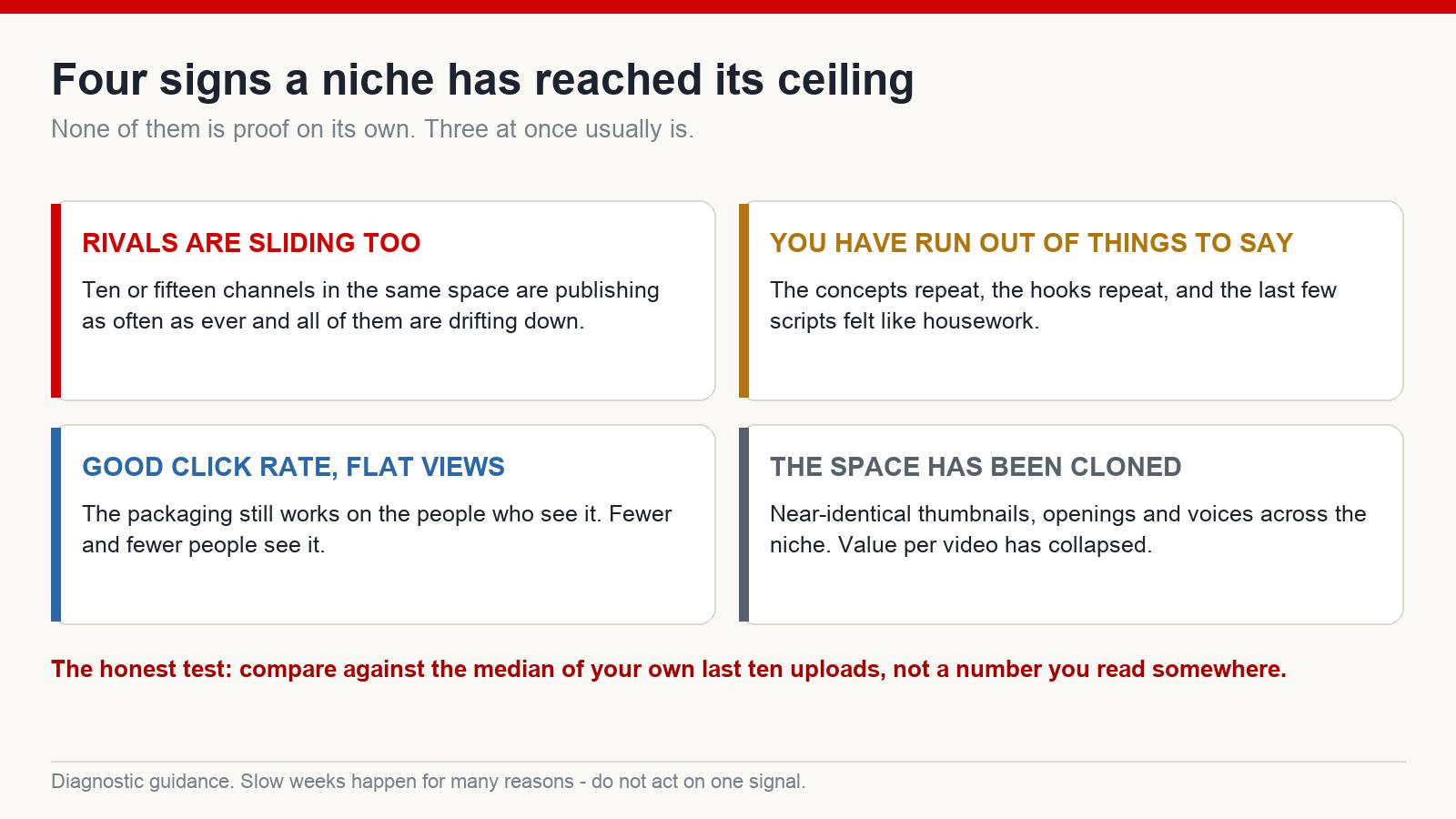
Your competitors are sliding too. This is the strongest single signal, and the one people check least. Look at ten or fifteen channels covering the same ground. If they are publishing as often as ever and their typical results are drifting down together, the problem is not your channel. The space is saturated. This happens fastest in areas that attracted a lot of near-identical production at once.
You have run out of things to say. Easy to mistake for a personal failure. When the concepts repeat, the openings repeat, and writing the last few scripts felt like housework, that is usually not a lack of imagination. It is the subject being close to exhausted at the depth you are working at. Squeezing further out of it produces videos that are visibly thinner than the ones before them.
The click-through rate holds but the views do not grow. A specific and common shape. Packaging is still doing its job on the people who see the video; fewer and fewer people are being shown it. That normally means the pool of obviously-interested viewers inside the niche has been worked through.
The space has been cloned. Near-identical thumbnails, near-identical openings, the same narration style across a dozen channels. When a format becomes ambient, its value per video collapses, and the reasonable move is to stop competing inside it on its own terms.
No one of these proves anything. Slow weeks happen for many reasons, and the honest test is always comparative: measure a video against the typical performance of your own recent uploads, not against a figure you read somewhere. Three of these at once, though, is usually a real ceiling.
The misread that causes the damage
Faced with a plateau, the tempting move is to make whatever is currently popular. It produces a genuine spike, which is why it keeps being recommended, and it does two expensive things at once.
It brings in people with no interest in what you normally publish, which teaches the system something false about your audience. And it takes attention away from the actual question, which was never “what is popular” but “who else has the problem my audience has.”
The gate you should pass before widening
Here is the part usually left out. Sometimes the answer is that you are not ready, and expanding will make things worse rather than better.
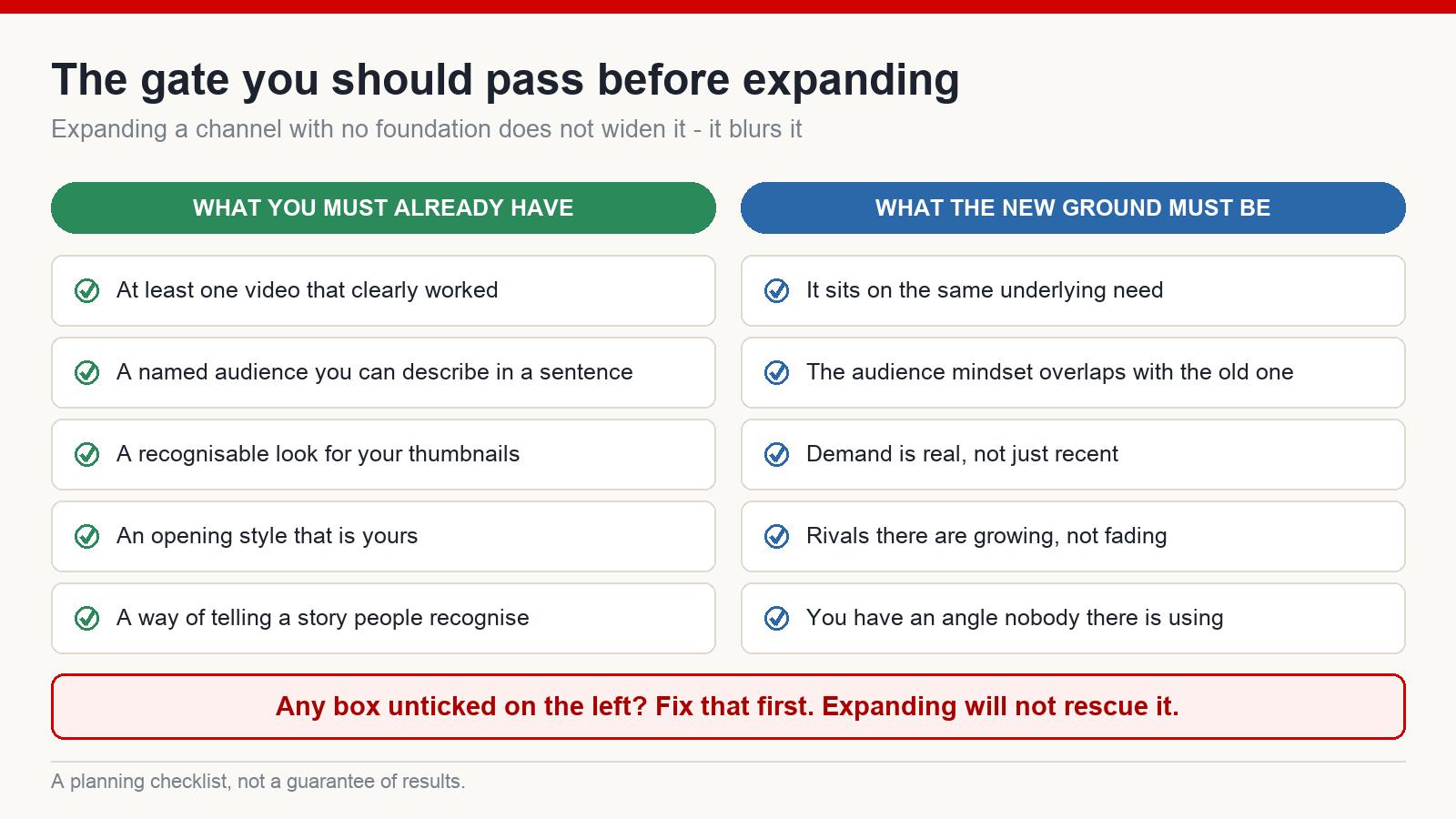
Before you widen at all, you need something to widen from: at least one video that clearly worked, an audience you can describe in a sentence, a look to your thumbnails that is yours, an opening style, a way of telling a story that people would recognise. If a channel has none of these, it does not have a niche that has hit a ceiling. It has a channel that has not started.
And the new ground has to hold up on its own: the same underlying need, an audience whose mindset overlaps with the one you have, real demand rather than a recent spike, competitors who are growing rather than fading, and an angle nobody there is already using. If those are not true, you are not widening into an opportunity. You are widening into somebody else’s saturated niche.
Widen along the insight
The mechanism is the same one that made the original niche work: find the need underneath the subject, then find other people who have it.
If the need is “get more done without giving up my evenings,” that need is held by office workers, freelancers, people running a small shop, people building something alongside a job. Different surfaces, same need. If the need is “understand something complicated without a background in it,” the same applies. The subject can move a long way as long as the need holds still.
One thing that is easy to miss: keep the emotional register too. If a channel is known for being calm and explanatory, a loud, urgent video in a new subject will underperform even when the subject is right – because the people who stayed for the old register do not recognise the new one. The feeling is part of what they subscribed to.
Test cheaply before you commit
Do not make a long video to find out whether a new direction has any pull. Short-form is the cheapest instrument available for this. It tests the opening, the framing and the basic level of interest in days rather than months, at a fraction of the production cost.
If a short version of the idea holds attention, provokes real comments rather than passing ones, and brings in people who then look at something else on the channel, the direction is worth a longer piece.
The caveat matters, though. Short-form and long-form audiences behave differently, and a short performing well is not proof that a long video on the same subject will. Treat it as a cheap indicator, not a verdict – and never as a reason to bet the schedule on one result.
The sequence
Confirm the ceiling with more than one signal. Check the gate honestly in both directions. Find the need underneath the niche rather than the trend beside it. Test the new direction in short form. Then move gradually, keeping most of your publishing on the proven ground while the new direction proves itself or does not.
Channels that scale fast and then collapse almost always skipped the gradual part. They changed everything at once, lost the read the system had on them, and never got it back. Results vary and platform behaviour changes, but expanding slowly is the version that leaves you something if the new direction does not work.
Frequently asked questions
When should I expand my niche?
When several signals appear together: views flattening while packaging still works, competitors in the same space also declining, your own ideas repeating, and the format being widely copied. One signal on its own is usually just a slow month.
Should I change subject completely?
Almost never if you have a working audience. A full change asks the recommendation system to relearn who you serve, and you give up the signal you spent months building. Widen around the same underlying need instead.
Can short-form really test a new direction?
It can test the opening, the framing and whether anyone cares, quickly and cheaply. It cannot tell you whether people will watch fifteen minutes on the subject. Treat it as an indicator.
Will expanding cost me my recommendations?
It can, if you change audience abruptly or if the new content has nothing in common with the old. Keeping the underlying need and the emotional register constant is what limits the damage.
Can I run several new directions at once with AI tools?
Producing them is easy now, which is exactly the problem. Each direction still needs its own angle, its own packaging and its own way of telling, or the whole set reads as one template – and you will not be able to tell which direction actually worked.
I have been building faceless channels for English-speaking audiences since 2017, and getting the timing of this wrong has cost me more than any production mistake. More of how I think about it is at mmoyoutube.com.