Nineteen Of These Channels Own One Word. One Is Allowed To Be General
Twenty YouTube channels for learning tech and data skills, one topic each, with three badges across the top: free to watch · learn at your pace · zero extra cost. As a list of places to learn SQL or statistics it does exactly what it promises.
But this blog is about building channels, not only about watching them — and read from that side, this card stops being a playlist and becomes something more useful. It is a map of who currently owns what, and it happens to demonstrate the single most repeated piece of advice in this field more clearly than any explanation could.
Go down the list. SQL. Excel. Statistics. Mathematics. Python. Data analysis. Machine learning. Deep learning. Java. Big data. Data engineering. NLP. Computer vision. Generative AI. Ethical hacking. Data science. Web development. Cloud. AI and ML.
Nineteen channels, nineteen words. Not one of them got onto this card by covering “tech”.
And then there is number twenty, labelled All-in-One — the single general-purpose entry, and the slot already occupied by one of the largest free-education operations on the platform. Exactly one channel here is allowed to be about everything, and it is the exception that explains the rule.
Three layers of a learning path
| FOUNDATIONS | APPLIED SKILLS | SPECIALIST TRACKS |
|---|---|---|
| Mathematics · Statistics · Excel · SQL · Python · Java | Data analysis · Web development · Cloud · Data engineering · Big data | NLP · Computer vision · Deep learning · Gen AI · Ethical hacking |
| Biggest audience, hardest to stand out in | Fewer viewers, far more intent | Smallest audience, highest value per viewer |
| People who have not decided what they are doing yet | People with a job or a project in front of them | People who already know the field and want depth |
| Crowded. You need a format advantage, not just accuracy | The sweet spot for a new channel | Defensible, but you must genuinely know it |
All twenty, as the card lists them
Every word in the first three columns is the card’s own, handles included.
| # | Topic | Handle | What the card says |
|---|---|---|---|
| 1 | SQL | @techTFQ | Learn SQL from basics to advanced |
| 2 | Excel | @excelisfun | Excel tips, formulas and real-world use |
| 3 | Statistics | @statquest | Easy and clear statistics explained |
| 4 | Mathematics | @khanacademy | From basic to advanced math |
| 5 | Python | @BroCodez | Python tutorials for everyone |
| 6 | Data Analysis | @AlexTheAnalyst | Real data. Real projects |
| 7 | Machine Learning | @campusx-official | ML concepts and projects |
| 8 | Deep Learning | @deeplizard | Neural networks and AI made simple |
| 9 | Java | @Telusko | Java tutorials for beginners and pros |
| 10 | Big Data | @SimplilearnOfficial | Big data concepts and career skills |
| 11 | Data Engineering | @dataengineeringvideos | Build data pipelines and more |
| 12 | NLP | @codebasics | Understand and build NLP systems |
| 13 | Computer Vision | @murtazasworkshop | AI that sees the world |
| 14 | Gen AI | @sunnysavita10 | Learn generative AI and LLMs |
| 15 | Ethical Hacking | @NetworkChuck | Cybersecurity skills and basics |
| 16 | Data Science | @krishnaik06 | Data science, ML and AI projects |
| 17 | Web Development | @TraversyMedia | Build websites and web apps |
| 18 | Cloud Computing | @TechWorldwithNana | DevOps, cloud and Kubernetes |
| 19 | AI & ML | @DeepLearningAI | AI tools, tutorials and projects |
| 20 | All-in-One | @freeCodeCamp | Full courses. Free. For everyone |
WATCH THE ORIGINAL — 20 SECONDS
All twenty channels with their handles and one-line descriptions, and the footer reminding you to check each one.
▶ Best YouTube channels to learn tech and data skills — BANI Academy on Facebook
What the card teaches a creator
Three things, and none of them are in the descriptions.
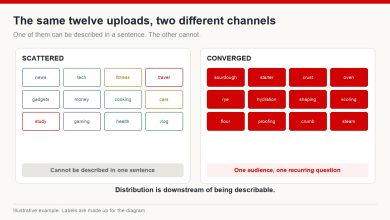
One: the topic is the channel. Every entry here is findable because somebody can type a single word and the channel is what comes back. That is not a branding choice, it is a search behaviour — people do not search for a personality, they search for the thing they are stuck on at eleven at night. A channel named after a topic is a channel that can be found by somebody who has never heard of you.
Two: the general slot is taken, and it was taken by an institution. The All-in-One row is a non-profit with an enormous library and a decade of head start. If your plan is “I’ll cover everything in tech”, you are not entering an open category — you are entering the one category on this card that already has a winner, with no niche to defend you.
Three: look at what you are competing with. The badges across the top of the card are the viewer’s side of the deal: free to watch, learn at your pace, zero extra cost. Those are also the terms you have to beat. The question for somebody starting a teaching channel is not “can I explain SQL” — nineteen people already can, for free, with ten years of back catalogue. The question is what you have that a back catalogue does not: a newer version of the tool, a specific audience nobody is speaking to, your own real project with real numbers, or a language the existing twenty do not teach in.
That last one matters more than it sounds. Every handle on this card teaches in English. The same twenty topics, taught properly in another language, is twenty open slots — and the audience is identical in size to the problem.
So where is the opening?
| If your plan is | Where that leaves you | What to do instead | The practical note |
|---|---|---|---|
| “I will teach programming” | Taken, nineteen ways over | Name the exact thing: one language, one stage, one job it gets you | Your channel name should be searchable as a phrase |
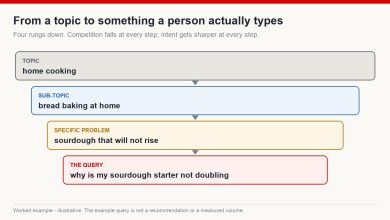
| “I will cover all of AI” | Taken by the All-in-One row | Pick the sub-topic you have actually shipped something with | Gen AI, computer vision and NLP are three different channels here |
| “I will explain it better” | Weakest position on the list | Better is invisible in search results. Different is not | Format, language, or audience — pick one to change |
| “I will teach the newest tool” | Genuinely open | Back catalogues cannot cover something released last month | But you must keep doing it, or the advantage expires |
| “I will teach in my own language” | Genuinely open | Twenty topics, taught properly, for an audience nobody serves | The hardest part is sustaining it, not finding viewers |
| “I will show my own project” | Genuinely open | Nobody else has your data, your mistakes or your numbers | One real project beats twenty tutorials of theory |
Four honest caveats
The footer is right and worth repeating. Channel picks are suggestions only. Check each channel yourself before you follow it. Handles change, channels go quiet, and a recommendation made once stays in circulation long after the channel stopped posting. Before you commit a month to any of them, check when the last upload was.
A saved list is not a curriculum. Twenty channels covering twenty topics looks like a syllabus and is not one. There is no order, no prerequisite chain, and no way to tell which three of these you need. Pick the one that matches the thing you are trying to build and ignore the other nineteen — the argument for going that narrow is in Pick One Per Stage And Learn It Properly, and the case for starting from the project rather than the subject is in Which Language Should I Learn First Is The Wrong Question.
Watching is not learning, and this is the expensive one. Free, self-paced and zero cost also means nothing forces you to finish. The failure mode of a list like this is twenty subscriptions, four hundred saved videos and no project. Whatever you watch, stop at the first thing you can build and go build it badly.
Nobody is checking the work. A tutorial is somebody making something and saying it is good — and the thing that produced the output cannot also be the thing that grades it. If you follow along, decide in advance what a working result looks like, then test against that rather than against how confident the video sounded. That argument in full is in The Thing That Makes It Can Never Be The Thing That Grades It.
Questions people ask
Which of the twenty should I start with? Whichever matches the thing you want to exist in four weeks. If nothing comes to mind, that is the actual problem, not the channel choice.
Is a niche channel really better than a broad one? This card is twenty pieces of evidence for it. Nineteen topics, nineteen owners — and the one general entry is an institution, not a person.
Can a new channel still get into a category this crowded? Into the topic, yes, by being the version of it that does not exist: newer, in another language, or built around a real project. Into the generic middle, no.
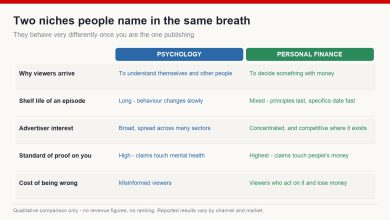
How does this connect to making money from a channel? It does not, directly, and that gap is the point. A topic gets you an audience; what you offer them is a separate decision — the split we worked through in The Channel Is The Audience, The Offer Is The Income.
One word each
Twenty channels, three badges, one quiet footer. As a list of places to learn, it is a good one and the footer tells you how to use it responsibly.
As a map, it says something sharper. Nineteen people found a word nobody else had taken and spent years making that word theirs. The twentieth is an institution with the only general slot on the board. There is no row on this card for somebody who wanted to cover everything.
Pick your word. Then make something with it before you make a video about it.
Learning a lot does not make anyone good. Doing a lot does.
If you want a deadline rather than twenty new subscriptions, we run a free challenge — there is no barrier to entry, only a commitment fee that is refunded when you finish. It exists because a deadline finishes the project, and a saved list finishes nothing.
Which word would be yours? Tell us in the comments under the original reel.
More on building a channel for a global audience at mmoyoutube.com.
2 Comments