The YouTube Title and Thumbnail Formula That Wins the Click Before the Video Starts
The night I worked out why nobody was clicking
There was a night I sat looking at a video I had just published. A few hundred views. I had spent three days on it, cutting every shot, cleaning every sound. Still a few hundred views. Then my hand drifted, half-consciously, to the video sitting next to mine in the suggested column: The Ultimate Girls Fail Compilation | Try Not to Laugh. Out of curiosity I glanced at the counter. 213 million views. 213,178,098, to be exact, with around 381,000 likes. Uploaded in 2012 and still collecting, fourteen years on, from one video made once.
Two numbers collided in about three seconds. A few hundred, and 213 million. I was not jealous. I was stung – the particular sting of losing without being able to see where you lost.
Do you know what actually made my skin go cold? A viewer decides to click or scroll in one or two seconds. All they look at is a line of text and a picture. They had not watched a single second of my content. Three days of work, and they never saw any of it. What they saw – and what they rejected – was only the outermost wrapper.
In this trade that fight is called CTR, click-through rate: of the people who saw your thumbnail, how many actually clicked. And I lost that fight before the content fight had a chance to start. I will say it plainly: back then I packaged badly. My content was not so weak that it deserved a few hundred views. But the wrapper I put around it genuinely was. Nobody unwraps a gift wrapped in yesterday’s newspaper.
I did not have the answer that night. What I had was a suspicion: the channel with 213 million views on a single upload was not lucky. It had a template. And I had never studied the template.
You are not short of talent, you are short of a template
I can guess the sentence you are saying to yourself right now, because I said the identical one: maybe I just do not have the eye for this.
You watch someone else’s channel take off. You look at FailArmy – 17.5 million subscribers, close to five billion lifetime views spread across 991 videos – and then back at your own few hundred. And the thought slips in: some people are born with taste and instinct, and I am not one of them.
Let me take that weight off you. It is not a talent problem. It is a packaging problem.
Here is the thing that rescued me. When a FailArmy video crosses a million views around the four-week mark, that is ordinary for them, not a fluke. Flukes do not repeat for years on end, and they do not spread five billion views across nearly a thousand uploads. Anything that repeats at that scale has stopped being a gift and become a template. Templates can be learned. You do not have to wait for the universe to hand you an instinct. You just have to pick up the template.
And to keep myself honest: I am not promising that you learn this template tonight and wake up to a million views. That is not how it works. Titles and thumbnails decide exactly one thing – whether someone CLICKS. Whether they stay once they are inside is the content’s job.
The picture I use is a door. The thumbnail and title are the door. The content is the room behind it. However beautiful the room, however carefully arranged, if the door stays shut nobody walks in to see it. All that effort building the room is wasted on a door.
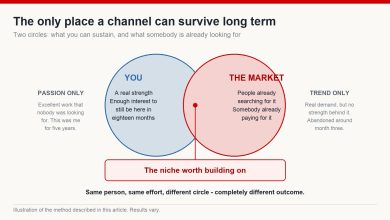
So carve this into your head: people do not click your video. They click the PROMISE your title and thumbnail make.
Inside an evergreen title system: a handful of templates reused for fourteen years
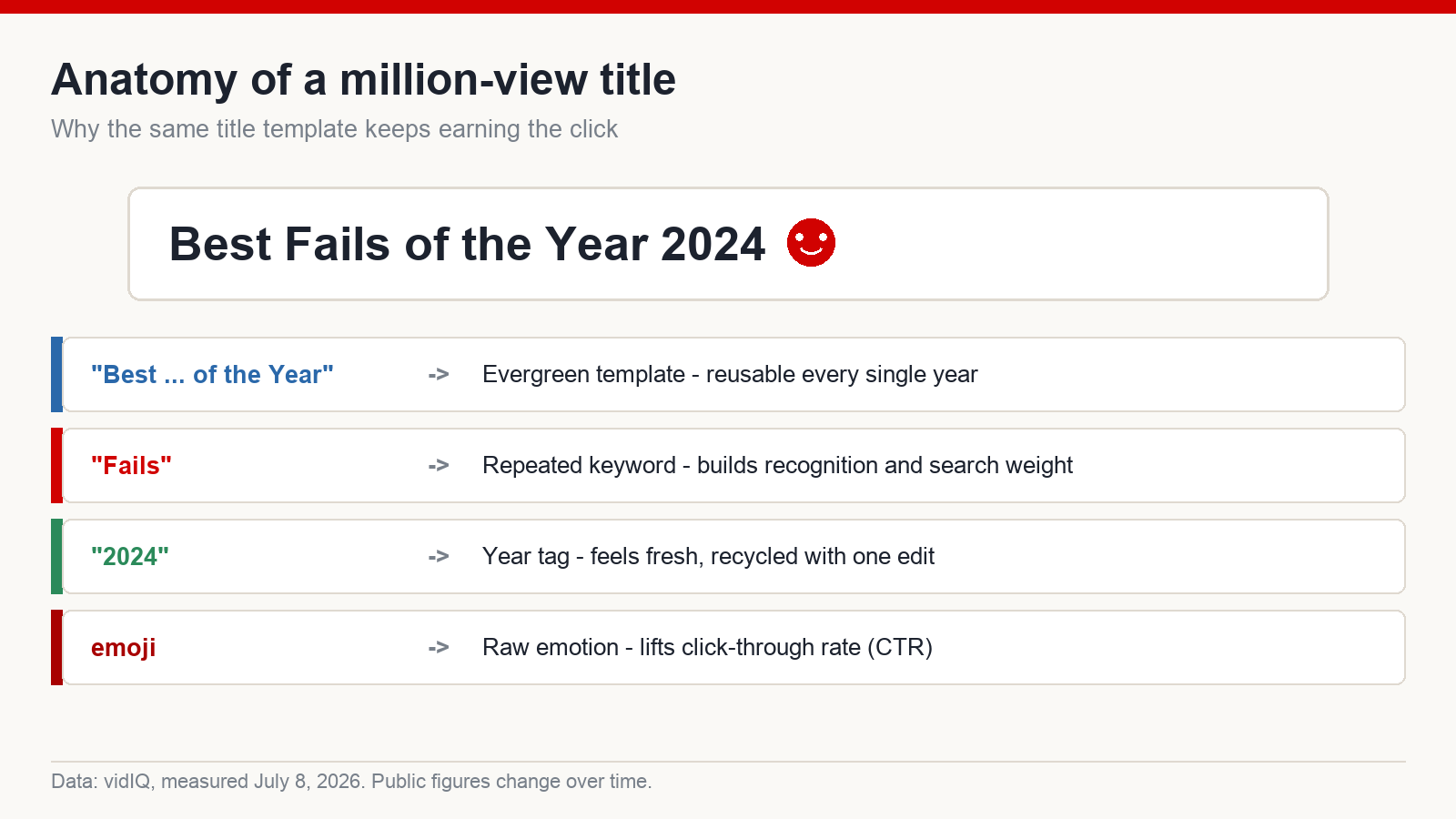
Have you noticed something strange about a channel with 991 videos? The titles all look alike. I used to read that as laziness. Taking it apart properly, I understood it as discipline. FailArmy barely invents a new title on upload day – they cast a few templates once and then pour new content into the old moulds, year after year.
Look at their comedy frame: Try Not to Laugh Challenge, Best Fails of the Week, Best Fails of the Year. The word “Fails” and the phrase “Try Not to Laugh” repeat like an incantation. A viewer scrolling past recognises the dish instantly, the way you recognise the sign of a restaurant you already know without reading the menu. And notice the tail – “of the Week”, “of the Year”. Change one word and you have a new video, reusable weekly, annually, indefinitely.
Then the vehicle frame: Idiots in Cars, Insane Dashcam Fails, Stupid Drivers Caught on Camera. One niche, three titles, one skeleton. What I like is the restraint – each template holds a single niche instead of cramming everything into one impressive-sounding line.
The security-camera frame: Security Camera Disasters | Best of CCTV. That vertical bar is not decoration – it slots in another keyword phrase while the eye still reads the line smoothly. The nature frame: Damn Nature You Scary | WILD Animal Encounters. The comeuppance frame: Funny Instant Karma Fails, Expensive Fails. You read it and you want to click, because everybody is curious about what stupidity costs.
So what do you take from that as someone building for an English-speaking audience? Stop inventing a fresh title for every upload. Pick three to five fixed English templates for your niche and reuse them: one repeated keyword as the spine (their “Fails”), one strong adjective carrying the emotion (Insane, Expensive), and where it fits, a year tag or an “of the Week” so the template can be recycled forever. This does two jobs at once. The algorithm reads you as a series with a clear subject, and the audience learns your face – they see it and know it is yours. That is the root of evergreen content: package the template once, and it carries dozens of videos behind it.
Strong adjectives and the year tag: one template, many harvests
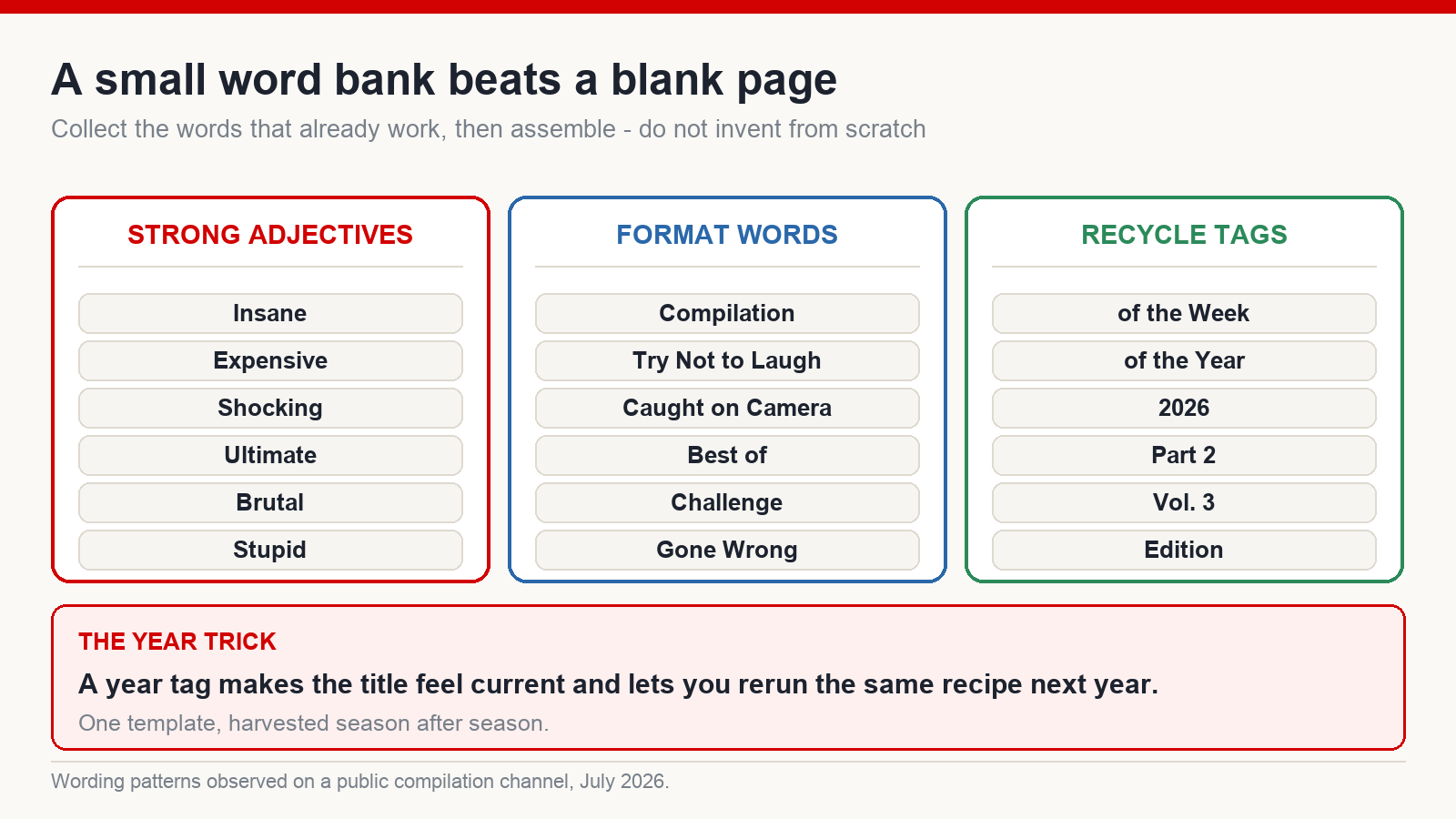
Open any FailArmy title and one word hits you in the face: Insane, Expensive, Shocking, Idiots, Stupid. Not an accident. Those are strong adjectives, and their job is to promise an emotion before your finger has finished moving. “Idiots in Cars” is a different animal from “funny car videos”. One pulls you in – there are real idiots, you are going to laugh. The other slides past and leaves nothing behind. A viewer scans dozens of thumbnails in a few seconds, and the strong adjective is the hook that catches the eye. It does not describe the content. It baits a feeling.
The second move is quieter: put a year in the title. Expensive Fails | Total Idiots 2022 was published in December 2021 and has gathered roughly 19 million views since – 19,005,804 at the time I measured it. That “2022” is doing two jobs. It breathes “new, current, worth watching”, and it lets you re-cook the same recipe every year under a fresh label. Next year it becomes “…2023”, the year after “…2024”. Same template, harvested season after season.
This is the part I want you to sit with. Because they anchor to a template rather than to a news cycle that dies in 48 hours, those videos keep trickling views for years. That is evergreen content: not a spike that goes out, but a steady, durable flow.
The numbers back it up. A “normal” video on that channel reaches a median of about 743,000 views after 7 days and about 1,031,000 after 28. I use the median rather than the mean so that a handful of monsters do not distort the picture. And to be blunt so you do not build a fantasy on it: this is a channel with 17.5 million subscribers that has been standing for years. It is not a promise that anyone doing this gets a million views. But the template travels. Try it today: pick a strong adjective, attach an evergreen subject, put a year on the end. Package it decently and publish consistently.
Thumbnail, then title, then content: three links that cannot break
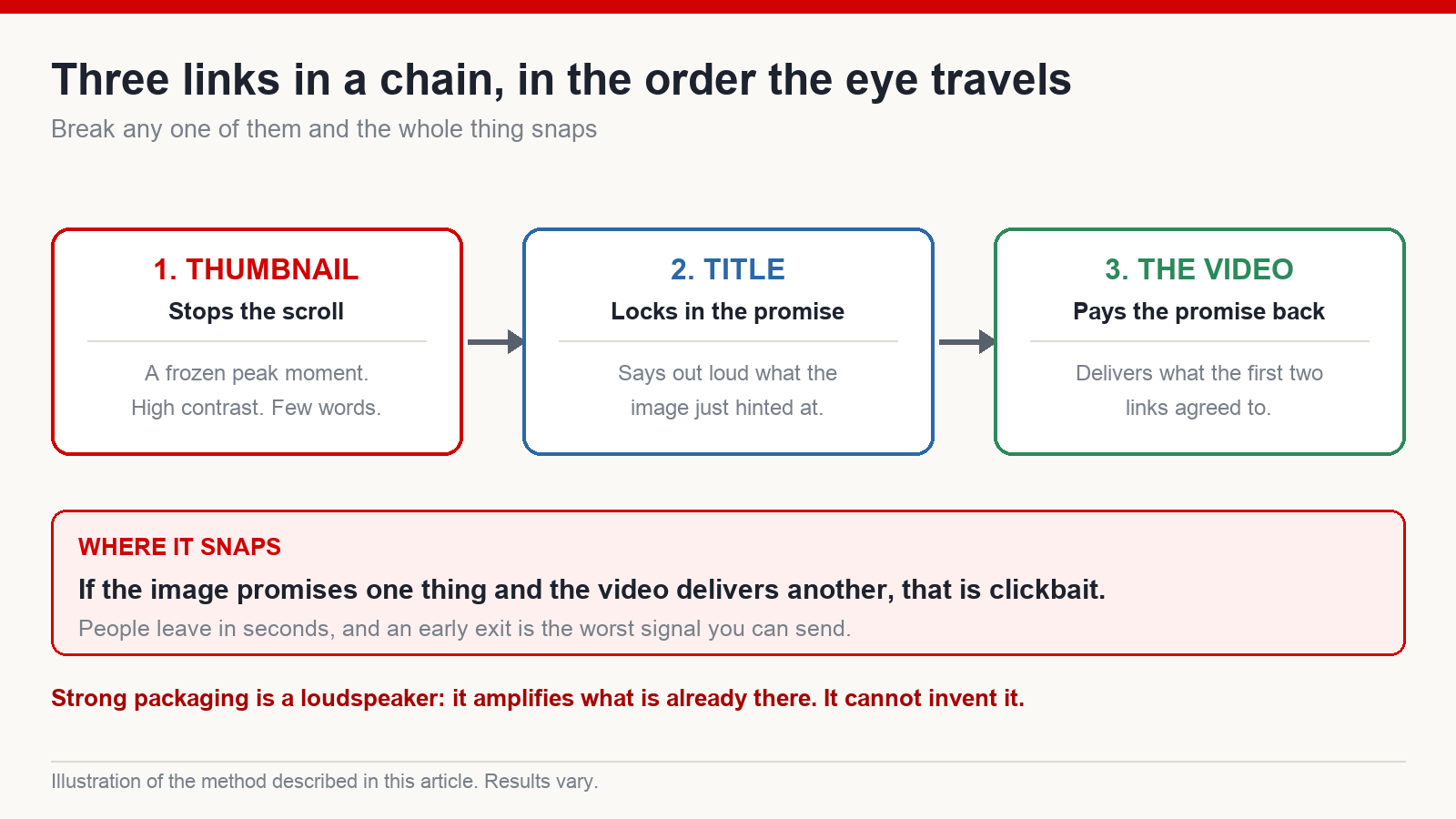
Let me describe how a viewer decides. They do not read the description. They do not preview. Their eye lands on the thumbnail first, in about the time of a blink. Before thought arrives, the eye has already flicked to the title to confirm the promise it just saw. Only after those two beats does the finger move. Three links in strict order: the thumbnail stops the scroll, the title locks in the promise, the content pays the promise back. Break one link and the chain snaps, and the video dies at the impression stage.
In the five-source framework I teach, I put those three pillars side by side – thumbnail, then title, then content – not for tidiness. It follows the path the eye actually takes. And it matches how this channel packages for viewers in the US, UK, Germany and Japan, markets where CPM, the amount paid per thousand views, tends to run higher. Look closely at their thumbnails: always a peak moment frozen in place. A face mid-panic. A fall halfway down. Heavy contrast, few words, and matched exactly to what the title promised.
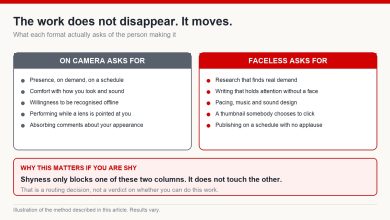
Here is where I want to remove a fear. Plenty of people assume a strong thumbnail requires your own face in it. Wrong. A faceless channel can hit just as hard, because the emotion does not come from your face – it is already sitting inside the clip. That fall, that expression, is already in the footage. Your job is only to find the most valuable frame and put a border around it.
And to be fair about what packaging can do: it is a loudspeaker. It amplifies what is already there. It cannot generate sound of its own. If the three links do not agree – the thumbnail promising one thing, the content handing over another – that is clickbait. The viewer clicks, feels tricked, and leaves within seconds. The algorithm reads that early exit and stops pushing the video. You have just spent a valuable impression shooting yourself in the foot. So my rule is blunt: you are allowed a bold thumbnail and a strong title, as long as the content pays in full. All three layers have to agree. Do not deceive the viewer.
The fill-in-the-blanks formula for writing English titles
Do you know the fear I hear most often from people starting out on an international audience? Not running out of ideas, and not editing badly. It is writing English wrong – putting up a title and having a native speaker read it as clumsy or off. I understand that feeling completely. The good news is that you do not need strong English. You need a template.
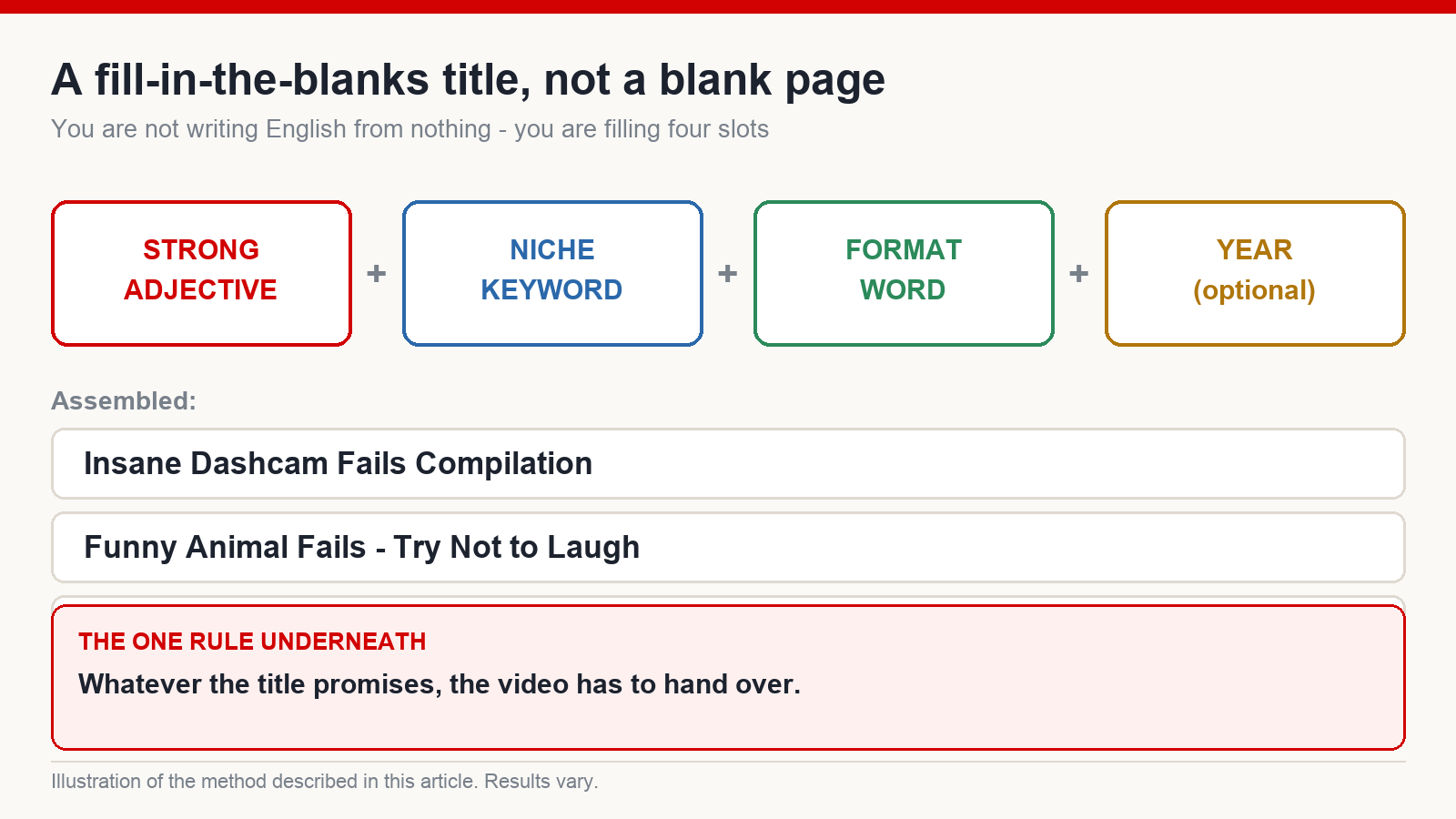
Here is the formula I extracted after taking apart a pile of real titles:
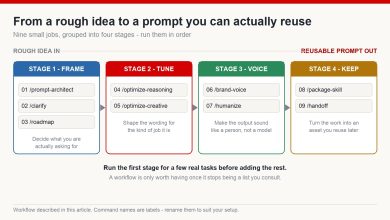
[Strong adjective] + [Niche keyword] + [Compilation / Try Not to Laugh] + [Year]
Assemble a couple: “Insane Dashcam Fails Compilation”. “Funny Animal Fails – Try Not to Laugh”. See it? You are not composing anything. You are filling in blanks.
Six rules I want fixed in your head:
- Pick one core keyword and repeat it everywhere. This channel has repeated “Fails” and “Try Not to Laugh” for fourteen years, right up to a 213-million-view video still using the phrase. The audience learns the face, the algorithm learns the name. Choose your phrase and stay loyal to it.
- Borrow the FRAME, do not translate word by word. Thinking a sentence in your first language and converting it word by word shows immediately. Take the structure that already works and drop your subject into it.
- One or two strong adjectives per title, no more. Insane, Shocking, Expensive – one or two is enough to carry the emotion. Stack five or six and it reads cheap, and a native speaker spots the imitation instantly.
- Learn templates from real channels, do not invent them. Type your niche keyword into YouTube search, look at how the big channels in that space write titles, and study the frame. I am not promising you a million views, but learning from people who already won beats guessing.
- Attach a year so the template recycles. “Best Fails of the Year 2026” becomes 2027 next year – same template, and the video reads as new. This is what keeps a title alive for years.
- Whatever the title promises, the video hands over. A sharp title over an empty video sends people away in three seconds, and the algorithm remembers and stops pushing you.
Fill one in tonight and see how it reads.
The safe boundary: copy the packaging, not the footage
Now I have to say something directly, because it touches your money and your safety.
Here is a fact people rarely mention: FailArmy is allowed to drop entire long clips into its videos, and you are not. Not because they are better at this. Because behind the channel is Jukin Media, now part of Trusted Media Brands – a company whose business is buying and licensing viral user-generated footage. They have the budget to purchase individual clips legally and a legal team to handle the paperwork. Someone starting out has neither. So if you copy the “gather other people’s clips and stitch them together” part exactly, you are not following their model – you are walking into copyright strikes, demonetization, and possibly the loss of a channel you spent months building.
So what do you take? The craft of packaging. The title templates, the year tag that lets you recycle, the thumbnail that frames one peak moment – all of that is yours to use freely. Nobody sues you for writing a good title. The raw material has to come from somewhere else.
The route I use is a blend rather than a single source. Mix five: short fair-use excerpts kept under five seconds, licensed stock footage, footage you shoot yourself, AI-generated shots, and your own added audio layers. Keep excerpts short, avoid broadcast material, and mix widely enough that the result is genuinely your compilation. I say “safer”, not “safe” – copyright law differs by country and changes over time, and for anything significant you should talk to a qualified legal professional rather than take my word for it.
And here is one concrete thing to do. Tonight, reopen exactly ONE of your old videos, the one with the lowest views. Rewrite the title using the formula. Rebuild the thumbnail. One video, not the whole channel. Because on the night I sat looking at a few hundred views and then landed on a video with 213 million, I was not short of talent – I was short of one person telling me the fight was happening at the packaging stage.
I will be honest to the end: good packaging only amplifies what already exists, and it cannot save an empty video. You do not need to be smarter than anyone. You need to package a little better than yesterday, and publish a little more steadily than last week.
How should I write YouTube titles for an English-speaking audience?
Pick one core English keyword and repeat it across the whole channel, add one or two strong adjectives such as Insane or Expensive, and put a year at the end so the template can be reused annually. Borrow the frame from million-view channels in your niche instead of translating from your own language word by word.
Does a high-performing thumbnail have to show a face?
No. A faceless channel can build strong thumbnails, because the emotion lives in the peak moment of the clip rather than in your face. Your job is to select the most valuable frame – a fall halfway down, a startled expression – and present it with heavy contrast and very few words.
Which matters more, title optimisation or content?
They are different jobs and neither substitutes for the other. Title and thumbnail decide click-through rate: whether people come in. Content decides whether they stay. Strong packaging over an empty video makes people leave in seconds, and the algorithm buries it. Both have to work.
Can I build compilations from other people’s clips the way large compilation channels do?
Not by copying them directly. Those channels typically sit behind a parent company that buys licences and employs lawyers. Someone starting out does not have that, and the exposure is copyright strikes and demonetization. The safer route is a blend of sources – fair-use excerpts under five seconds, licensed stock, footage you shoot, AI-generated shots – assembled into a compilation that is genuinely yours. For anything significant, consult a qualified copyright professional.
Written by Phuc, a YouTube trainer who has been building on the platform since 2017 (nine years) and specialises in faceless channels aimed at viewers in the US, UK, Germany and Japan. Everything above comes from taking real titles apart and rebuilding my own packaging from scratch after four years of getting it wrong.
The full step-by-step system I run with the creators I work with lives at mmoyoutube.com.
Disclaimer: this article shares personal experience and method. It is not legal advice and it is not a promise of views or income. Results vary and YouTube’s policies change over time. The channel figures quoted were measured with vidIQ on July 8, 2026 and will have moved since.