One Strike, Every Channel: Running Multiple YouTube Channels Without Breaking the Rules
I have watched people lose four, six, ten channels in the same week. Not one bad video taken down – the whole operation going quiet at once.
The instinct afterwards is always the same, and it is always technical. Same laptop. Same network. Same browser. Same login. The conclusion people draw is that they were identified, and the fix they reach for is to hide better next time.
I want to argue the opposite, because I think the diagnosis is usually wrong and the cure is worse than the disease. If you run more than one channel, the thing that links them in a way that matters is almost never your hardware. It is your content.
What actually ties your channels together
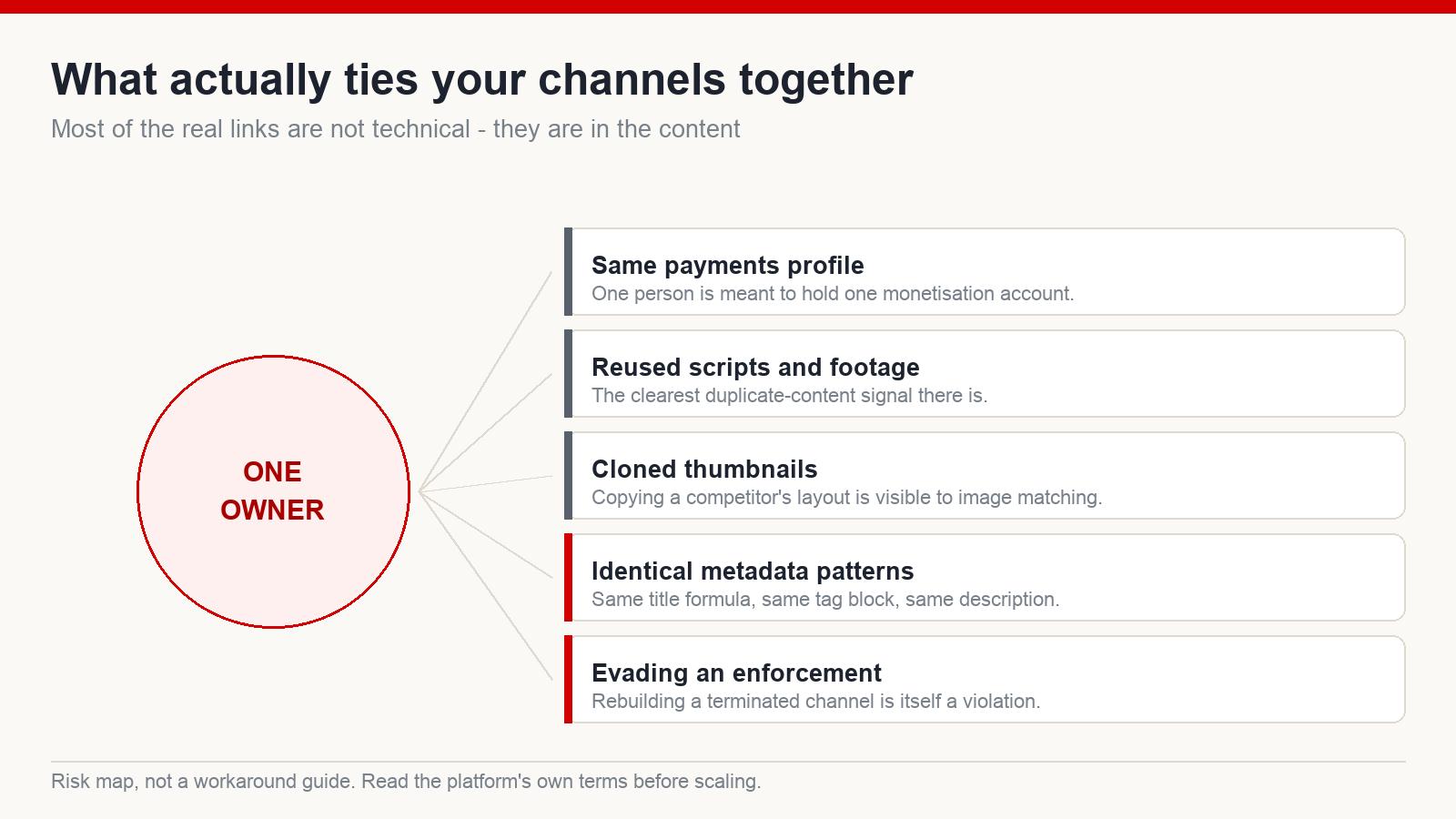
Sit down and list what your channels genuinely have in common. In my experience the list looks like this, and only the first item is technical:
- One payments profile. This is not a loophole to be closed – it is how the system is designed. A person is meant to hold one monetisation account, and multiple channels attach to it. That is normal.
- Reused scripts and footage. The clearest duplicate-content signal there is, and the one people underestimate most.
- Cloned thumbnails. Copying a competitor’s layout, colour and text treatment closely is visible to image matching, and so is copying your own across channels.
- Identical metadata patterns. The same title formula, the same tag block, the same description template on every upload across every channel.
- Rebuilding after an enforcement. Recreating a channel that was terminated is itself a violation of YouTube’s terms, and it is the one that reliably takes everything else down with it.
Look at that list again. Four of those five are editorial choices you make at the desk. They are also the four that are entirely within your control to change this week.
Why I will not write the technical evasion guide
There is a whole genre of content about separating browser fingerprints, running each channel behind its own address, aging accounts with fake viewing behaviour before uploading, and reconstructing an identity after a termination. I am not going to walk you through any of it, and not because I am being coy.
Three reasons, in order of how much they should matter to you.
First, circumventing an enforcement action is explicitly against YouTube’s terms. If a channel has been terminated, building a replacement is a fresh violation regardless of how well you disguise it. You are not routing around the rule; you are breaking a second one.
Second, the asymmetry is brutal. Detection is a permanent, well-funded engineering effort and your workaround is a weekend project. When it fails – and the failure is usually late, after you have built something worth losing – the penalty lands on everything associated with you at once, and there is no meaningful appeal for deliberate evasion.
Third, and most practically: it is the wrong problem. Every hour spent on identity separation is an hour not spent on the editorial differentiation that would have removed the risk at its source. People who solve the content problem rarely need the technical one.
The symptoms people mistake for a sweep
Before you conclude that you have been marked, check whether you have. The signals people cite are real, but they are ambiguous:
- Videos taking longer than usual to appear in search
- Shorts not reaching the feed
- Views flat immediately after upload
- A decent click-through rate but almost no impressions
- A new channel that seems suppressed from day one
Every one of those is also the normal appearance of a video the system tested and declined to push. Low impressions with a healthy click-through rate usually means the small test audience it received did not stay – which is a retention problem, not a punishment.
The test I use is simple. Compare the video against the median of your own last ten uploads on the same channel, not against a number you read somewhere. If this one is in line with your own baseline, nothing has happened to you; the content did not land. If every upload across every channel dropped off a cliff on the same day, that is a different conversation – and the place to look is your account’s own policy and monetisation status page, which will tell you directly rather than leaving you to guess.
How to run several channels the ordinary way
Multiple channels is a supported thing to do. There is a normal path, and it is duller than the workaround genre suggests:
- Create additional channels through YouTube’s own account tools rather than manufacturing separate identities.
- Add collaborators using the platform’s channel permission roles – manager, editor, viewer – rather than sharing a password. Shared passwords are how teams lose channels, and they are also how a departing freelancer takes one with them.
- Keep one monetisation account, as intended. If an account has a history of serious policy problems, that history follows it, and that is the point of it.
- Give each channel a genuinely separate editorial identity – different topic, different audience, different look. This is the separation that actually does something.
None of that requires hiding. It requires the channels to be genuinely different products, which they should be anyway if you expect anyone to subscribe to more than one of them.
Scale by angle, not by identity
Here is the part that replaces the whole technical apparatus.
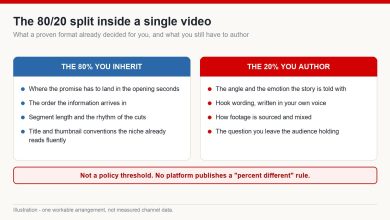
Most people scaling content are trying to publish the same video repeatedly without it being read as the same video. So they change the narrator, swap the subtitles, redo the thumbnail – and the core remains identical. Automated review reads structure, pacing, narrative shape and semantic similarity, not just wording. Same insight, same flow, same phrasing, different voice, is still the same video.
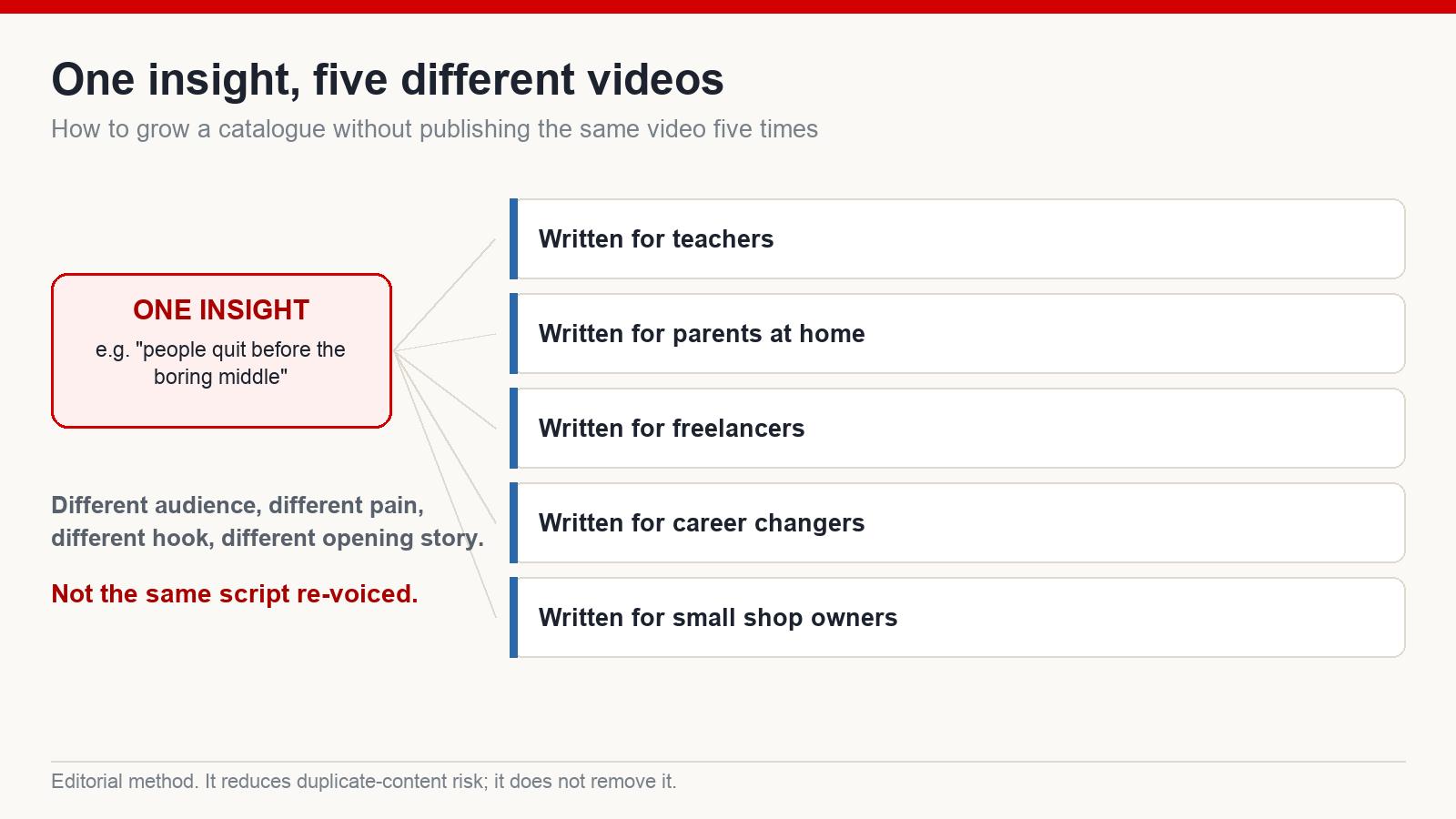
The alternative is to take one insight and write genuinely different videos from it. Change the audience and everything downstream changes with it: the pain being addressed, the opening, the examples, the context, the story you lead with.
Take an insight as plain as “people quit before the boring middle.” Written for teachers, for parents working from home, for freelancers, for career changers, for small shop owners, that is five videos that share a spine and share nothing else. Nobody watching two of them would call them the same video, because they are not.
That is what “learn from it, do not clone it” means in practice. When you deconstruct a competitor’s winning video, take the framework – the hook mechanism, the psychological observation, the retention structure. Leave the script where it is.
Thumbnails duplicate too
People treat thumbnails as purely a click-through concern, and forget that image matching is cheap and thorough. Copy a competitor’s layout, palette, subject placement and text treatment closely and it is visible. Copy your own across a group of channels and you have hand-drawn the connection between them.
The way out is the boring one: develop a visual signature per channel. A consistent treatment, a consistent palette, a consistent compositional habit that is yours. It helps click-through and it removes a duplication signal at the same time, which is a rare thing in this work.
A checklist worth running
Content – no reused scripts; no cloned thumbnails, from competitors or from yourself; a clearly separate angle per channel; a distinct narrative approach; a fresh hook; metadata written per video rather than pasted from a template.
Operations – permission roles instead of shared passwords; licences saved for every piece of footage you did not shoot; one monetisation account, used as intended; the policy status page checked before you draw conclusions from a quiet week.
Trust – something genuinely useful in every video; retention you actually watch; real comments from real viewers; AI disclosure where the rules call for it.
The uncomfortable conclusion
Scaling fast is not the hard part. Anyone can publish more. Scaling without producing a pile of near-identical content is the hard part, and no amount of technical separation fixes it, because the duplication is in the videos.
AI makes the volume possible. What decides how long a group of channels lasts is whether each one has an angle, an insight and a way of telling a story that belongs to it. If the working model is copy and adjust slightly, the ending is already written. Results vary, platform rules change, and nothing here is a guarantee – but building distinct things is the only version of this that does not require you to keep looking over your shoulder.
Frequently asked questions
Is it against the rules to run more than one YouTube channel?
No. Multiple channels are supported and normal, and there are account tools for creating and managing them. What is against the rules is using extra channels to get around an enforcement action – recreating a terminated channel, or continuing content that was removed – regardless of how the accounts are set up.
Will using the same monetisation account across channels cause a problem?
Using one monetisation account for your channels is the intended design. The complication is history: if that account carries serious past policy or invalid-traffic problems, it carries them everywhere. That is deliberate, and it is not something to engineer around.
My views suddenly stopped. Have I been penalised?
Check before assuming. Compare the video to the median of your own recent uploads, and read your channel’s policy and monetisation status directly – it reports restrictions rather than leaving you to interpret symptoms. Flat views with normal status is far more often a content and packaging result than a penalty.
Does using AI to make videos get channels flagged?
Not on its own. What gets flagged is content with no transformation – recycled material, near-duplicate scripts, undisclosed synthetic media. Use AI to produce something genuinely yours and disclose it where the rules require, and it is not the AI that is the issue.
How do I publish a lot in one niche without it reading as duplicate content?
Split by audience rather than by wording. One insight, written for five different groups of people, produces five videos with different pain points, hooks and examples. Changing the narrator on the same script does not, and that distinction is the whole game.
I have been building faceless channels for English-speaking audiences since 2017, and I have watched more channels lost to shortcuts than to bad videos. If you want the longer version of how to build this properly, that is what I write about at mmoyoutube.com.