Inauthentic Content: Why Faceless Channels Get Demonetized, and What Actually Survives
The night I searched my own niche and found hundreds of identical videos
Around one in the morning, I typed the exact keyword my channel was built on into YouTube search. Then I sat still.
Scroll. Scroll again. Hundreds of near-identical videos pouring out without end. The same synthetic voice reading in the same flat cadence, like an automated phone menu. The same style of generated illustration, obviously not made by a person. The same title template with two words swapped. I kept scrolling and kept finding copies of copies. Something cold went down my back, and one sentence went through my head: is there any room left in here for me?
If you have ever sat in front of a screen with that feeling, then you know the fear underneath it goes one layer deeper. The fear of opening your email one morning and reading that your channel has been demonetized for inauthentic content. All those nights editing. One message and it is over.
I am not going to soothe you. That fear is real, and I have lived with it. But it is not a death sentence.
Here is what I believe down to the bone: there is no easy seam left to mine. Generative tools have turned most of the platform into sand, into slop – mass-produced filler content. But the moment the rules of a game change is exactly the moment there is room for anyone willing to work differently. From here on it is panning: sifting through the sand for gold.
I am a few steps ahead of you on this road, not standing on a podium above it. For the rest of this article I am going to sit next to you and tell you what I understood during the storm that let me still be standing. And the first thing to make clear is what the word that scares everyone actually means.
What “inauthentic content” means, and why faceless channels get caught by it
Put simply, inauthentic content – also referred to as reused content – describes videos where the platform looks in and cannot find a real person behind them. The same machine voice. The same assembled visuals. The same structure as hundreds of other channels pumping out uploads every day. No experience, no point of view, nobody who actually made it. Just an output pipe.
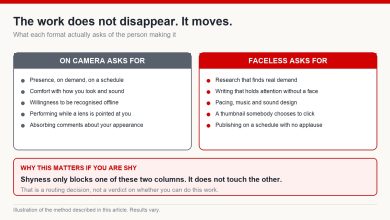
And here is why faceless channels get caught more often. When you do not appear, when there is no real voice and not one frame that suggests a human being sat at an edit bay, your content is easy to sweep into the same bucket as the mass-produced stuff. Being faceless is not wrong. It is that you have voluntarily removed the most obvious markers of a real person, so you have to replace them with something else. Otherwise the system looks at you the way it looks at the pipe.
But I want you calm for this part: YouTube does not hate you. What is happening is a cleanup. Generated content grew too fast, in too much volume, too similar to itself, until the platform had to sweep some of it out to keep its viewers. I have been watching this closely, and one pattern is fairly clear: smaller channels get swept first and larger ones later. That sounds chilling. Think about it for a second longer, though, and for a beginner it is good news – you can see which direction the storm is travelling, so you get to build correctly from day one instead of discovering the sand under your castle later.
After years sitting alongside people building for English-speaking audiences, I keep coming back to one line: this platform rewards the people who work out what it wants and then do that thing before they are forced to.
So the question I want you to answer right now is not “how do I dodge the sweep”. It is: are you standing on the side that gets swept, or the side that survives? The answer is not luck. It is in what you do differently from here. And the first thing that has to change is not a technique. It is what sits behind your eyes.
Sift the sand for gold: change the posture before you change the workflow
That night, scrolling past hundreds of near-identical videos, what decided whether I panicked or got excited was not a skill. It was the stance I was standing in: victim of the storm, or the person rolling their trousers up and wading in to pan while the storm is on.
I say it to people this way: there is no exposed seam left to mine. The era where you opened a channel and views arrived, where sloppy work still paid, is finished. What this year hands you instead is something I think lasts longer: an enormous beach to sift.
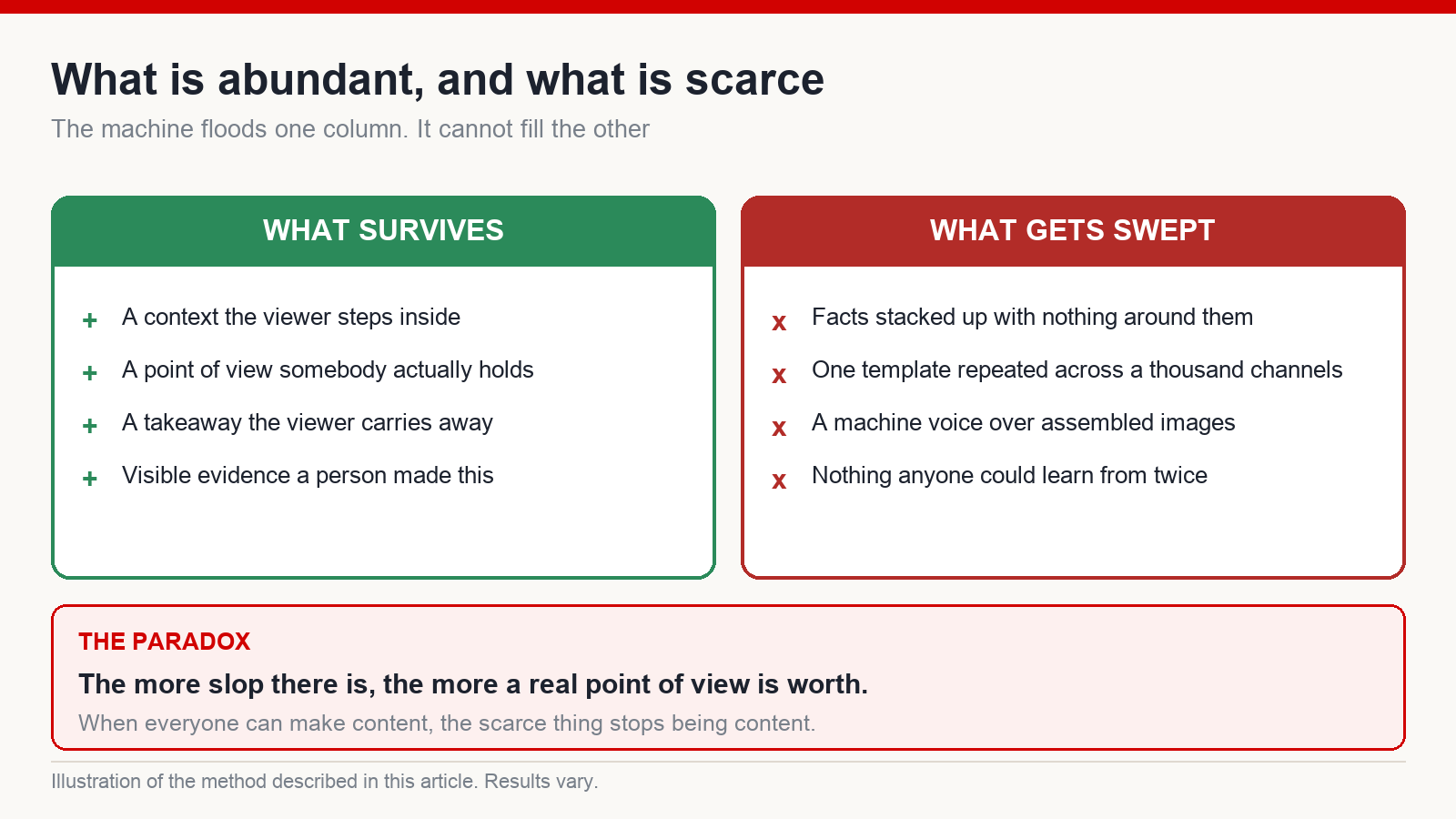
Notice the paradox. Generative tools are turning everything into sand and slop. That sounds frightening. But the more slop there is, the more valuable gold becomes. When everybody can produce content, the scarce thing stops being content and starts being truth – a real person standing behind it. Somebody else’s danger is your opening.
Most people go wrong right here. They watch the machines work fast, so they try to race them and start extruding videos to keep up. Do not. You will not win that contest – it does not sleep, it does not tire, it does not run out of ideas. Your job is the thing the machine cannot do: truth and context. That is the gold. And the first handful of it is in your head, before your hand touches a single button.
Content is context: how to make a video that does not read as slop
There is a line I use with my own team: the age of “content is king” has passed, and now content is context. That sounds like word games until you see it.
A generative tool produces facts a hundred times faster than you can. You type “ten most dangerous wild cats” and it lists them in one breath, machine voice, images of animals that do not exist. That material is flooding the platform. It is sand. You will not beat the machine on that field, so stop trying.
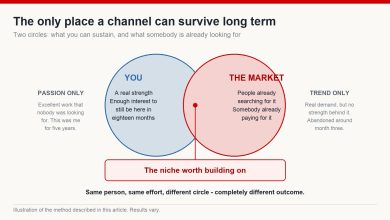
But there is one thing these tools do badly: building a context the viewer can see themselves standing inside. To me, good content is simply the creation of a context. Not stuffing a video full of information, but building a scene the audience steps into and thinks “this is about me”. Same information, two outcomes: the channel that stacks facts gets scrolled past, the channel that builds context gets watched to the end.
And inside that context, there always has to be something the viewer can take away. However dramatic or sensational your video is, it has to leave a lesson in the viewer’s hands. Without one it is disposable entertainment – watched and forgotten. With one it becomes the thing people save, send to a friend, and remember you for.
One tool I use every day and you can take right now is the title frame: Emotion + Context + Action. Put all three together and the title has already built a scene in a scrolling stranger’s head before they have clicked anything. Missing emotion and it is dry. Missing context and it is generic. Missing action and nobody has a reason to press play. Go and pull up the titles you wrote last week and check whether all three are there. I would bet at least one is missing.
Copying with a point of view: how to be different without being duplicated
I once sat in front of a blank screen for an entire evening forcing myself to invent something nobody had ever made. The harder I pushed, the emptier my head got. Around midnight I shut the laptop without having filmed one second. The next day I understood: the pressure to create from zero does not produce videos. It produces procrastination.
Here is a line that stuck with me: almost nothing is invented, most of it is inherited. That sounds harsh until you look around. Every good story is a retelling of an older one. The question is not where your raw material came from. It is what you added that is yours.
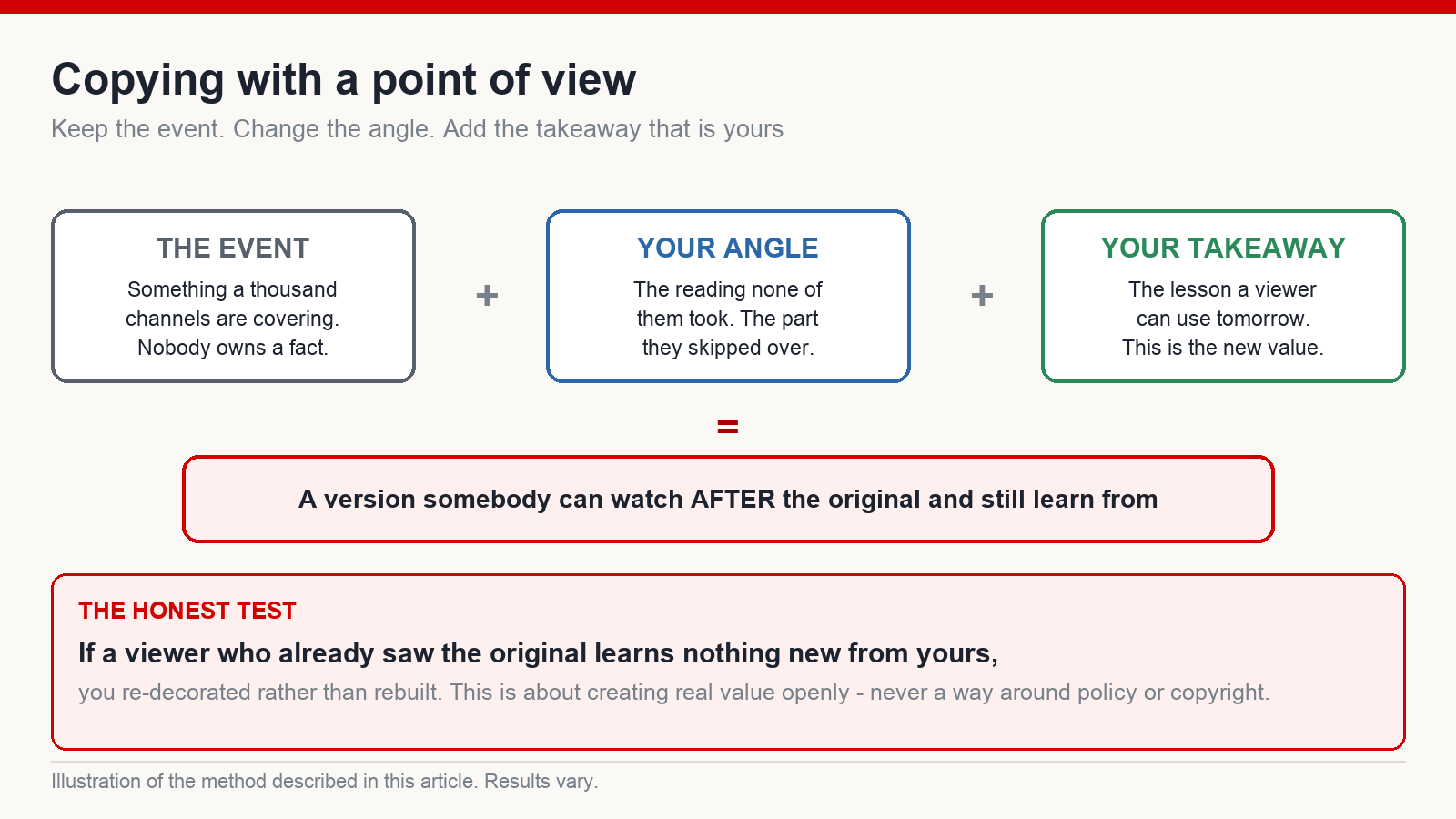
I call the working method copying with a point of view. The same underlying event that a thousand channels are covering, retold from an angle they did not take, ending in a takeaway that is yours. That is not invention from scratch. It is rebuilding with genuine new value on top. The viewer receives something they did not get from the other nine hundred and ninety-nine, even though the starting material was shared.
And this is survival, not taste. Repost the source as-is while a thousand channels are doing exactly the same thing, and the platform is very likely to strip monetization for duplication. Months of effort, and one morning it is nothing. Cover the same ground with your own angle and your own lesson, and you separate yourself from the identical crowd – which is exactly how you stay clear of the inauthentic-content problem we opened with.
Let me be plain about a boundary: copying with a point of view means creating genuine new value openly and legally. It is not a trick for slipping past policy, and it is not a workaround for copyright. If you are unsure whether your version has added enough, the honest test is simple – could somebody watch yours after watching the original and still learn something new? If not, you have not added anything yet.
But an angle alone is still not enough for the platform to believe there is a person here. There is one more layer, and it is the one I treat as armour.
Making honest content: behind the scenes, and saying what a thing is
Stop here for a moment. “Honest” sounds like a moral principle hanging on a wall. For a faceless channel it is not morality. It is the thing standing between you and the email you are afraid of.
I look around at the people still standing in this community and they are all moving the same direction: away from fully generated production. A year or two ago, building an entire video out of generated images, a generated voice and generated music was ordinary – everybody did it. And anything everybody can do is exactly what gets classed as inauthentic. One team I work alongside stopped doing fully generated video about half a year ago. Today most of their output is scripted compilation – legally licensed footage from other people, cut together with real footage they shot themselves. Not because these tools are bad. Because a machine produces the thing everyone has, and the thing everyone has stops being gold.
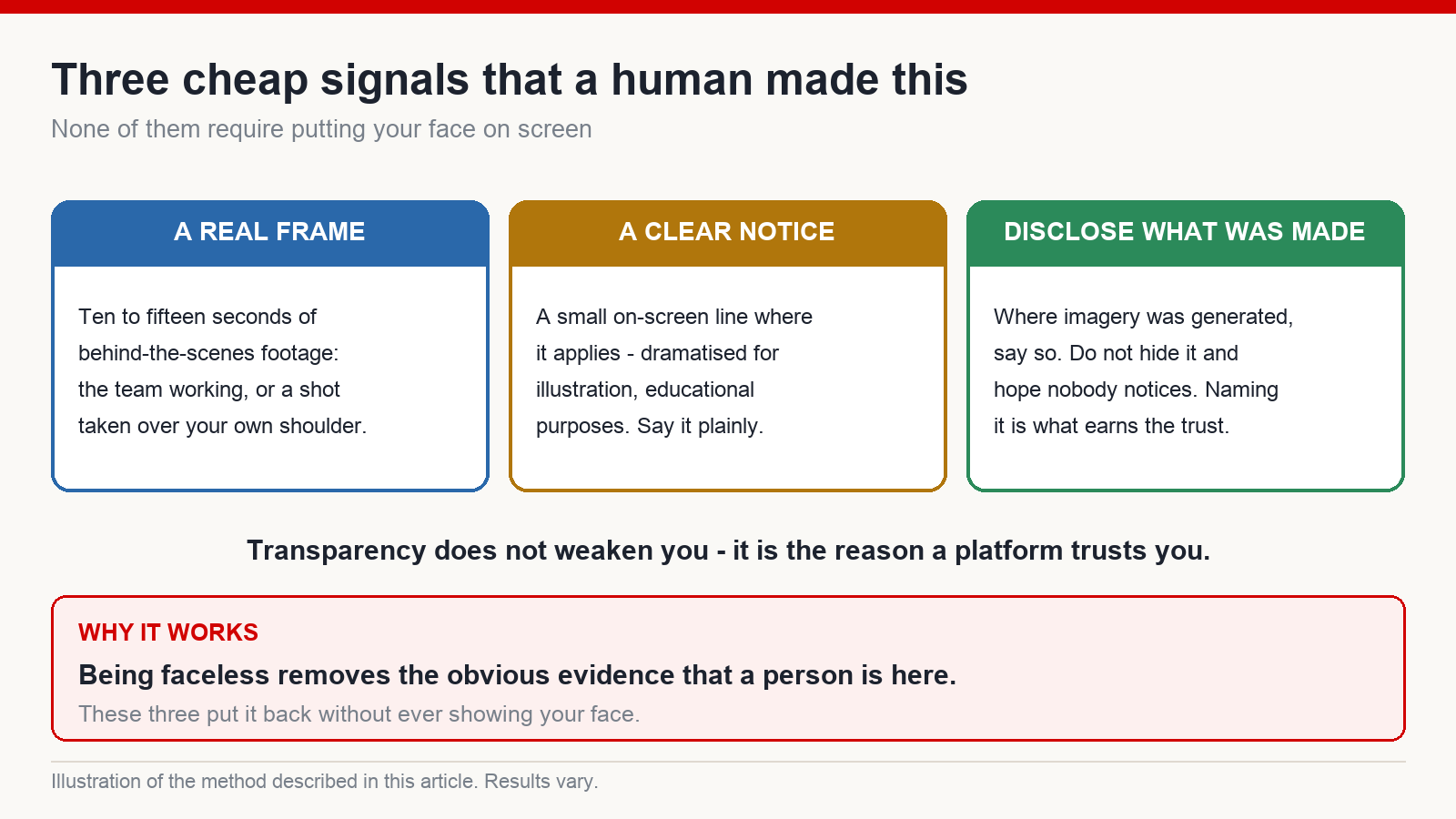
So how do you get a human pulse into a video while still keeping your face out of it? Here is what I do. Drop ten to fifteen seconds of behind-the-scenes footage into the video: the team at work, or just a shot taken from behind your own shoulder while you sit at the desk – no face, one real frame so the audience knows somebody is breathing back here. Add a small on-screen line where it applies: “Dramatised for illustration. Educational purposes.” And where images were generated, I say so, plainly – this is a generated image, it is not a photograph – instead of hiding it and hoping nobody notices.
Transparency does not weaken you. It is the reason a platform trusts you, and the people who trust you are the ones who stay.
One more sentence and I will move on: register your income and pay your taxes properly, wherever you live. Do not end up in a position where you earned money you are not free to spend. Being straight with your audience and being straight with the law are the two legs that keep you standing in this business for a long time.
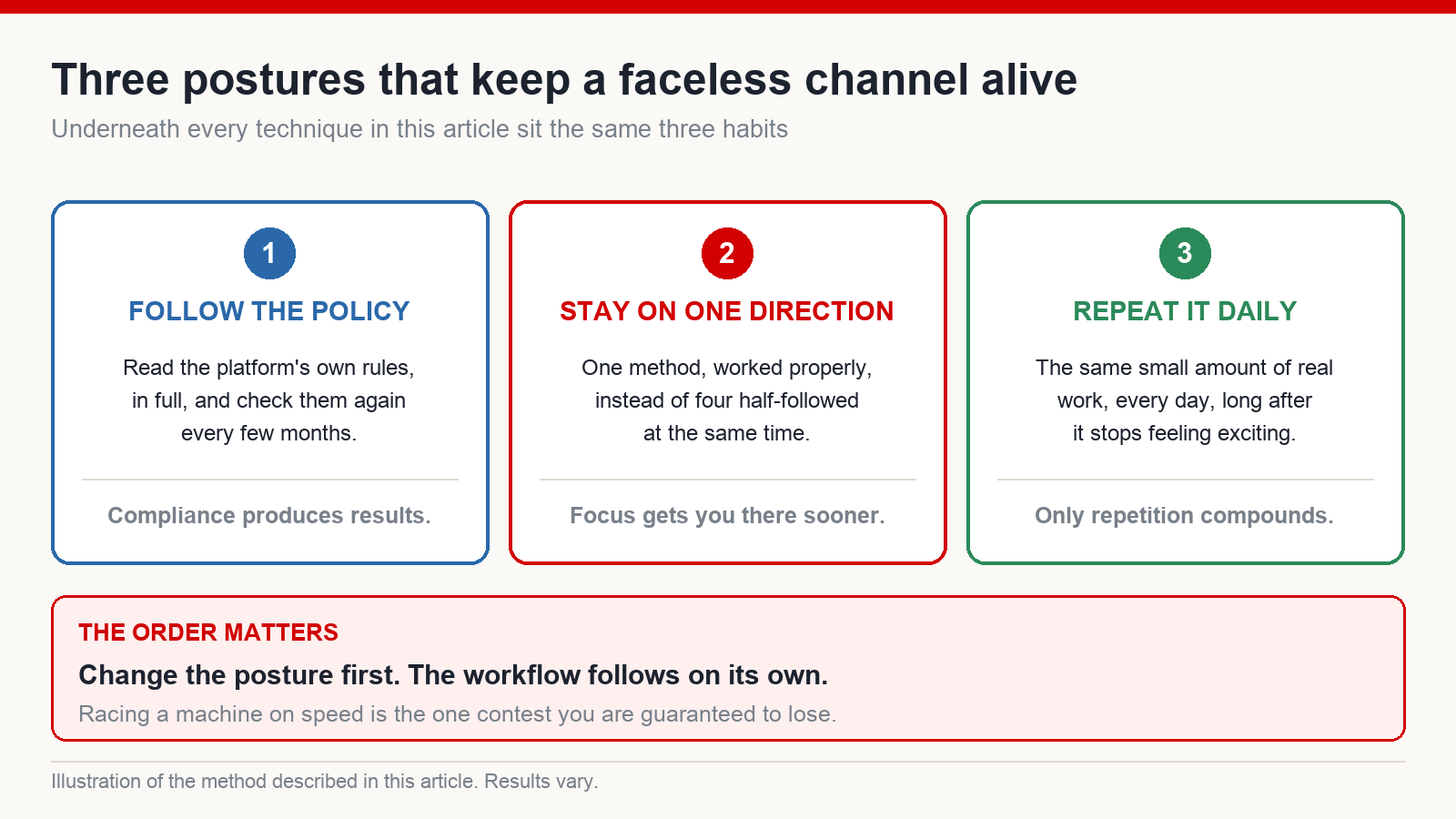
If you want to go deeper, do not just take my word for it – read the source. Go and read YouTube’s own monetization policies and its spam and deceptive practices policies in full, in your own language, and check them again every few months. They change, and they are the thing I check my own work against.
Three things to do this week
If you close this tab now, everything above stays as words on a page. So here it is reduced to three things you can do this week without anyone’s permission.
One – audit your channel, honestly. Open your most recent videos one by one and ask a single question: was this generated filler, with no context and no takeaway – yes or no? Every yes goes on a list. That list is your rebuild queue, to be redone with a point of view: keep what worked, change the angle, add your own lesson. You are not deleting everything. You are rebuilding it with a person inside.
Two – put something real into your next video. Have ten to fifteen seconds of behind-the-scenes ready: the team working, or the back of your own head at the desk. No face required. If you used generated material, say so in one line. That alone puts your video on a different side of the fence from a content pipe.
Three – pick one direction and work it daily. Chasing several teachers at once before you have any result of your own is how people dig their own hole. Following the rules produces results; concentrating gets you there faster; but only the discipline of repeating it every day compounds into anything.
Now back to that disorienting night at the start. The way out was never running faster than the machines – you will not beat them, and neither will I. The way out is doing real work, honestly, every day, so that you are the one still standing when the market thins. Getting a result can happen quickly. Keeping it is the hard part.
So tonight, not tomorrow. Make one real video with one real takeaway in it.
What does “inauthentic content” mean on YouTube?
It describes videos the platform looks at and cannot find a real person behind: machine narration, mass-assembled visuals, a structure duplicated across hundreds of channels, no experience and no point of view. It is treated as reused content lacking the mark of a real creator, and it can cost a channel its monetization.
Do faceless channels get penalised just for being faceless?
No. Faceless is not against any rule and is not automatically penalised. The issue is that hiding your face removes the most obvious evidence that a person made this, so you have to supply it another way – your own context, your own angle, and a little real texture such as a behind-the-scenes insert or a clear disclosure.
Will using AI in my videos get me demonetized?
Using these tools is not itself an offence. What gets swept is a fully generated video identical to thousands of others. The safer route is to blend generated material with real or properly licensed footage, add your own angle and your own takeaway, and disclose plainly what was generated.
I am just starting. What should I do first?
Pick one direction and work it every day rather than chasing several methods at once. Start by building a context for each video and always leaving a takeaway behind. This is what I have learned over years of doing it, not a guaranteed formula – the outcome still depends on how long you keep going.
How do I know whether my rebuild added enough new value?
Ask whether somebody who has already seen the original would still learn something from yours. If the answer is no, you have re-decorated rather than rebuilt. Change the angle further, or find the lesson the original never drew.
This article is a personal point of view and personal experience, not a commitment about income or views. Platform policies change constantly, and results depend on the individual and on how you practise, day after day.
Written by Phuc, a YouTube trainer who has been building on the platform since 2017 – nine years – working mainly on faceless channels aimed at English-speaking audiences.
The full step-by-step system I run with the creators I work with lives at mmoyoutube.com. It is a route to follow, not a promise of a result.