How To Start A Faceless YouTube Channel From Scratch: The Complete Beginner Roadmap
Most people start a channel on one assumption: post enough videos and the views will show up eventually.
They do not. There are channels sitting on two hundred uploads and forty views a piece. There are channels that got picked up by the recommendation system somewhere around video seven. The gap between them is almost never effort — it is strategy.
YouTube stopped rewarding volume a long time ago. It rewards creators who understand one audience well enough to keep giving them the same kind of satisfaction, video after video. This is the roadmap I would hand to anyone who wants to start a faceless YouTube channel and still be running it in two years: how to pick the niche, what to make, how to optimise it and what a realistic first month actually looks like.

Why YouTube is still worth building on
The reason I have kept working on this platform since 2017 is shelf life. A genuinely useful video can keep getting recommended for months or years as long as it still answers a question people are searching for and still holds attention once they click.
That is not true of most other formats. A social post has a lifespan measured in hours. A YouTube library compounds — every new upload adds to a catalogue that keeps working while you sleep.
Ad revenue through the YouTube Partner Program is only one door, and you need to meet the platform’s current requirements before it opens at all. Creators also build income around:
- Affiliate marketing
- Brand sponsorships
- Courses and digital products
- Services sold off the back of the channel
- A personal or company brand that opens other doors entirely
For channels aimed at English-speaking countries, revenue per thousand views is often higher than in lower-CPM markets. Be careful with that fact, though: what you actually earn depends on your topic, where your viewers live, how long they watch, what advertisers are bidding and several things nobody outside the platform can see. There is no fixed rate, and anyone quoting you one is guessing.
Start by narrowing the niche until it is uncomfortably specific
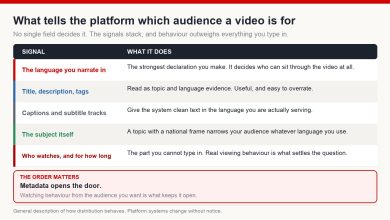
The most common beginner mistake is trying to cover everything. AI this week, football next week, general knowledge after that, then a pivot to film breakdowns. The recommendation system never gets a clear signal about who should be shown your videos, so it shows them to nobody.
Go the other way. Keep narrowing until the topic feels almost too small:
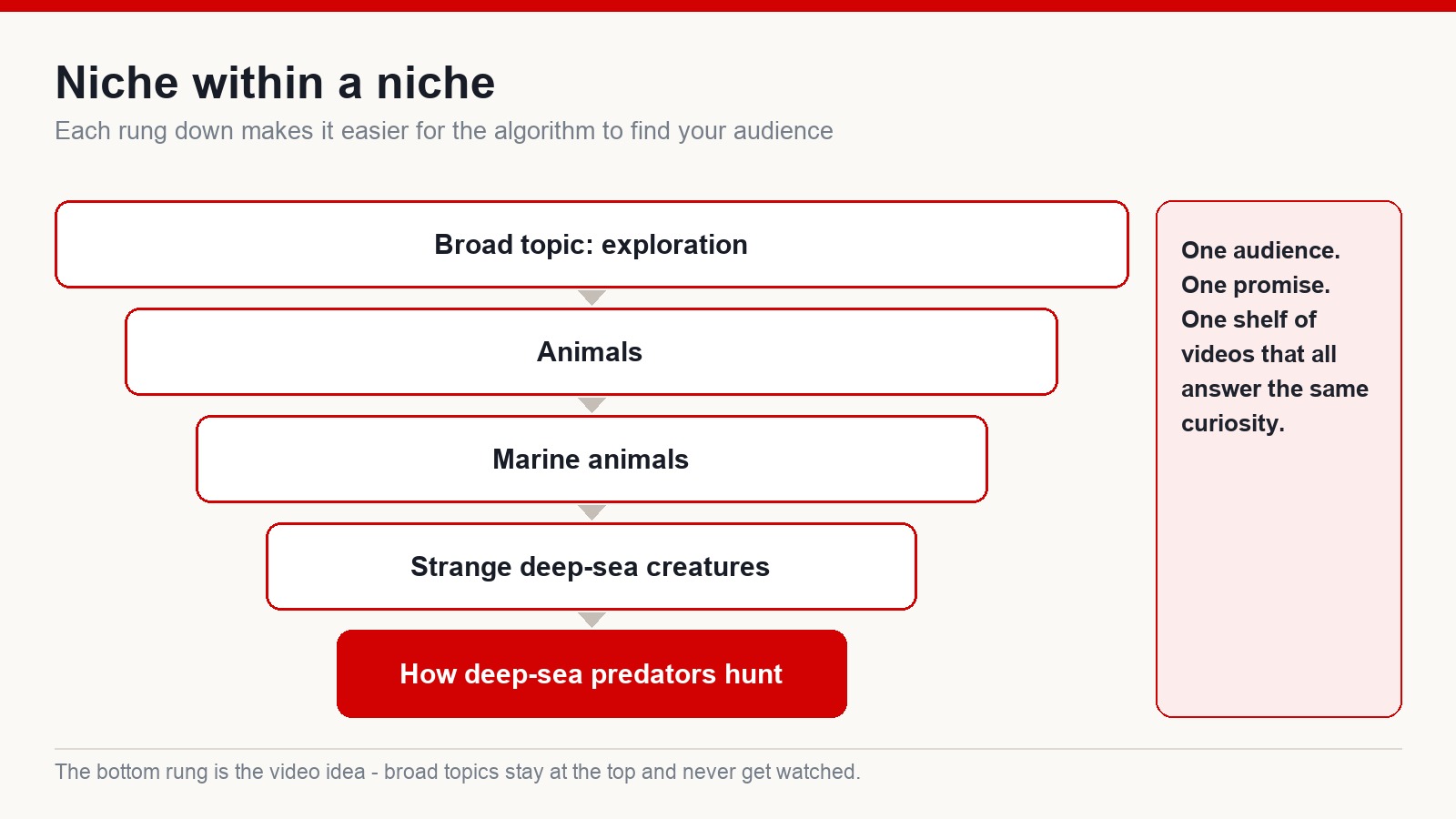
Broad topic: exploration. Narrow it to animals. Narrow that to marine animals. Narrow that to strange deep-sea creatures. Narrow that to how deep-sea predators hunt. That last rung is not a category any more — it is a video idea, and the twenty videos next to it all satisfy the same curiosity.
That is the niche-within-a-niche discipline, and it is the single highest-leverage decision you will make before you own any data.
Which topics keep earning attention
Evergreen subjects are the ones people still search for months and years later. In practice that means:
- Science
- Education and how-things-work explainers
- History
- Exploration and geography
- Manufacturing and process videos
- Animals and nature
- Puzzles and riddles
- Health and everyday wellbeing
- Technology
News and trend-chasing content can spike hard, but it decays just as fast. If you are building a library rather than a moment, weight your catalogue towards the evergreen side.
Tell a story instead of reciting facts
People are curious animals. A video holds them when it answers the questions curiosity actually asks:
- Where did this come from?
- How does it work?
- And then what happened?
Compare two framings of the same subject. One is “the coffee plant”. The other is “the journey from one seed to the cup on your desk this morning”. Identical information, completely different retention curve. You changed nothing except the shape you poured it into.
Study what already works instead of inventing from zero
When you are new, the fastest way to learn structure is to take apart videos that have already proven they hold an audience. Look at how the title sets an expectation, what the thumbnail promises, how the first thirty seconds are built, where the pace changes and what keeps a viewer through the middle third.
The point is to understand why something worked and then build your own version with your own value added. Copying the video itself gets you nowhere — it creates copyright exposure, it risks being treated as repetitious content, and it teaches you nothing you can reuse.
Long-form or Shorts?
Neither format is universally better; they do different jobs.
Long-form builds watch time, depth and a library people binge. If you are aiming at a serious catalogue and the revenue that comes with sustained viewing, long-form is the backbone.
Shorts are a reach instrument. They put you in front of people who have never heard of you and build recognition quickly, but they convert to loyal viewers less reliably.
Pick based on what you are trying to build, and do not run both badly because you felt you had to.
Own the footage you publish
If your video uses images or clips, you need the right to use them. That means one of these:
- You filmed it
- You designed or generated it
- You licensed it
- It comes from a source that explicitly permits the use
Legal sourcing lowers your copyright risk and, just as importantly, it makes the channel look like a business rather than a scrape. This is the least glamorous item on the list and the one that ends the most channels.
Does YouTube SEO still matter?
Yes — not as a replacement for quality, but as the way the platform works out what your video is and who should see it.
When you publish, get these right:
- A clear title containing the phrase people actually search
- A description that explains the video properly, not two lines and a link dump
- Relevant tags
- A thumbnail that reads at a glance on a phone
- Chapters on anything long
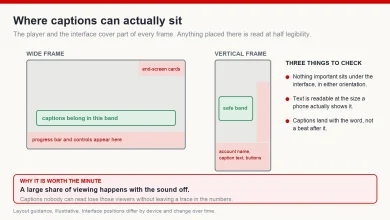
- Captions where they make sense, especially for non-native audiences
Good metadata will not rescue a weak video. It will stop a good one from being shown to the wrong people.
Should you push your first views?
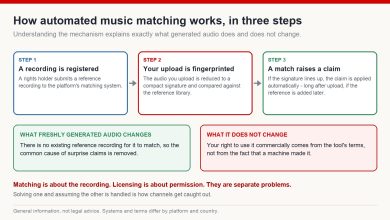
Sharing a new upload with a community that genuinely cares about the topic is fine and often useful. What matters is that those views come from real people with real interest, because the platform reads early behaviour as a signal about who to show the video to next.
Artificial engagement — bought views, view-exchange schemes, anything that manipulates the numbers — puts the channel at risk and teaches you nothing about whether the content works. It is not a growth strategy; it is a way to lose the asset you are building.
What it costs to get started
You do not need expensive equipment. A computer that can edit video comfortably covers the first stretch. Beyond that, budget for:
- AI tools for research and drafting
- Editing software
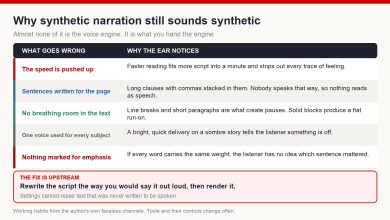
- AI narration, if your format uses it
- Licensed footage and images
Treat these as production costs, the same way any small studio would. Spending on licensed footage is cheaper than losing a monetised channel.
A realistic first month
Week 1
- Research the niche and narrow it down the ladder
- Analyse the channels already serving that audience
- Plan your first batch of topics
Week 2
- Write the script
- Design the thumbnail before you edit, so the video delivers what it promises
- Produce the first video end to end
Week 3
- Publish on a schedule you can actually keep
- Watch click-through rate, average view duration and retention rather than subscriber count
Week 4
- Read the data and find where viewers leave
- Fix that specific thing in the next video
- Keep adding to the library
One caveat worth stating plainly: there is no guaranteed timeline for reaching monetisation eligibility or any particular audience size. It depends on your content, your niche’s demand, the platform’s current requirements and how consistently you keep going. Some channels move fast; many do not.
Frequently asked questions
Is it too late for a beginner to start?
No. It is harder to coast than it used to be, but a creator who picks a narrow audience and improves with each upload still has room. What has ended is the era of posting anything and hoping.
Do I have to show my face?
No. Plenty of channels run entirely faceless using narration, graphics, licensed footage and strong editing. The format is a production choice, not a limitation.
Will AI replace creators?
AI has genuinely compressed research, drafting, editing and narration. What it has not replaced is judgement — which idea is worth making, what the angle should be, and whether the finished video is worth an audience’s time.
How soon can a channel earn?
There is no fixed answer. Eligibility for the YouTube Partner Program depends on meeting the platform’s current requirements, and how quickly any channel gets there varies enormously. Plan as if it will take longer than you would like.
The takeaway
Success on YouTube is rarely luck. It is a narrow niche, content that genuinely gives something to the viewer, an experience optimised around attention, and constant small corrections based on data.
Do not try to be the creator who covers the most subjects. Be the one who understands a specific audience better than anyone else serving them. Do that consistently and every upload becomes another brick in an asset that keeps working long after you published it.
If you want the full step-by-step system for building faceless channels aimed at English-speaking markets, that is what I teach at mmoyoutube.com.